---
title: "TanStack Start 1.0 vs Next.js: Explicit Type Safety vs Framework Magic"
description: "Engineering comparison of TanStack Start 1.0 (Vite + Nitro, compile-time type-safe routing, createServerFn, opt-in RSC) vs Next.js 16 (Turbopack default, RSC-first App Router, Server Actions): architecture, code examples, caching, deployment, and when to choose each."
author: Aleksei Aleinikov
date: 2026-11-24
lang: en
tags: [tanstack start, tanstack start vs nextjs, tanstack start 1.0, nextjs 16, createServerFn, react server components, nitro vite]
canonical: https://www.alekseialeinikov.com/en/blog/topics/programming/tanstack-start-1-vs-nextjs-architecture-comparison
source: alekseialeinikov.com
---

# TanStack Start 1.0 vs Next.js: Explicit Type Safety vs Framework Magic

For years, picking a full-stack React framework meant either accepting **Next.js App Router** conventions or stitching together Vite, a router, and a custom server by hand. On October 13, 2026, **TanStack Start 1.0** shipped its stable release — turning TanStack Router, Vite, and Nitro into a cohesive full-stack alternative.

Meanwhile, **Next.js 16** matured on the other side with **Turbopack** enabled by default and `no-store` dynamic fetching defaults that corrected earlier caching pain. Comparing them is no longer about "mature vs experimental" — it is a sharp architectural choice between **explicit client-driven control** and **framework-managed automation**.
![TanStack Start 1.0 vs Next.js 16 3D editorial duel cover showing modular crystal stack vs obsidian disc monolith.](https://www.alekseialeinikov.com/blog/tanstack-start-vs-nextjs-cover.webp)

> [!NOTE]
> **Engineering Basis:** Based on the official [TanStack Start 1.0 documentation](https://tanstack.com/start/latest), [Next.js 16 release documentation](https://nextjs.org/docs), Nitro universal deployment specs, and architectural comparisons across real-world TypeScript applications; no synthetic RPS micro-benchmark was run.

> [!KEY]
> **The short verdict:** Choose **TanStack Start 1.0** for data-dense SaaS apps, strict URL/search-param type safety, **TanStack Query** caching, and effortless deployment to Cloudflare Workers, Node.js, or Docker via **Nitro**. Choose **Next.js 16** when your core product is content/SEO-driven (SSG/ISR), relies on RSC-first streaming, or needs the largest React hiring ecosystem.

## Who Owns the Component Tree?

The deepest difference between TanStack Start and Next.js is not syntax — it is **who controls execution boundaries**:
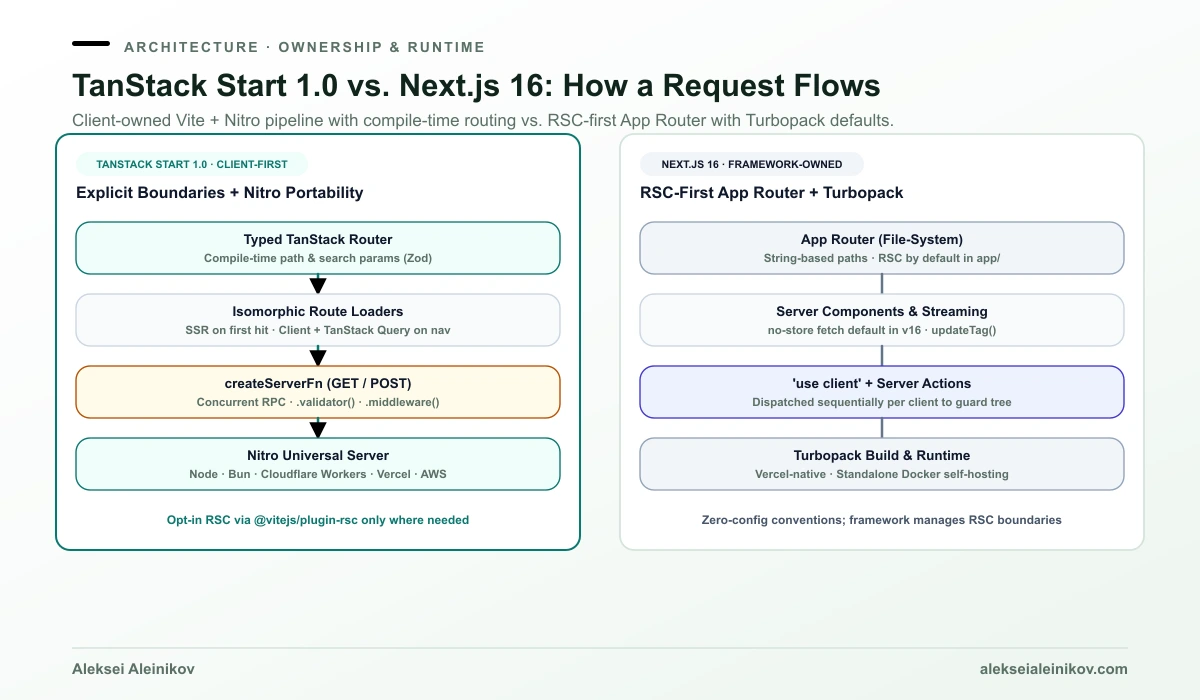
![Architecture diagram comparing TanStack Start 1.0 (Vite + TanStack Router + createServerFn + Nitro) against Next.js 16 (Turbopack + RSC-first App Router + Sequential Server Actions).](https://www.alekseialeinikov.com/blog/tanstack-vs-nextjs-architecture.webp "TanStack Start keeps the tree client-driven with Nitro portability; Next.js 16 defaults to React Server Components managed by the App Router.")

- **Next.js 16 (Framework-owned):** Every file under `app/` defaults to a **React Server Component (RSC)**. Interactive components must opt into the browser with `'use client'`. Data flows top-down through server components, with Next.js orchestrating streaming, request deduplication, and cache tags behind framework conventions.
- **TanStack Start 1.0 (Client-owned):** Your React tree behaves like a classic Vite SPA/SSR application by default. Route `loader` functions run isomorphically (on the server during initial SSR, in the browser on client navigation), calling `createServerFn` RPCs when server-only access is required. If you want RSCs for heavy Markdown parsers or server-only UI subtrees, you enable them selectively via `@vitejs/plugin-rsc`.

## TanStack Start 1.0 vs Next.js 16 at a Glance

| Dimension | TanStack Start 1.0 | Next.js 16 |
|---|---|---|
| **Core philosophy** | Explicit, client-first + opt-in RSC | Convention-first, RSC by default |
| **Bundler** | **Vite** (fast plugin ecosystem) | **Turbopack** (Rust default in v16) |
| **Server runtime** | **Nitro** (Node, Workers, Bun, Vercel, AWS) | Node / Edge (Vercel-optimized, Docker standalone) |
| **Routing type safety** | **Compile-time** (paths, params, search params) | File-system / string-based |
| **Server RPC / Mutations** | `createServerFn` (`GET` / `POST`, concurrent) | `'use server'` Server Actions (sequential queue) |
| **Caching model** | **TanStack Query** + HTTP headers | Uncached by default in v16 + tag revalidation |
| **Ecosystem & hiring** | Growing rapidly (huge Query/Router base) | Largest React meta-framework ecosystem |

Just as moving to [TypeScript 7's native compiler](https://www.alekseialeinikov.com/en/blog/topics/programming/typescript-7-vs-typescript-6-native-compiler-upgrade-guide) or [Vitest](https://www.alekseialeinikov.com/en/blog/topics/programming/jest-to-vitest-migration) reshaped JS tooling around speed and strict types, TanStack Start bets that TypeScript teams want **compile-time guarantees** on URLs and server boundaries rather than implicit string conventions.

## Routing, Search Params, and `createServerFn` vs Server Actions

In complex web apps — filters, paginated tables, multi-pane dashboards — **the URL is state**. Next.js gives you string-based `useSearchParams()` where parsing, defaults, and refactoring across `<Link>` components stay manual.

TanStack Start inherits **TanStack Router**: every route declares typed `validateSearch` schemas (using Zod, Valibot, or ArkType), and renaming a route param or search key fails TypeScript compilation immediately across every `<Link>` in the codebase.

On the server boundary, **`createServerFn`** behaves like a clean, typed RPC layer rather than hidden form magic:

```tsx
import { createServerFn } from '@tanstack/react-start'
import { z } from 'zod'

const filterSchema = z.object({
  teamId: z.string().min(1),
  status: z.enum(['open', 'closed']).default('open'),
})

export const getTeamIssues = createServerFn({ method: 'GET' })
  .validator((input: unknown) => filterSchema.parse(input))
  .middleware([authMiddleware])
  .handler(async ({ data, context }) => {
    // Runs strictly on the server; client receives typed JSON
    return db.issues.findMany({
      where: { teamId: data.teamId, status: data.status, orgId: context.orgId },
    })
  })
```

Compare that to Next.js **Server Actions** (`'use server'`):

- **Server Actions** shine when submitting HTML `<form>` mutations with `useActionState`, returning both updated state and re-rendered RSC UI in a single network round-trip. However, Next.js dispatches Server Actions **sequentially per client** to keep the RSC tree consistent — firing several actions concurrently queues them behind each other.
- **`createServerFn`** supports explicit `GET` (cacheable reads) and `POST` (mutations), composable `.middleware()`, and built-in CSRF protection (`createCsrfMiddleware`), executing concurrently like normal API endpoints and integrating directly with **TanStack Query** (`ensureQueryData`).

## Opt-In RSC vs Mandatory RSC

One of the biggest misconceptions about TanStack Start 1.0 is that it cannot do React Server Components. In reality, v1.x supports RSCs modularly via `@vitejs/plugin-rsc` without forcing every page into server-component rules:

```ts
// vite.config.ts
import { defineConfig } from 'vite'
import { tanstackStart } from '@tanstack/react-start/plugin/vite'
import rsc from '@vitejs/plugin-rsc'

export default defineConfig({
  plugins: [
    tanstackStart({
      rsc: { enabled: true },
    }),
    rsc(),
  ],
})
```

That gives you a clean escape hatch: keep 90% of your interactive dashboard in standard client/SSR React with TanStack Query, and isolate heavy syntax highlighters, MDX renderers, or server-only templates inside opt-in RSC boundaries (`createCompositeComponent`).

## Caching, Tooling Speed, and Deployment Lock-In

Next.js 16 fixed the biggest developer complaint of the App Router era: **dynamic `fetch()` requests now default to `no-store` (uncached)** instead of aggressively caching by accident, and **Turbopack** is now the default bundler with persistent file-system caching for fast cold starts and low memory usage.

To replace the old implicit cache, Next.js 16 introduces **Cache Components** (`cacheComponents: true` in `next.config.ts`) and the **`'use cache'`** directive alongside `cacheLife()` and `cacheTag()` — allowing you to cache individual async functions or React Server Components inside a **Partial Prerendering (PPR)** shell while streaming dynamic `<Suspense>` holes:

```tsx
import { cacheLife, cacheTag } from 'next/cache'

export async function BillingSummary({ orgId }: { orgId: string }) {
  'use cache'
  cacheLife('hours')
  cacheTag(`billing-${orgId}`)
  const summary = await db.billing.findSummary(orgId)
  return <span>{summary.plan}</span>
}
```

TanStack Start takes a simpler environment-primitive approach instead of directive-based component caching: you rely on **TanStack Query** (`queryKey` invalidation) and HTTP headers for caching, and use explicit runtime guards like `createServerOnlyFn(() => process.env.API_SECRET)` or `createIsomorphicFn().server(...).client(...)` to separate Node-only utilities from browser code without `typeof window` checks.

Still, two operational differences remain decisive in production:

1. **Deployment portability:** TanStack Start delegates server output to **Nitro**. Changing from a Node.js container to **Cloudflare Workers**, **Netlify**, or **AWS Lambda** is a Nitro preset switch rather than rewriting middleware or debugging standalone Next.js output edge cases.
2. **Cache transparency:** Debugging Next.js revalidation tags (`updateTag()`, route-level revalidation) can still feel opaque across nested layouts, whereas TanStack Start lets you keep server HTTP caching simple and rely on **TanStack Query's** explicit `queryKey` invalidation on the client.

Pairing TanStack Start's Vite pipeline with modern Rust linters like [Biome](https://www.alekseialeinikov.com/en/blog/topics/programming/biome-2026-replace-eslint-prettier-benchmark) and [UI primitives like shadcn/ui](https://www.alekseialeinikov.com/en/blog/topics/programming/shadcn-ui-vs-mui-vs-mantine) keeps both local DX and CI times noticeably lean.

## Production Gotchas: Where Both Frameworks Bite

Every architectural trade-off shows up as real operational friction once an app hits production or grows beyond a starter template:

![Diagram explaining why calling createServerFn literally strips server code safely while wrapping createServerFn in a helper factory leaks server imports into the client bundle.](https://www.alekseialeinikov.com/blog/tanstack-start-bundle-boundary.webp "Always call createServerFn() directly at each endpoint — share auth and logging with .middleware([...]), never custom wrapper factories.")

### TanStack Start 1.0 Gotchas
1. **Wrapping `createServerFn` in helper factories leaks server code:** The Vite compiler statically detects literal `createServerFn(...)` call sites to strip database drivers and server-only logic from the client chunk. If you wrap it in a custom helper (`makeAuthServerFn(...)`), static extraction fails and server imports can leak into the browser bundle or break builds. Share cross-cutting logic with `.middleware([...])` instead.
2. **Strict ESM-only build graph:** `@tanstack/react-start/plugin/vite` is ESM-only. Projects without `"type": "module"` or with legacy CommonJS `require()` inside `vite.config.ts` fail immediately at startup.
3. **No built-in `next/image` or `next/font`:** Migrating from Next.js means wiring up image optimization (such as `@unpic/react` or CDN transforms) and font loading (`@fontsource` or CSS preloads) explicitly.

### Next.js 16 Gotchas
1. **Sequential Server Action queue & hidden `POST` endpoints:** Rapidly triggering multiple Server Actions queues them sequentially per client, and debugging hidden framework `POST` payloads in network tabs is harder than inspecting explicit `GET`/`POST` RPC endpoints.
2. **Docker / self-hosted memory pressure:** Large App Router component trees can still drive high local dev memory usage and require careful container memory sizing (`output: "standalone"`) outside Vercel.
3. **The "RSC Security Tax":** Treating UI component serialization as an implicit server-client security boundary requires strict discipline around `'use client'` boundaries and prompt security patching when RSC CVEs land.

## When to Choose TanStack Start 1.0 vs Next.js 16

![Decision matrix showing when to choose TanStack Start 1.0 vs Next.js 16 across SaaS dashboards, content SEO, edge deployment, and team onboarding.](https://www.alekseialeinikov.com/blog/tanstack-vs-nextjs-decision.webp "Pick TanStack Start 1.0 for type-safe SaaS apps and multi-cloud Nitro deploys; pick Next.js 16 for content/ISR sites and zero-config conventions.")

- **Choose TanStack Start 1.0 if:**
  - Your app is **dashboard-, table-, or SaaS-heavy** with complex URL filters and client state.
  - You already rely on **TanStack Query** and **TanStack Router** and want compile-time safety across every link and search param.
  - You deploy to **Cloudflare Workers, Bun, or self-hosted containers** via Nitro and want zero vendor lock-in.
- **Choose Next.js 16 if:**
  - Your site is **content- and SEO-driven**, leaning heavily on SSG, ISR, and automatic `<Image>` / font optimization.
  - You want an **all-in-one convention** where routing, RSC streaming, and form actions work out of the box with minimal wiring.
  - **Hiring speed** matters most and you need engineers who already know Next.js App Router on day one.

## Bottom Line

**TanStack Start 1.0** finally gives React teams a production-ready alternative to Next.js without sacrificing Vite speed, Nitro deployment portability, or compile-time type safety. **Next.js 16** remains the safer default for content-heavy sites and large teams standardized on Vercel and RSC conventions — while **TanStack Start 1.0** is the cleaner, sharper tool for engineers building stateful web applications who want full control over every boundary.
