
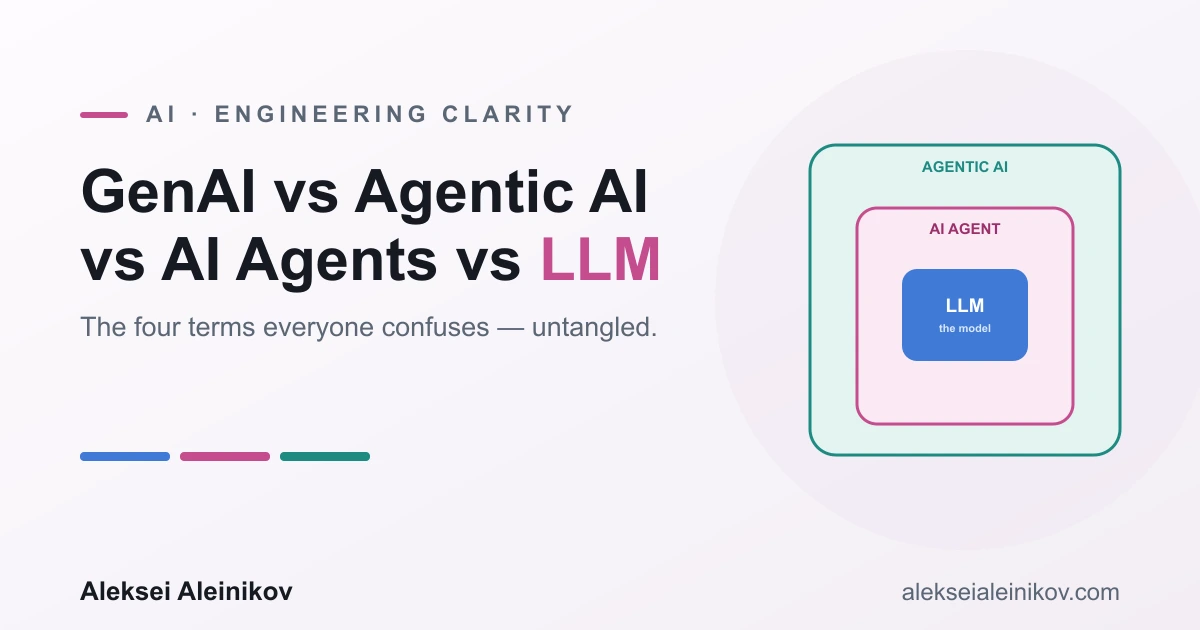
Four words get used as if they mean the same thing: LLM, GenAI, AI agent, and agentic AI. Vendors blur them on purpose — “agentic” sells better than “a chatbot with an API call.” But if you’re building anything real, confusing them costs you money, latency, and a system that’s far more complex than the job requires.
So here’s the clear, engineering version — what each term actually means, how they fit together, and how to know which one you need.
The One Insight That Untangles Everything
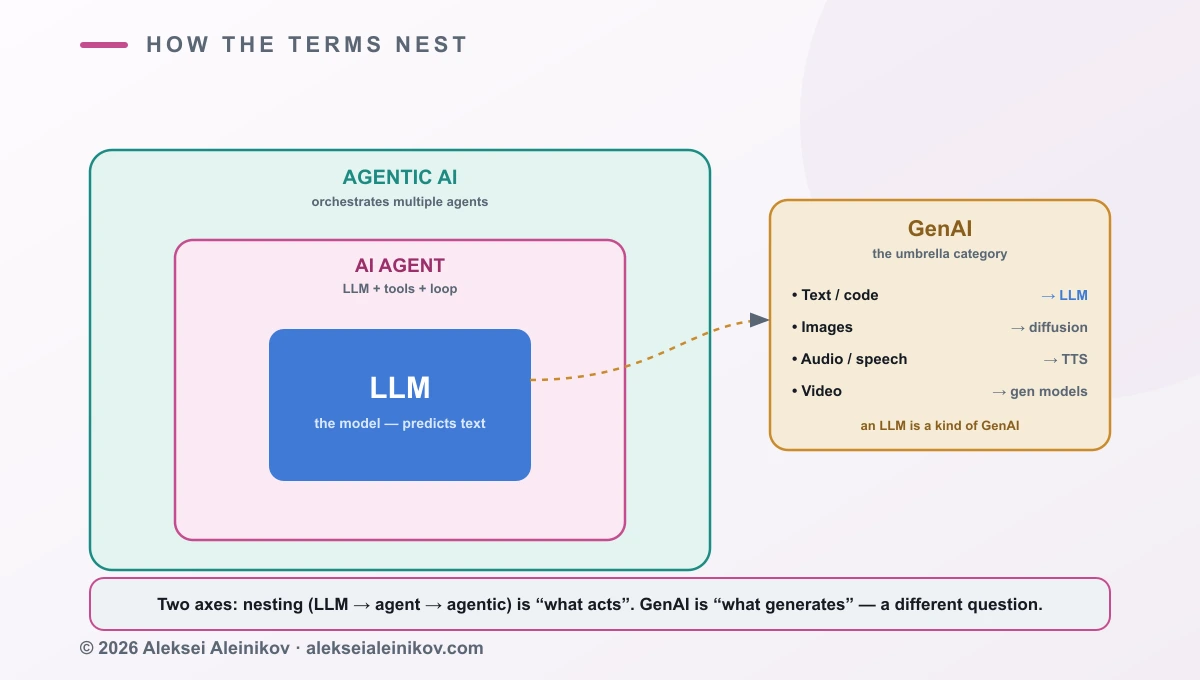
Most explainers line these four up as if they’re four points on a single ladder. They’re not. There are two different axes hiding here, and once you see them, the confusion evaporates:
- “What generates content?” → this axis holds GenAI (the category) and LLM (a member of it).
- “What acts autonomously?” → this axis holds the LLM (can’t act), the AI agent (acts alone), and agentic AI (agents acting together).
The LLM appears on both axes — it’s the text-generating kind of GenAI, and it’s the engine you drop inside an agent. That’s why everything gets tangled. Keep the two axes separate and each term snaps into place.
LLM — The Model (The Brain in a Jar)
An LLM (large language model) is exactly one thing: a neural network trained to predict the next token. Text goes in, text comes out. That’s the entire job.
What it cannot do on its own is the important part:
- It has no memory beyond the context window you hand it each time.
- It can’t take actions — it can’t call an API, query a database, or run code.
- It can’t check its own work against the real world.
An LLM is a brain in a jar: brilliant at reasoning over text, but with no hands and no persistent memory. Gemini, GPT, Claude, and Llama are LLMs. When you use one as a plain chatbot, you’re using it as an LLM — nothing more.
GenAI — The Family the LLM Belongs To
GenAI (generative AI) is not a component you build with; it’s a category. It covers any model that generates new content:
- Text and code → LLMs
- Images → diffusion models
- Audio and speech → TTS and audio models
- Video → video generation models
So an LLM is GenAI — the text-generating member of the family. But a text-to-image model is also GenAI and is not an LLM. This is why “is GenAI the same as an LLM?” trips people up: it’s a category-versus-member question, like asking whether “vehicle” is the same as “car.”
The key move: GenAI and LLM answer “what generates content.” They say nothing about whether the thing can act. That’s the other axis.
AI Agent — The LLM Plus Hands Plus a Loop
Here’s where “acting” begins. An AI agent takes an LLM and wraps it in three things the model doesn’t have on its own:
- Tools — functions it can call: search an API, query a database, run code, send an email.
- A loop — the reason → act → observe cycle. The model decides what to do, does it, sees the result, and decides the next step.
- Autonomy and state — it pursues a goal across multiple steps, carrying context forward, without a human driving each turn.
That loop is the entire difference between a chatbot and an agent. Ask an LLM “book me a flight under $500” and it writes you instructions. Give an agent the same request and it searches flights (tool call), compares them, and books one (tool call) — looping until the goal is met.
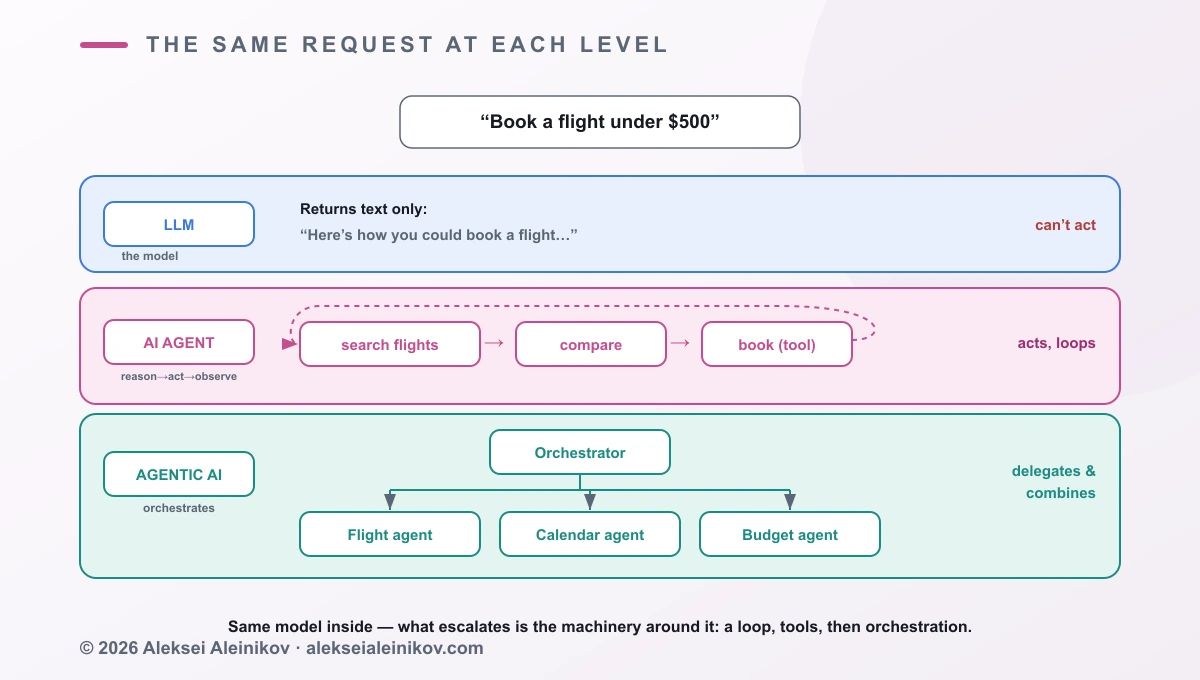
Crucially, the model didn’t change — the same Gemini or GPT can be a plain LLM or the engine of an agent. What you added was the loop, the tools, and the authority to act. The brain got hands.
Agentic AI — Agents Working as a System
Agentic AI is the paradigm one level up: multiple agents (or sophisticated planning agents) that coordinate to accomplish a goal too complex for one. If an AI agent is a worker, agentic AI is the whole team plus the manager.
It adds:
- Planning — breaking a big goal into sub-tasks.
- Delegation — routing each sub-task to a specialized agent (a research agent, a coding agent, a QA agent).
- Orchestration — handing off between agents, running them in parallel, and combining results.
This is where frameworks live: Google’s Agent Development Kit (ADK), LangGraph, CrewAI, AutoGen. They exist to define agents, wire up their tools, and orchestrate the hand-offs. Agents are the building blocks; agentic AI is the architecture that assembles them.
The Whole Picture, One Table
| LLM | GenAI | AI Agent | Agentic AI | |
|---|---|---|---|---|
| What it is | The model | The category of generative models | LLM + tools + loop | System of coordinated agents |
| Can it act on the world? | No | No | Yes | Yes, across many agents |
| State / memory? | Context window only | N/A (a category) | Yes, across steps | Yes, shared/orchestrated |
| Example | Gemini, GPT, Claude | LLMs + image/audio/video models | A booking assistant | A research pipeline of agents |
| Reach for it when | You need text/reasoning | You’re describing the whole field | The task must take actions | The task needs specialized coordination |
Read the “act on the world” row top to bottom — that’s the real progression: LLM (no) → agent (yes) → agentic (yes, at scale). GenAI sits outside that progression entirely, because it’s a category, not a capability level.
Which One Do You Actually Need?
The most expensive mistake in 2026 is reaching for “agentic” when a prompt would do. More machinery means more cost, more latency, and more ways to fail. Here’s the honest decision path.
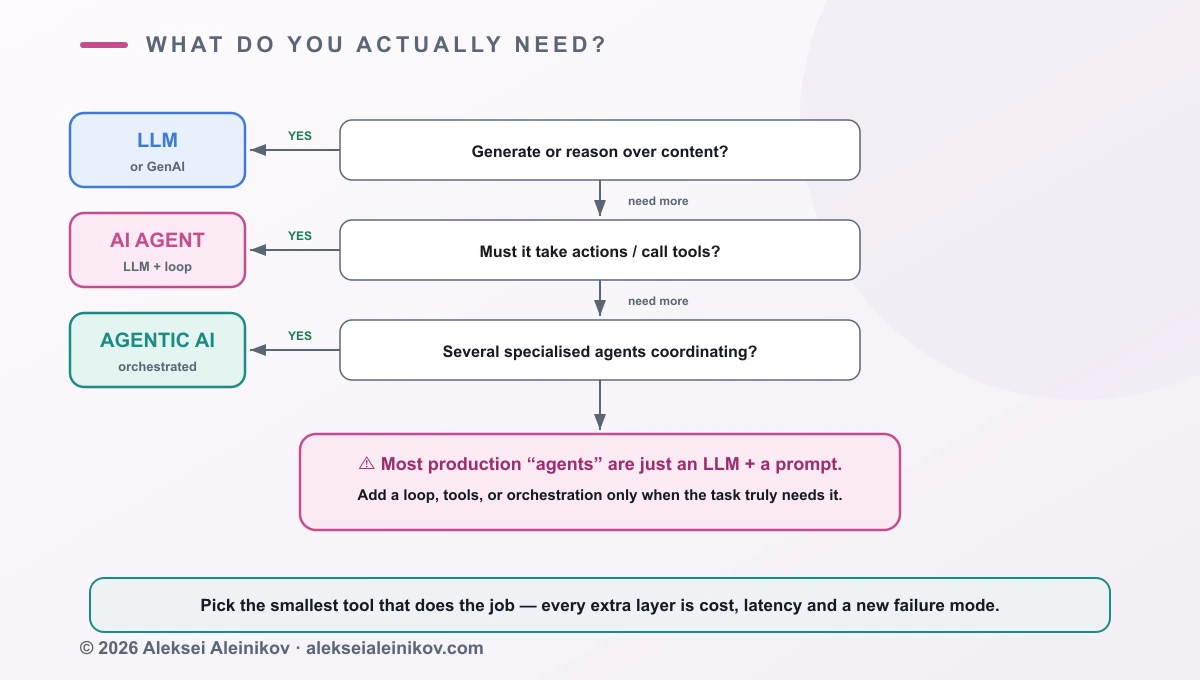
- Just generating or reasoning over content? An LLM with a good prompt. Cheapest, fastest, easiest to debug.
- Needs to take actions — call APIs, query systems, run code, adapt across steps? An AI agent. Now you need the loop and tools.
- Needs several specialized agents to coordinate a genuinely complex workflow? Agentic AI. Now you’re doing orchestration.
And the uncomfortable truth worth repeating: a large share of production “agents” are just an LLM plus a prompt wearing a fancier label. That’s not a failure — it’s usually the right call. Add a loop, tools, and multi-agent orchestration only when the task truly needs to act or coordinate, because each layer you add is a layer you have to secure, debug, and pay for.
Where This Lands on Google Cloud
If you’re building on GCP, the layers map cleanly:
- Model layer (LLM / GenAI): Vertex AI with Gemini and other foundation models.
- Agent layer: the open-source Agent Development Kit (ADK) to define agents, tools, and the loop.
- Agentic layer: multi-agent orchestration with ADK, deployed on a managed runtime — Vertex AI Agent Engine, Cloud Run, or GKE.
Same mental model, concrete products: the model is the LLM, ADK gives it hands and a loop, and orchestration makes it a system.
The Honest Verdict
Strip away the marketing and it’s simple. An LLM is the brain. GenAI is the family that brain belongs to. An AI agent is that brain given hands and a loop so it can act. Agentic AI is a team of those agents coordinated toward a goal.
Two axes, not one ladder: GenAI and LLM answer what generates content; LLM, agent, and agentic answer what acts autonomously. Keep them separate, pick the smallest tool that does the job, and you’ll build systems that are cheaper, faster, and far easier to trust than the “fully agentic” thing the slide deck wanted you to buy.
Related reading: how AI coding agents actually work and user-level permission controls for AI tool access — because the moment an LLM gets hands, governing what it can touch becomes the real work.
From the community
Discussion on Mastodon & Bluesky
Replies to this article from the open web, pulled in live. No ads, no tracking scripts.
Reply there — it shows up here automatically.