
Bigtable is the most misunderstood database on Google Cloud. Teams reach for BigQuery when they need Bigtable, bolt an analytics warehouse onto a workload that just wants fast key lookups, and then wonder why the bill and the latency both went the wrong way. Others hear “NoSQL at Google scale” and throw Bigtable at a problem that actually needed relational transactions.
The confusion is understandable — the names all blur together, and every one of them says “petabytes” on the tin. But these engines solve genuinely different problems, and picking the wrong one is expensive in a way you feel for years. This is a practical guide to what Cloud Bigtable actually is, when it beats BigQuery, Spanner, Cassandra and DynamoDB, and the single design decision that determines whether it flies or falls over.
What Bigtable Actually Is
Bigtable is a wide-column NoSQL store: a single, enormous table where each row is addressed by one row key, and columns are sparse and grouped into column families. It descends directly from the 2006 Bigtable paper that inspired HBase, Cassandra, and much of the NoSQL era — and the same core ideas still explain how it behaves today.
Under the hood, three things matter:
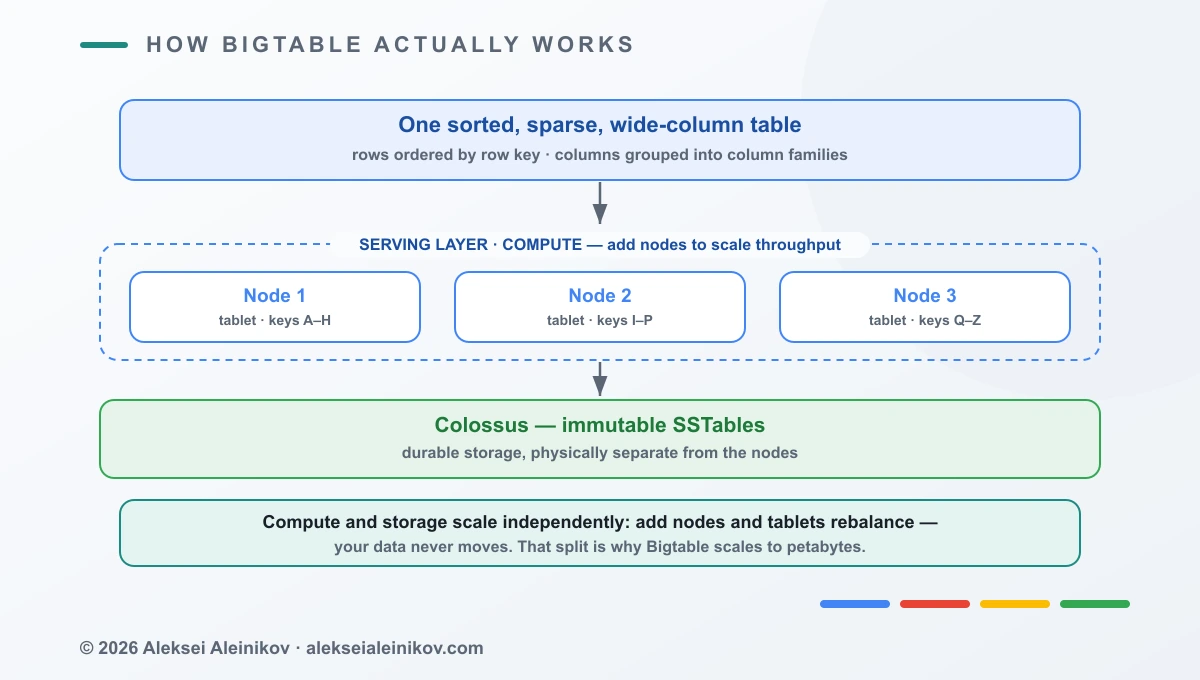
- Rows are stored sorted by row key. The table is one long, lexicographically ordered keyspace — this is why range scans are cheap and why key design matters so much (more on that below).
- The table is split into tablets. Contiguous ranges of rows form tablets, and each tablet is served by exactly one node. Add nodes and Bigtable rebalances tablets across them automatically.
- Storage is separated from compute. Data lives as immutable SSTables on Colossus, Google’s distributed file system. Nodes serve requests; they don’t own the data. That separation is why you scale throughput by adding nodes without ever moving a byte of data — and why Bigtable holds single-digit-millisecond latency from gigabytes to petabytes.
That is the whole mental model: a sorted wide-column table, sharded into tablets, served by a thin compute layer over durable storage. Everything Bigtable is good and bad at follows from it.
Where It Fits: Bigtable vs BigQuery vs Spanner vs Cassandra
The fastest way to pick right is to place each engine by how you access the data, not by the marketing.
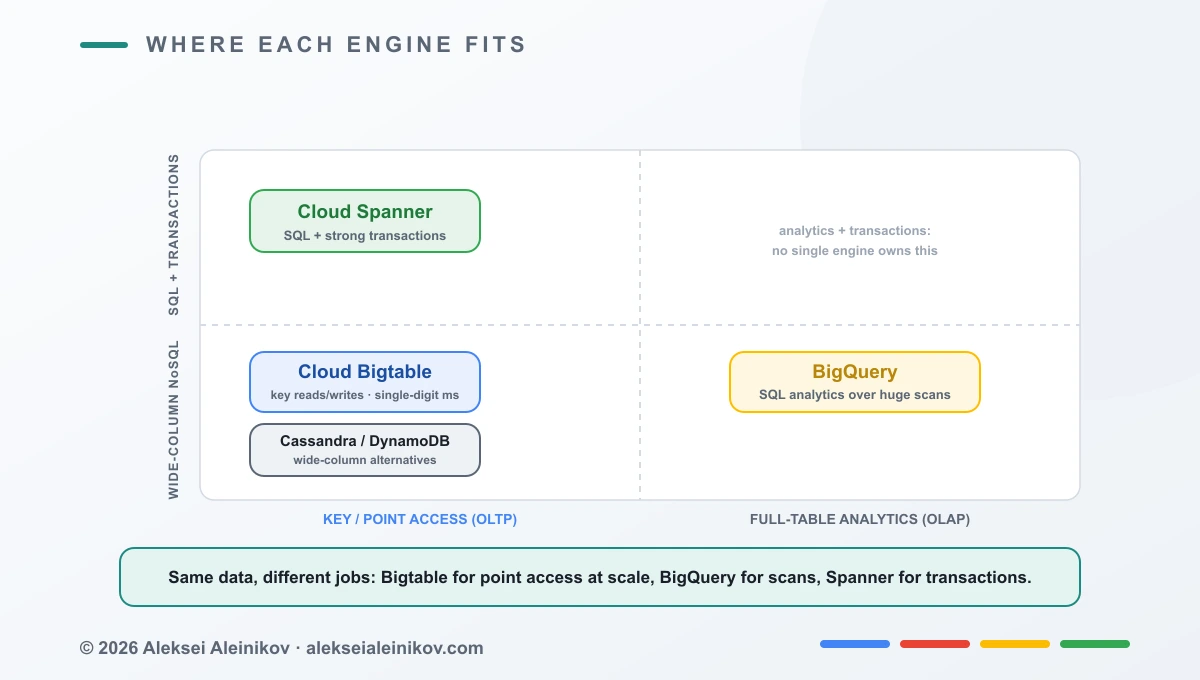
- Cloud Bigtable — point/key access, wide-column NoSQL. High-throughput reads and writes by row key, single-digit-ms latency, single-row atomicity.
- Cloud Spanner — point/key access, but relational with SQL and strong multi-row transactions. You pay more per operation for that correctness.
- BigQuery — the opposite corner: full-table analytical scans with SQL. Superb for aggregations over billions of rows, wrong for fetching one row fast.
- Cassandra / DynamoDB — the same wide-column family as Bigtable, the ones you reach for on AWS/Azure or in a specific hybrid setup.
Here is the same decision as a table:
| Cloud Bigtable | BigQuery | Cloud Spanner | Cassandra / DynamoDB | |
|---|---|---|---|---|
| Data model | Wide-column NoSQL (sparse) | Columnar warehouse | Relational (SQL) | Wide-column NoSQL |
| Best at | High-throughput key reads/writes | Ad-hoc analytics over huge scans | Global, strongly-consistent transactions | Key reads/writes off-GCP |
| Query | Key + range scans, no joins | Full SQL, joins, aggregates | Full SQL + transactions | Key/CQL API, no joins |
| Transactions | Single-row atomic only | None (analytics) | Multi-row, external consistency | Single-row / lightweight |
| Latency | Single-digit ms at any scale | Seconds (scan-based) | Low ms (higher than Bigtable) | Single-digit ms |
| Scale | Petabytes, linear with nodes | Petabytes, serverless | Petabytes, global | Petabytes |
| Pick when | Time-series, IoT, adtech, ML features | You need SQL analytics, not point reads | You need relational + strong txn | You are on AWS/Azure or hybrid |
The pattern is clear: Bigtable owns point access at massive scale. The moment you need SQL analytics, that is BigQuery; the moment you need relational transactions, that is Spanner. If you are still choosing between the two warehouses for the analytics side, the trade-offs are laid out in BigQuery vs Snowflake in 2026: An Honest Comparison.
When Bigtable Is the Right Call
Bigtable shines when a workload has a known key access pattern and a very high read/write rate. The classic fits:
- Time-series and monitoring — metrics, events, and sensor readings written continuously and read back by entity + time range.
- IoT — millions of devices each appending data; Bigtable absorbs the write firehose without breaking latency.
- Adtech and personalization — user profiles and real-time bidding state fetched in milliseconds, billions of times a day.
- Financial / operational data — high-volume transactional records (not multi-row transactions) like tick data or ledgers.
- ML feature stores — low-latency feature lookups at serving time, at a scale that would make a relational database sweat.
The common thread: you know the key, you need the answer fast, and there is a lot of traffic. If that is your workload and you do not need joins or multi-row transactions, Bigtable is hard to beat.
The Row Key Is the Whole Game
Everything good about Bigtable depends on one decision: the row key. Because rows are stored sorted and split into tablets by contiguous range, the key determines which node handles each write. Get it wrong and you defeat the entire architecture.
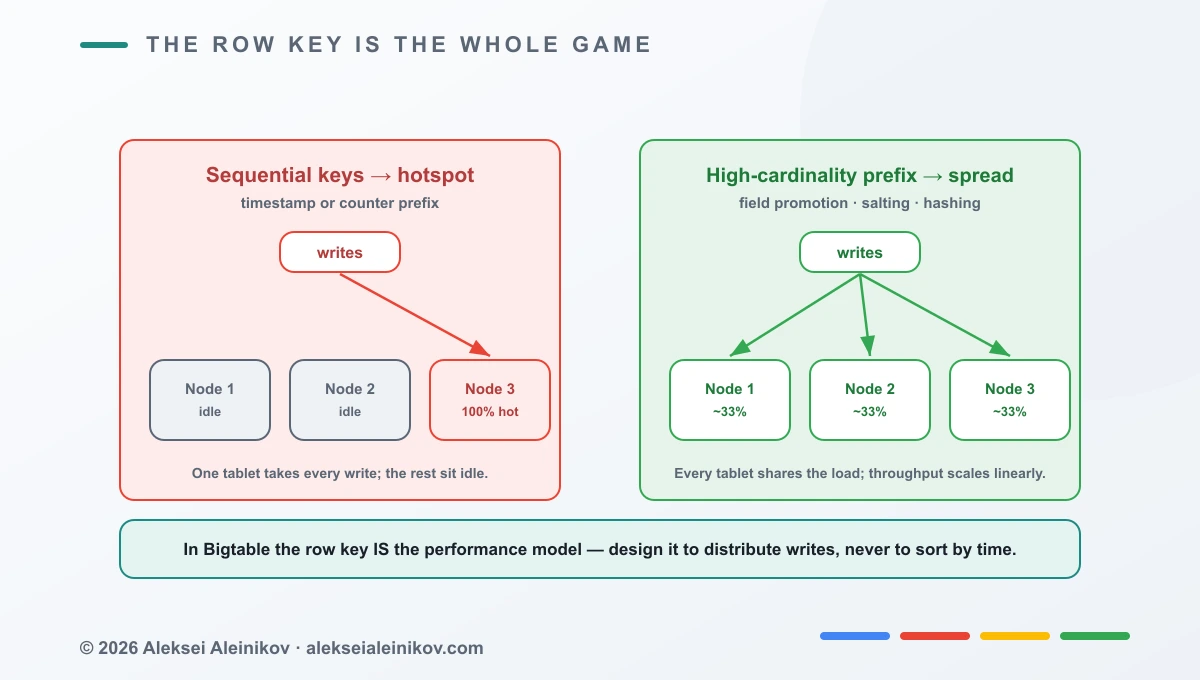
The trap is sequential keys — a raw timestamp, an auto-incrementing counter, anything monotonic. Every new write sorts to the end of the keyspace, which means every write lands in the same tablet, which means one node takes 100% of the write load while the rest sit idle. You bought a hundred-node cluster and you are using one. This is the number-one Bigtable performance bug, and it is entirely self-inflicted.
The fix is a high-cardinality prefix that spreads writes across the keyspace:
- Field promotion — put a high-cardinality attribute (like
device_idoruser_id) before the timestamp:device123#2026-07-13T10:00. Writes now scatter across devices instead of piling onto “now.” - Salting — prepend a hash bucket (
03#…) so writes distribute round-robin across N tablets. - Hashing / reversing — reverse a sequential ID or hash it so adjacent values land far apart.
In practice the key is a compound string, and the order of its parts is the whole decision:
# Good: high-cardinality prefix first, then a reversed timestamp#   device123#20260713T0959      → writes scatter across devices# Bad: the timestamp leads#   20260713T1000#device123      → every write piles onto "now"
cbt createtable metrics families=mcbt set metrics "device123#20260713T0959" m:temp=21.4cbt read metrics prefix="device123#"     # fast range scan for one device
The goal is always the same: distribute writes, don’t sort them by time. Keep related data close enough that your common range scans stay efficient, but never let the “newest” rows all collapse onto one tablet. In Bigtable, the row key is not just an identifier — it is the performance model.
Three More Things That Bite in Production
Row-key design is the big one, but three constraints catch teams the first time:
- There are no secondary indexes. You can only look up by row key, so you design the key for your primary read — and for a second access pattern you often store the same data again under a different key or in a second table. Plan for deliberate denormalization; there is no ad-hoc
WHEREon a non-key column. - Consistency depends on your cluster setup. A single-cluster instance is strongly consistent. Multi-cluster replication is eventually consistent, and you steer traffic with app profiles. If you need strong consistency across regions, that is Spanner, not Bigtable.
- You pay for nodes × time, plus storage. Throughput is provisioned: idle nodes still cost money, so size to sustained load and lean on autoscaling for spikes. And keep rows tall, not wide — model events as many rows and keep any single row well under the ~256 MB limit, instead of growing one giant row.
When NOT to Use Bigtable
Bigtable is a specialist, and the wrong workload makes it painful:
- You need SQL analytics, joins, or ad-hoc aggregation → that is BigQuery. Bigtable will not scan-and-group billions of rows for you.
- You need multi-row transactions or a relational schema → that is Spanner. Bigtable guarantees atomicity only per row.
- You have small data or modest traffic → the minimum cluster and operational model are overkill. A managed Postgres (Cloud SQL / AlloyDB) is simpler and cheaper.
- Your access pattern is unpredictable and query-driven → without a clear key access pattern, you will fight the row-key model instead of riding it.
Bigtable earns its keep at scale, on a known key. Below that bar, simpler tools win.
The Field Rule
Match the engine to the access pattern, not to the “petabytes” label. Bigtable for high-throughput point access on a known key; BigQuery for SQL analytics over huge scans; Spanner for relational transactions; Cassandra or DynamoDB when you are off Google Cloud. And if you do pick Bigtable, spend your design time on the row key — distribute writes, keep scans tight, and never sort your keyspace by time. Everything else about scaling Bigtable takes care of itself; the row key is the part only you can get right.
Bigtable rarely lives alone — it usually sits behind a stream of events feeding it writes. For keeping that ingestion path clean, see Pub/Sub or Eventarc? Event-Driven GCP Without the Spaghetti.


From the community
Discussion on Mastodon & Bluesky
Replies to this article from the open web, pulled in live. No ads, no tracking scripts.
Reply there — it shows up here automatically.