
Data12 articlesEN · DE
Databases and data platforms — choosing the right store and keeping it fast
Data systems fail quietly: a query fast at a thousand rows crawls at a million, and the wrong store costs you for years. This hub is about those choices — relational vs NoSQL vs graph vs vector, BigQuery vs Snowflake vs Bigtable, Iceberg vs Delta Lake — plus SQL query optimization and data governance on GCP. Written from production pipelines and analytics workloads at enterprise scale.
Start here
Your path through Data
A short reading order — from the fundamentals to production depth.
Articles in this hub
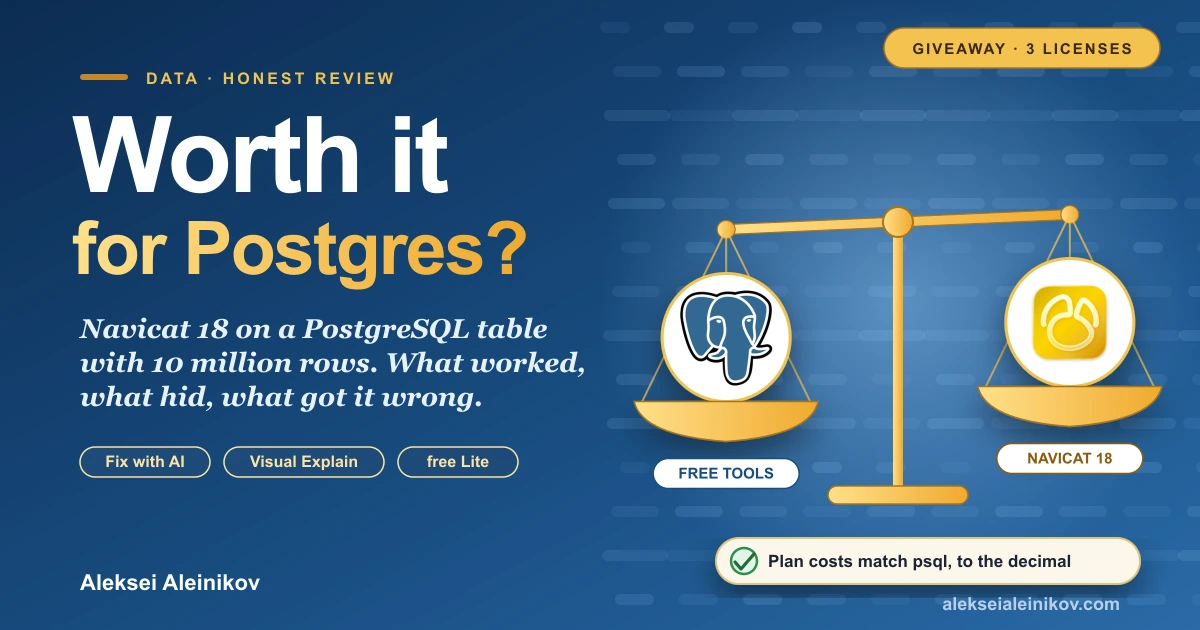
Navicat 18 Review: Is It Worth It for PostgreSQL? Tested on 10M Rows
Navicat 18 promises code insight, refactoring, data masking and AI that previews before it writes. I put it in front of a PostgreSQL table with 10 million rows and wrote down what worked, what hid, and what needs care.
Read article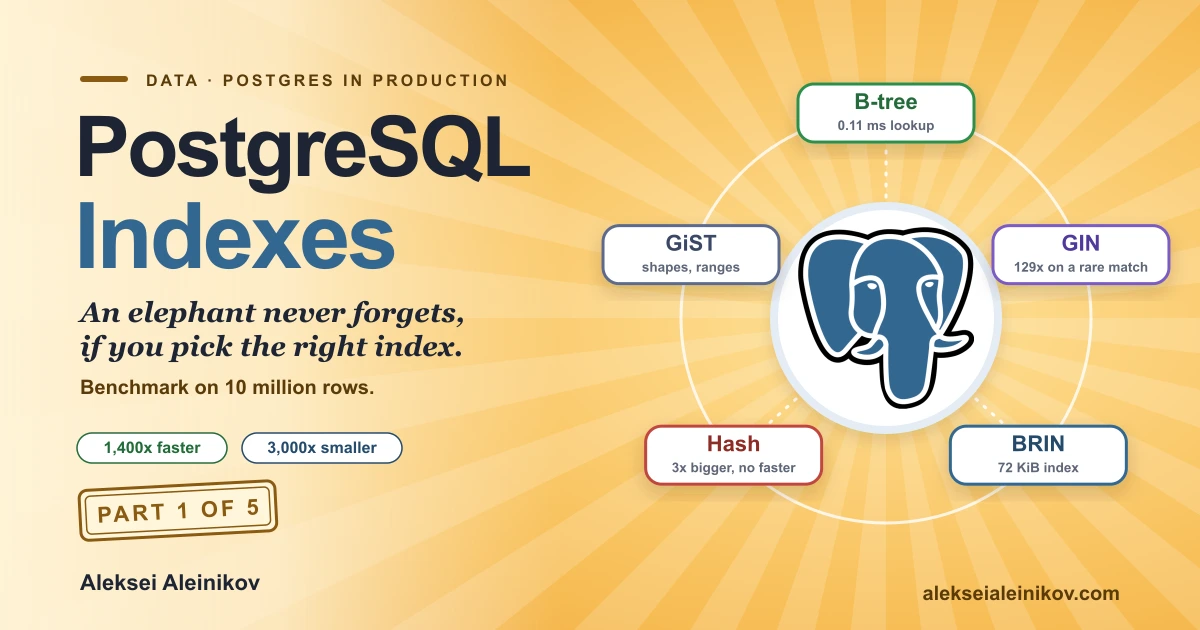
PostgreSQL Indexes: Which Type to Use (10M-Row Benchmark)
A PostgreSQL index is a separate structure that lets the database find rows without reading the whole table. Which type to use, from B-tree and hash to BRIN, GIN and partial or covering indexes, measured on 10 million rows with PostgreSQL 18.
Read article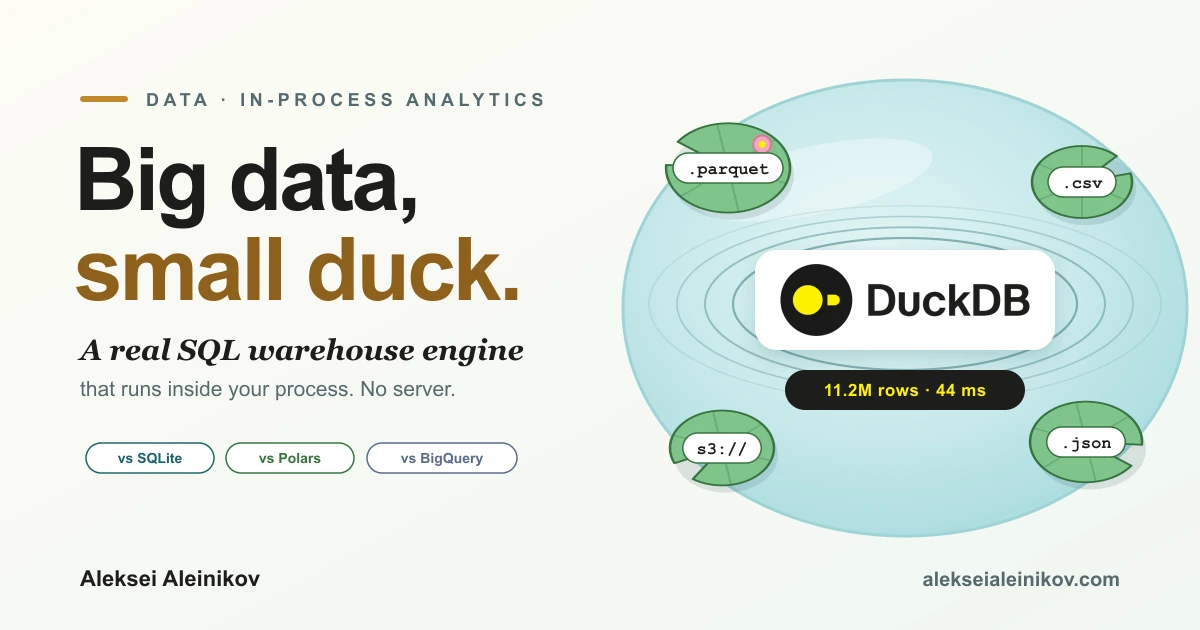
DuckDB Explained: When a Database on Your Laptop Beats SQLite, Polars and BigQuery
DuckDB is an in-process SQL database built for analytics: no server, columnar, vectorised, and able to query Parquet, CSV and S3 directly. What it is, a reproducible benchmark against SQLite, pandas and Polars on 11.2 million taxi trips, where it beats BigQuery and where it does not, plus Quack, DuckLake, MotherDuck and DuckDB 2.0.
Read article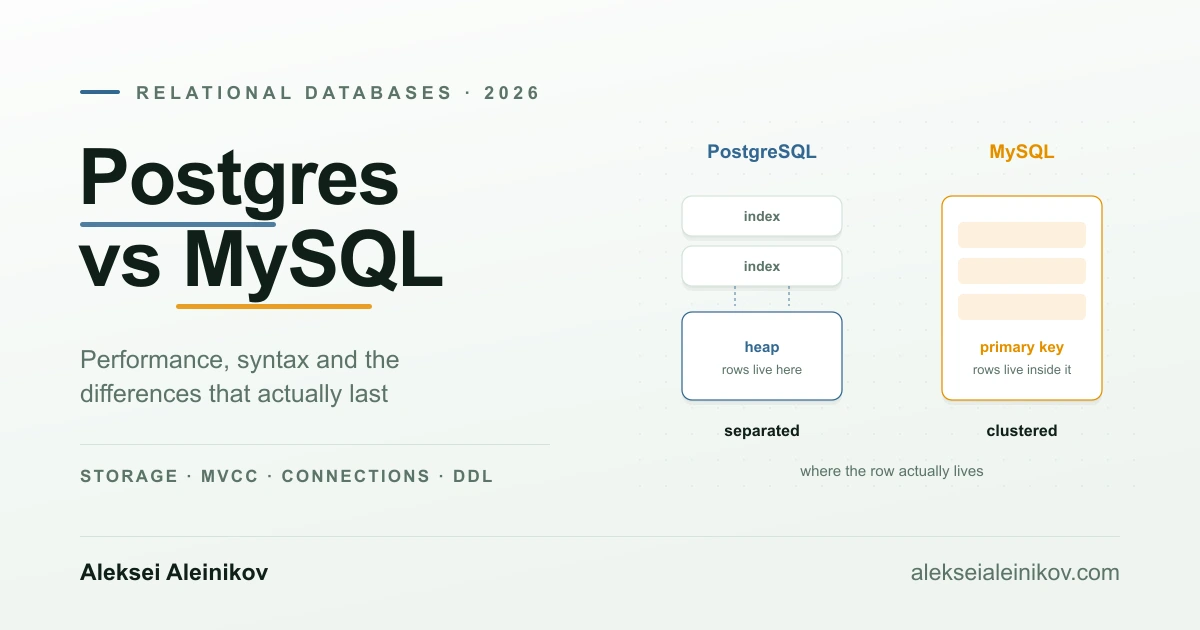
Postgres vs MySQL in 2026: Performance, Syntax and the Real Differences
Where Postgres and MySQL genuinely differ — storage engines, MVCC, connection models, SQL syntax and operations — plus where SQLite and MariaDB fit, and how to actually choose.
Read article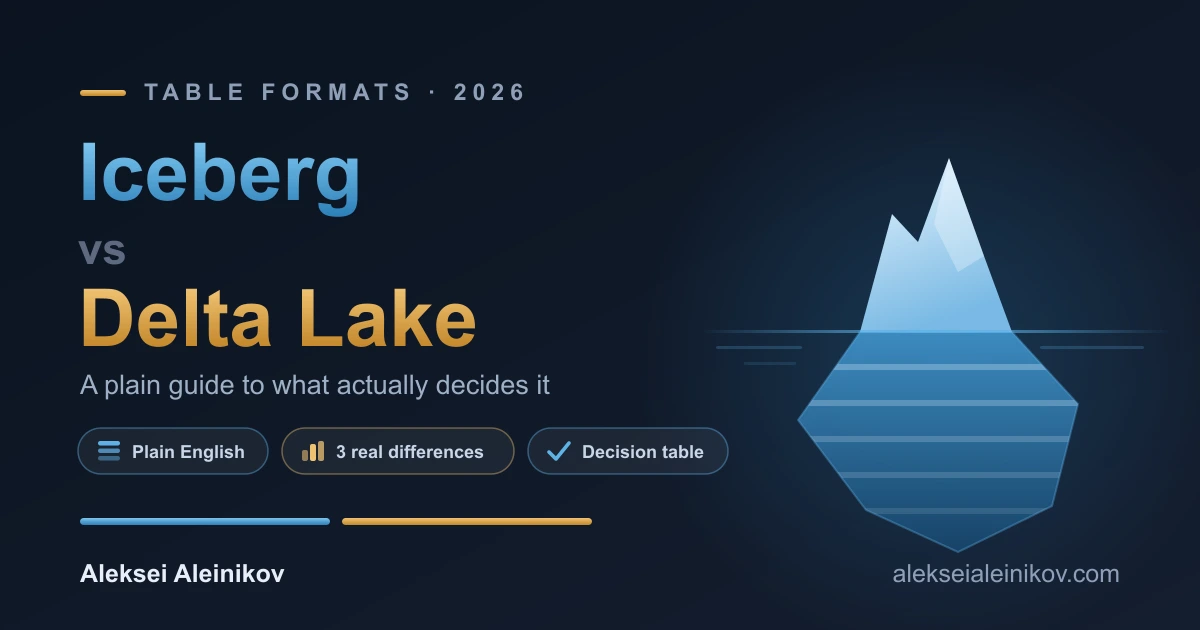
Iceberg vs Delta Lake in 2026: A Plain Guide to Picking One
What a table format actually is, what Iceberg and Delta Lake really do differently in 2026, and why the choice is decided by your catalog and your query engine rather than by the format itself.
Read article
Do You Need a Graph Database? What BigQuery Graph Going GA Actually Changes
BigQuery Graph reached GA on 1 September 2026. Before you model anything as a graph, here is the honest test for whether you need one — plus the line in the pricing page that decides whether you can even run GQL.
Read article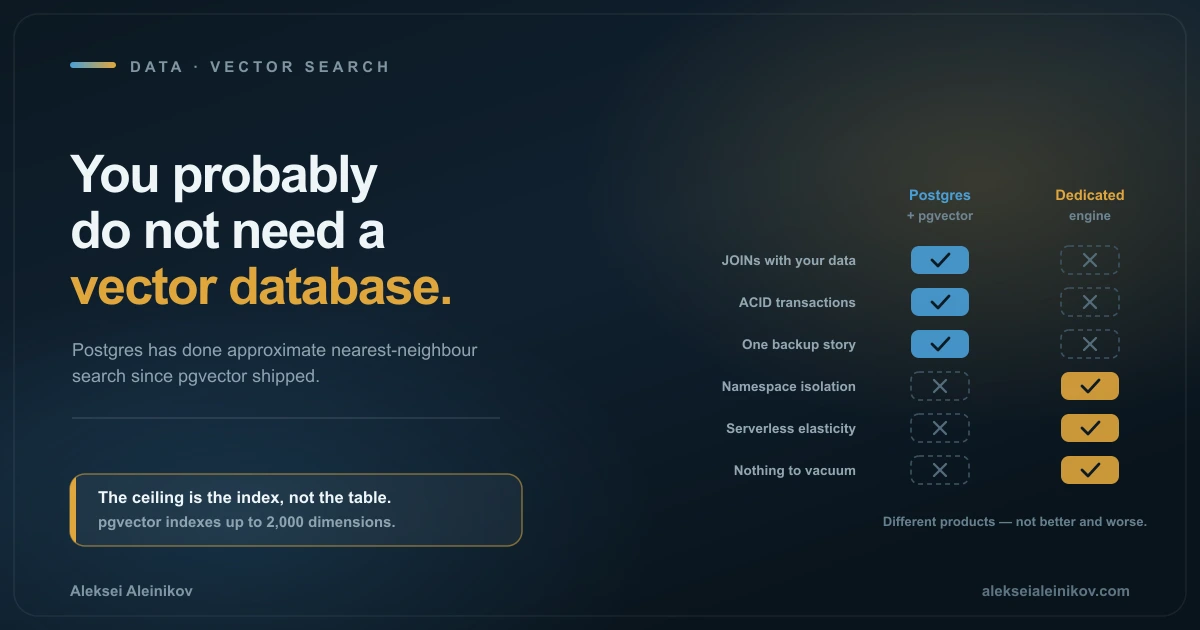
Do You Need a Vector Database? Postgres vs Dedicated in 2026
Most teams adding semantic search do not need a separate vector database. A practical 2026 guide to what pgvector actually does, the four mechanisms that make it run out, and what you are really buying when you pay for a dedicated engine.
Read article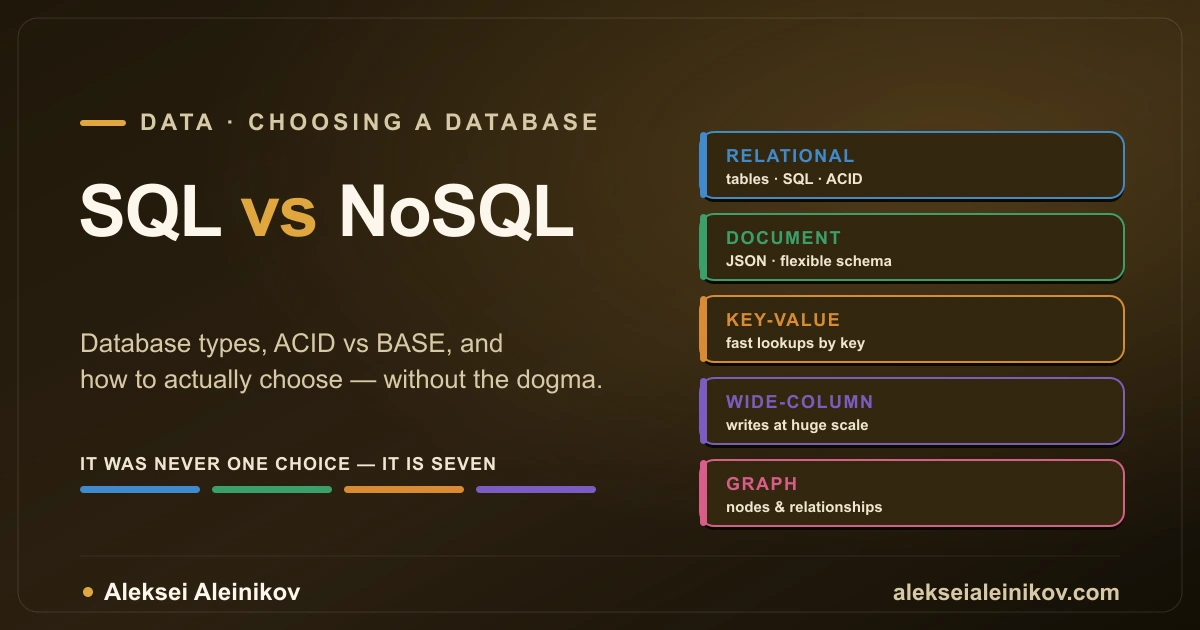
SQL vs NoSQL in 2026: Database Types, ACID vs BASE, and How to Actually Choose
"SQL vs NoSQL" is the wrong first question. A practical 2026 guide to database types, what relational really means, ACID vs BASE, and a decision framework to choose by your access patterns — not by hype.
Read article
Data Governance on GCP in 2026: Who Can See This Data?
A practical 2026 guide to data governance on Google Cloud: the four questions every program must answer, and the exact services that answer them — Knowledge Catalog (Dataplex), Sensitive Data Protection, BigQuery policy tags, and VPC Service Controls — with a comparison table and a decision guide.
Read article
Cloud Bigtable in 2026: When Wide-Column Beats BigQuery, Spanner, and Cassandra
A practical 2026 guide to Cloud Bigtable: what wide-column storage actually is, how Bigtable works under the hood, when it beats BigQuery, Spanner, Cassandra and DynamoDB, and the one thing — row-key design — that makes or breaks it.
Read article
BigQuery vs Snowflake in 2026: An Honest Comparison From a GCP Engineer
A practical, no-marketing comparison of BigQuery and Snowflake in 2026 — how their architecture, billing, performance and AI stories really differ, and how to choose the right one for your workload.
Read article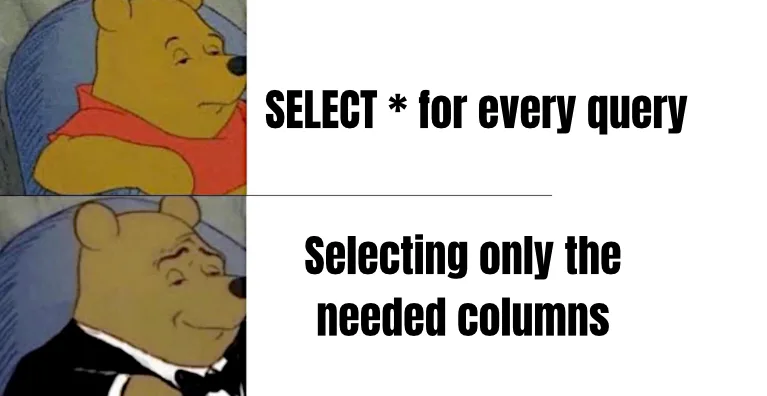
SQL Query Optimization in 2026: 7 Simple Techniques for Faster Database Performance
Seven practical SQL query optimization techniques for faster database performance, with PostgreSQL-focused examples for joins, IN lists, EXISTS, date ranges, aggregates, and deduplication.
Read article
FAQ
Before you reach out
What is your data engineering background?
I build production data pipelines and analytics workloads at scale — query optimization, managed messaging and large-scale collection — backed by 12+ years of platform engineering in large enterprise environments.
Are you open to a permanent role?
Yes — I am looking for a permanent, full-time role as a senior data or platform engineer in the DACH region (Germany, Austria, Switzerland): on-site, hybrid or remote, and ready to relocate. I work fluently in English.
How do we start the conversation?
Send me the role on the contact page — the data stack, the team and what it must deliver — and I will reply with my CV and how I would approach the first months.
Open to permanent roles · DACH
Hiring a senior data platform engineer in DACH?
Pipelines, query performance and analytics workloads in production at scale. I am looking for a permanent role in Germany, Austria or Switzerland — and ready to relocate.
- Permanent, full-time
- Germany · Austria · Switzerland
- Ready to relocate