
Jev looks like a direct competitor to GPT-5 and Claude only from a distance. All three can classify a ticket, score a lead, or choose the next handler. But they reach that result through different contracts.
GPT-5 and Claude are language models that can be constrained to return JSON or call a tool. Jev gives up arbitrary text generation and exposes three decision primitives instead. That narrower interface is the product.
The useful question is therefore not “which model is smartest?” It is: does this step need generated language, or does it need a bounded decision that code can act on?
The 30-Second Verdict
| If your production step needs… | Start with | Why |
|---|---|---|
| One label from a known taxonomy | Jev Choice or a conventional classifier | The answer space and probabilities are native |
| A yes/no risk signal | Jev Noul | One probability can drive explicit review thresholds |
| A rating against written levels | Jev Score | It returns the full distribution, not only one generated number |
| A label plus a written explanation | GPT or Claude with Structured Outputs | Jev cannot generate the explanation |
| Images, audio, or video | GPT or Claude | Jev 1.13 accepts text only |
| Counting, arithmetic, or date comparison | Deterministic code | TypeSafe explicitly documents these as Jev weak spots |
| A changing or unknown taxonomy | GPT or Claude for discovery; classifier for operation | Jev must choose from candidates declared before the request |
| A high-volume decision funnel | Rules → Jev → specialist LLM → human | Cheap cases stop early; uncertain cases retain an escape path |
The rest of this article explains why those boundaries matter. If you remember one rule, remember this: use Jev where the uncertainty is semantic but the action space is finite.
What Jev Actually Is
TypeSafe AI introduced Jev on 15 September 2026 as its first public “System One Model,” available in early access. TypeSafe says Jev uses a new architecture, a parallel sampler, and a training method it calls Reinforcement Learning for Calibrated Decisions. The company has not published enough technical detail for outsiders to reproduce that training claim, so treat RLCD as a product description, not an independently established method.
The public API is more concrete. A request contains shared state and one or more typed questions. The documentation defines three primitives:
- Choice selects one option from a closed set and returns the full probability distribution plus confidence. A Choice supports up to 255 options.
- Score places the state on an ordered set of two to ten descriptive levels. The numeric score is the probability-weighted mean of those levels.
- Noul evaluates a yes/no proposition and returns the probability of “yes” from 0 to 1. It has no separate confidence field because one probability describes both binary outcomes.
Questions in one request are evaluated independently against the same state and, according to TypeSafe, in parallel. That is useful for workflows that need several unrelated judgments about one record.
The current production alias jev-latest points to jev-1.13.0. TypeSafe’s model page lists these operational limits as of 21 September 2026:
| Jev 1.13 property | Current documented value |
|---|---|
| Context budget | 64k tokens across state and all questions |
| Per-question budget | 32k tokens for state plus the longest question |
| Input modalities | Text only; strings, JSON objects, or arrays of text values |
| Published rate limits | 250,000 tokens/s and 1,200 requests/min; TypeSafe says these can change during early access |
| Model customization | No customer fine-tune or LoRA; behavior is shaped through state, instructions, and criteria |
| Best-supported language | English; other languages are supported but not equally accurate |
| Data handling | Requests are not used for training; zero data retention is an enterprise option |
Pin jev-1.13.0 rather than jev-latest after tuning thresholds. The alias can move to a new model without an application change, while the response’s model field tells you which version actually answered.
{ "model": "jev-latest", "state": "My running shoes arrived in the wrong size.", "questions": { "department": { "type": "choice", "instructions": "Which team should handle this?", "criteria": { "returns": "Exchanges, wrong or damaged items", "shipping": "Delivery status, delays, lost packages", "billing": "Charges, invoices, payment problems" } }, "needs_human": { "type": "noul", "instructions": "Does this request require a human agent?" } }}This is not a chat completion with a clever prompt. The possible answer space is part of the model interface.
The Real Difference Is the Output Contract
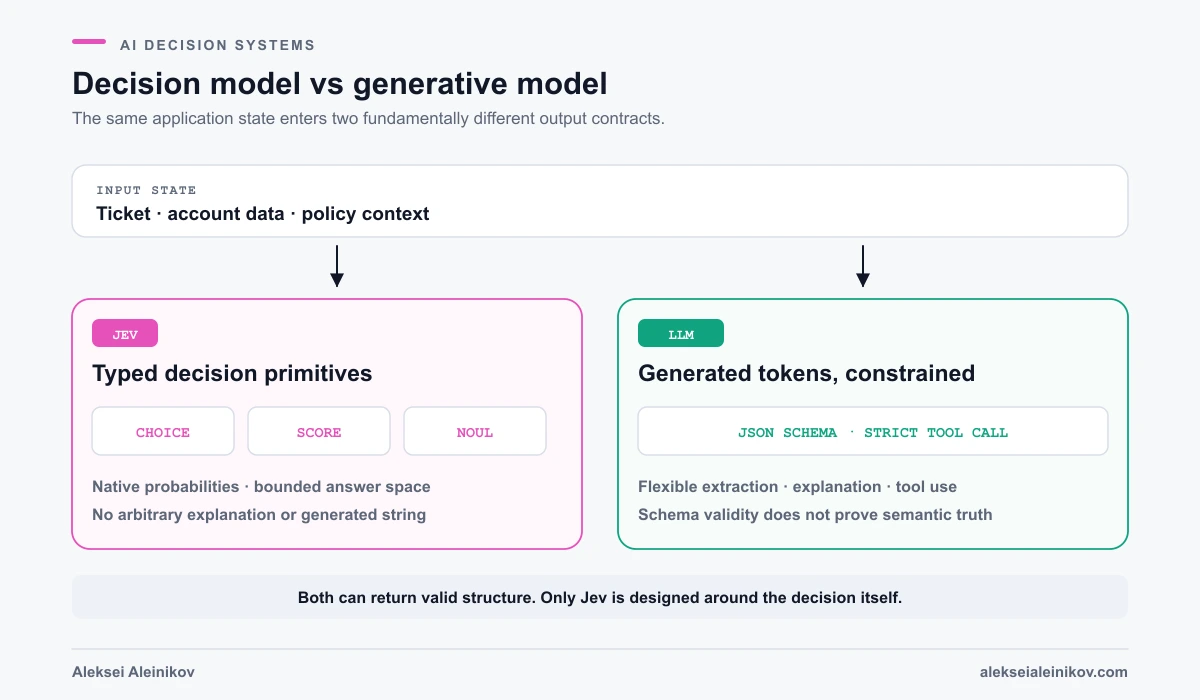
OpenAI’s Structured Outputs and Anthropic’s structured outputs both use constrained decoding to enforce a supported subset of JSON Schema. They solve an important engineering problem: required keys, types, and enum values no longer depend on prompt obedience.
That makes this valid:
{ "route": "billing", "confidence": 0.91, "reason": "The customer reports a duplicate charge."}But the schema guarantees only that route is an allowed string and confidence is a number. It does not prove that billing is correct or that 0.91 is calibrated. OpenAI explicitly warns that Structured Outputs can still contain mistakes and may force an unrelated input into the supplied schema. Anthropic documents exceptions for refusals, token limits, and even enum-value casing.
Jev’s contract is narrower. probabilities is a native result of a Choice or Score rather than a confidence number the model was asked to write into JSON. Its confidence is computed from the shape of that distribution. A flat distribution means the options are ambiguous; a sharp peak means one option dominates.
That still does not prove correctness. TypeSafe’s Score documentation says this directly: confidence describes the model’s answer, not a guarantee that the answer is right. Calibration has to be tested against labeled outcomes from your domain.
Classification: Jev Is Narrower, Which Is the Point
For a fixed taxonomy, Jev’s Choice primitive maps unusually well to the problem:
ticket + account state → returns: 0.61 → billing: 0.35 → shipping: 0.04Your code can send the primary route to returns, notify billing because its probability exceeds a secondary threshold, and send the ticket to manual triage when confidence is low. The policy stays in ordinary code.
GPT-5 and Claude can produce the same business result with a strict schema. They also let you request a rationale, extract arbitrary fields, read images, search files, call tools, or continue the conversation. That flexibility matters when classification is only one step in a broader cognitive task.
The trade-off is architectural:
| Question | Jev | GPT-5 / Claude |
|---|---|---|
| Closed-set classification | Native Choice primitive | Enum in a JSON schema or tool call |
| Binary judgment | Native Noul probability | Generated boolean or number |
| Ordered rating | Native Score distribution | Generated score in structured output |
| Free-form explanation | Not supported | Native strength |
| Tool use | Decision can select a function; your code executes it | Native function/tool calling and agent loops |
| Arbitrary extraction | Limited to predefined decisions and candidates | Flexible structured extraction |
| Uncertainty | Native probabilities; calibration still needs evaluation | Usually an application-designed field or external evaluation |
| Output validity | Guaranteed by the primitive | Guaranteed within supported schema, except documented edge cases |
If you need the model to discover a category that was not in the taxonomy, Jev is the wrong abstraction. A Choice can include other, but it cannot invent and explain the missing category. Use a language model to discover the taxonomy, then use a bounded model or classifier to operate it.
Nine Documented Jev Failure Modes
The most valuable TypeSafe page is not its homepage. It is the Jev 1.13 jaggedness list, last reviewed on 17 September 2026. The company documents nine ways its own model can fail:
| Failure mode | What breaks | Production response |
|---|---|---|
| Literal reading | Implied conditions, negation, and loose scope are interpreted differently from what the author meant | State the exact condition and put boundary cases in the criteria |
| Counting | Characters, occurrences, and long lists are not tallied reliably | Find candidates and count them in code |
| Numeric reasoning | Hex values, raw numeric relationships, and precise interpolation are weak | Convert numbers into semantic buckets; keep arithmetic in code |
| Date comparison | Ordering, date windows, relative dates, and mixed formats are unreliable | Extract bounded date parts, then compare real dates in code |
| Indirection | Multi-hop questions and double negatives lose accuracy | Point directly to relevant state and split the judgment |
| Irrelevant context | Accuracy falls as unrelated material grows | Retrieve or filter before the Jev call |
| Adversarial content | Prompt-injection-like text inside state can steer the answer | Treat state as hostile, make criteria explicit, and test attacks |
| Structural assumptions | Equivalent Noul and Choice questions need not return arithmetically compatible probabilities | Tune each primitive separately; enforce invariants in code |
| Generation | Chaining choices into free text is slow and poor | Use a generative model |
Two details deserve emphasis. First, Jev suffers from context rot: a 64k context limit does not mean 64k useful tokens for every decision. Second, its probabilities are not algebraic building blocks. TypeSafe shows one question and its negation returning probabilities that sum to 1.19; it explicitly warns not to assume $P(x)=1-P(\neg x)$ across separately asked questions.
This is why the best Jev architecture looks deliberately boring: preprocess exact facts in code, send only decision-relevant state, ask one atomic question per judgment, and validate the result against domain labels.
Routing: Separate Deciding From Doing
“Routing” hides two different jobs:
- Decide which route fits the current state.
- Execute the route by calling a service, model, queue, or human workflow.
Jev is designed for the first job. GPT-5 and Claude can do both inside an agent loop. That can reduce orchestration code, but it also gives the model a larger action surface.
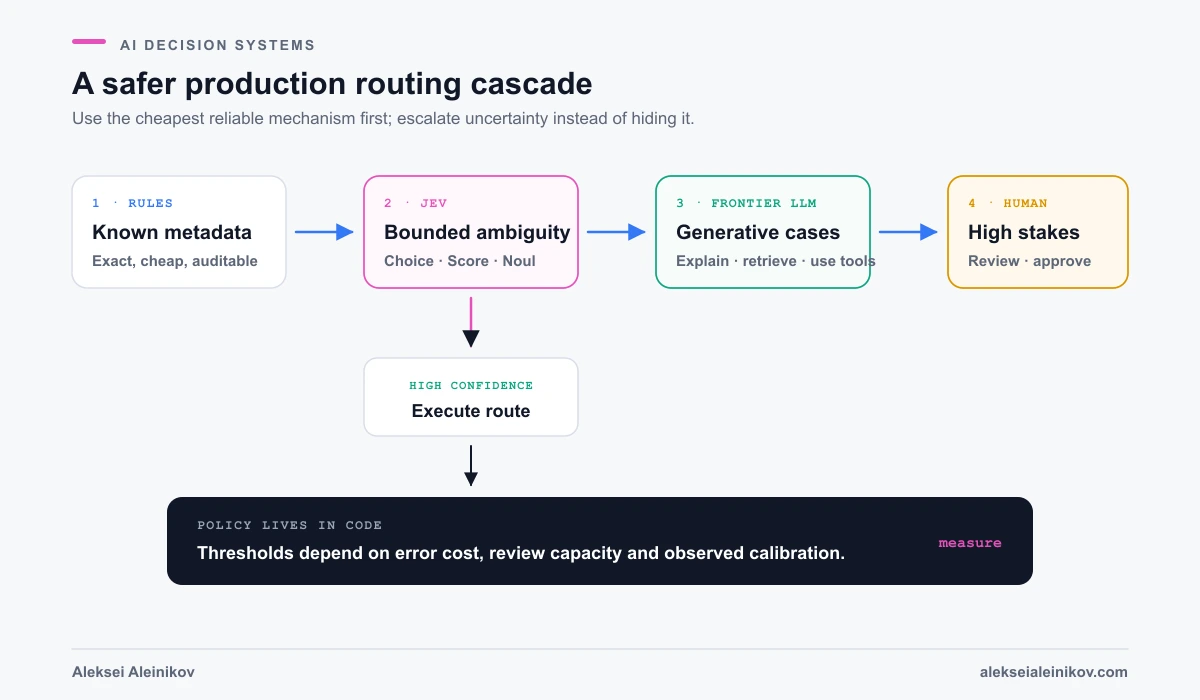
A practical production route can look like this:
def route(request):    known = route_from_metadata(request)    if known:        return known
    decision = jev_classify(request)    if decision.confidence >= 0.85:        return decision.choice
    if request.is_high_risk:        return "human_review"
    return route_with_frontier_llm(request)
The thresholds are examples, not recommendations. Set them from false-route costs and a validation set. A password-reset article can tolerate a lower threshold than a payment approval.
This “model as one bounded component” approach also fits the broader move from prompts to explicit runtime context described in Context Engineering. It is very different from letting a general agent own the entire loop; the distinctions in GenAI vs Agentic AI vs AI Agents vs LLM help separate those designs.
What the Price and Latency Numbers Really Say
TypeSafe publishes striking numbers: $0.042 per million input tokens, no metered output-token charge, and 70–500 ms end-to-end response time. Its homepage advertises 193.6× faster and 444.6× cheaper for its workflow comparison.
Those numbers need three labels attached.
First, they are TypeSafe’s measurements and pricing, not independent results. The company says its published runs originate from laptops on the US West Coast, where its service is currently based.
Second, the headline ratios come from four company-built workflow evaluations. The reference labels are the average answers of GPT-6 Astra and Claude Fable 5.1 at high thinking. TypeSafe says the workflows were created by members of its model-capabilities team and acknowledges possible bias. It also says the 193.6× and 444.6× gains are probably at the high end of real-world gains.
Third, the systems are not producing the same artifact. Jev returns bounded decisions. A frontier LLM in the comparison returns compatible decisions through TypeSafe’s System One adapter, including probabilities. Requiring an autoregressive model to emit more output naturally increases time and cost. That may be the exact cost your application faces, but it is not a universal model-intelligence benchmark.
For a stable pricing reference, the GPT-5 API page currently lists $1.25 per million input tokens and $10 per million output tokens, with a 400,000-token context window. It also labels GPT-5 the previous model and recommends GPT-6 Astra for new work. Anthropic’s current general-purpose Claude Sonnet 5 lists $2 input and $10 output per million tokens with a one-million-token context window; Opus 5 lists $5 and $25. These are base token prices, not end-to-end workflow costs.
The fair comparison is therefore your own cost per accepted decision:
$$ \text{cost per accepted decision} = \frac{\text{API cost} + \text{review cost} + \text{error cost}} {\text{automatically accepted decisions}} $$
A cheap model that sends half the traffic to review may cost more than an expensive model that resolves it correctly. A confident but miscalibrated model can cost far more than both.
The Most Useful Public Jev Result Is 90% vs 40%
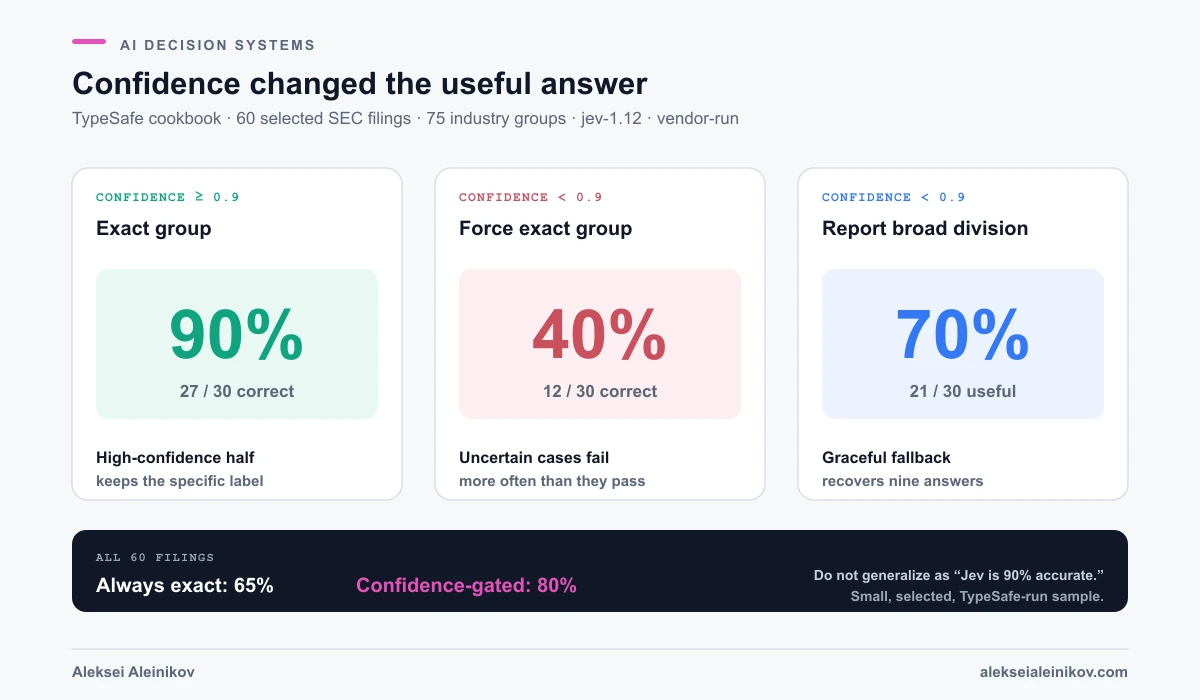
TypeSafe has published one smaller result that is more actionable than the 444.6× headline. In its classification-with-confidence cookbook, jev-1.12 classified 60 selected SEC annual reports into 75 industry groups. The documents ranged from 700 to 2,200 words and averaged 1,438 words.
With a confidence threshold of 0.9, the set split exactly in half:
| Policy and subset | Correct | Accuracy |
|---|---|---|
| Always force one of 75 industry groups | 39/60 | 65% |
| Confidence ≥ 0.9, report the exact group | 27/30 | 90% |
| Confidence < 0.9, still force the exact group | 12/30 | 40% |
| Confidence < 0.9, report the broader division | 21/30 | 70% |
| Confidence-gated result across all 60 | 48/60 | 80% |
That is a useful demonstration of selective prediction: confidence did not make difficult examples correct, but it separated a much stronger subset and allowed the application to degrade gracefully to a broader label.
It is still not an independent benchmark. TypeSafe selected filings whose text supported the filer-supplied SIC code, chose the 0.9 cutoff, used only 60 documents, and ran its own model. The right lesson is not “Jev is 90% accurate.” It is “measure accuracy as a function of coverage, and give uncertain cases a less specific or human route.”
“Zero Hallucinations” Is Too Broad
TypeSafe’s narrow technical claim is defensible: because Jev cannot generate arbitrary strings, it cannot return an option outside a Choice or malformed JSON. Type errors are excluded by construction.
Calling that “zero hallucinations” is misleading without the qualifier. A model can return a perfectly valid billing value when the right answer is fraud. That is a semantic error, even though it is not a type error.
The clean vocabulary is:
- Schema validity: Did the output match the declared type?
- Decision accuracy: Did it choose the expected outcome?
- Calibration: Among answers assigned probability 0.8, were roughly 80% correct?
- Coverage: What share of cases cleared the automation threshold?
- Consistency: Does the same or equivalent state receive a stable answer?
Jev makes the first property much easier and exposes useful signals for the next three. It does not remove the need to evaluate them.
How to Run a Fair Evaluation
Do not start with one polished support-ticket demo. Build a frozen set of real, de-identified cases with labels agreed by domain owners.
Measure each contender under the contract you would deploy:
- Give every system identical state and the same category definitions.
- Use strict structured outputs for GPT-5 and Claude, not regex parsing.
- Pin model versions where the provider supports snapshots.
- Record accuracy, macro F1 for imbalanced classes, p50 and p95 latency, token cost, refusals, and incomplete responses.
- Plot accuracy against automation coverage at several confidence thresholds.
- Price human review and wrong routes, not just API tokens.
- Repeat after taxonomy or prompt changes; schemas prevent malformed answers, not behavioural drift.
Before launch, also answer these operational questions:
- What happens on
429, timeout, refusal, or a provider outage? - Is the exact model ID logged with every decision?
- Can you replay a frozen evaluation set before changing model, taxonomy, or thresholds?
- Are adversarial strings in customer-controlled state tested like prompt injections?
- Is there an
other, abstain, broader-class, or human route for incomplete taxonomies? - Do dashboards show accuracy and automation coverage by class, language, and input length?
- Can a reviewer see the original state, chosen option, probability distribution, model version, and policy version?
For probabilities, add a Brier score or calibration curve. For a binary outcome, the Brier score is:
$$ \text{Brier} = \frac{1}{N}\sum_{i=1}^{N}(p_i-y_i)^2 $$
Lower is better. A system that says 0.9 only when it is right about nine times out of ten is more useful for threshold-based automation than one that attaches 0.99 to every answer.
Which One Should You Choose?
Choose Jev when all of these are true:
- the output can be expressed as Choice, Score, or Noul;
- the taxonomy or rubric is known before the request;
- you need many narrow judgments at low latency;
- probabilities and confidence gates are part of the product logic;
- early-access vendor risk and a young ecosystem are acceptable.
Choose GPT-5 or a current GPT model when the decision also needs broad tool access, code execution, retrieval, image understanding, rich explanations, or open-ended generation. Note that OpenAI now classifies GPT-5 as a previous model, so new evaluations should include its recommended successor rather than freezing the architecture around the headline name.
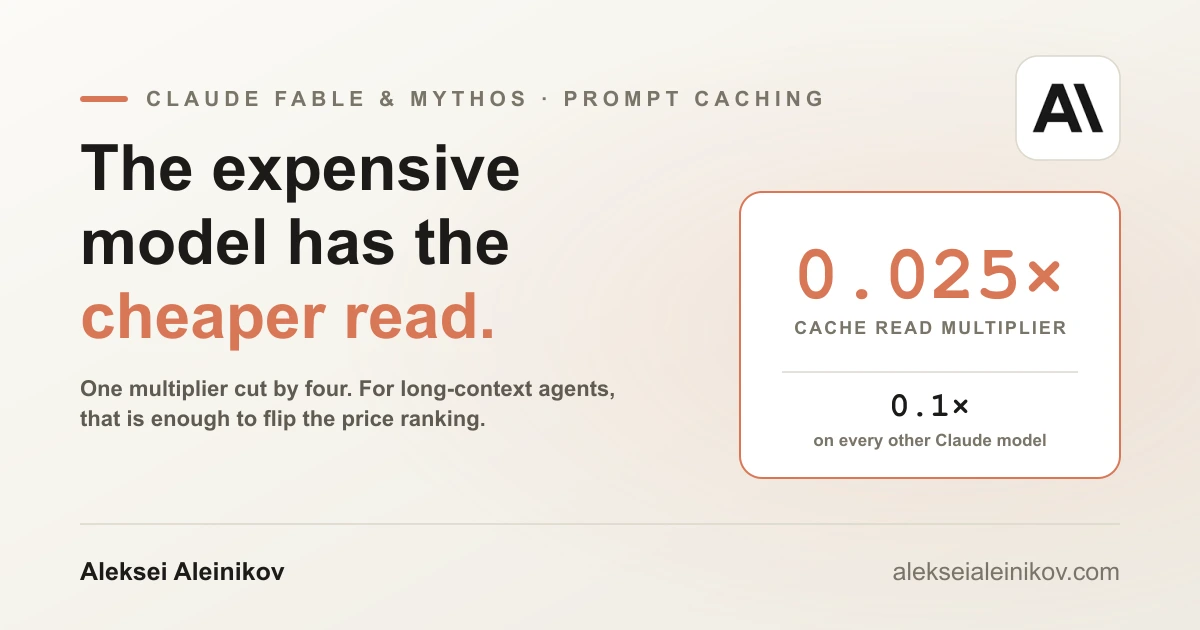
Choose Claude when the surrounding workflow benefits from long context, document interpretation, nuanced language, explanations, or an agent loop with strict tool inputs. Pick a specific Claude tier for the workload; “Claude” is a family, not one latency or price point. The newer pricing split is covered in Claude Fable and Mythos pricing.
Choose a traditional classifier when you have enough stable labeled data, need local inference or complete model ownership, and the taxonomy changes slowly. Jev does not make supervised learning obsolete.
The Bottom Line
Jev is interesting because it rejects the assumption that every intelligent operation should produce language. For classification and routing, a model that returns only bounded decisions and probabilities can be a cleaner component than a general LLM forced through a JSON schema.
But “cleaner contract” is not “proven better model.” TypeSafe’s output guarantees are real; its latency, pricing, and benchmark results are promising vendor evidence; semantic accuracy and calibration on your workload remain yours to establish.
The likely winner is not Jev or GPT or Claude. It is an architecture that spends each kind of intelligence where it fits: rules for certainty, a decision model for bounded ambiguity, a language model for generative complexity, and a human for consequences the evaluation cannot price away.
From the community
Discussion on the Fediverse
Replies from Mastodon and Bluesky — straight from the open web, no tracking.
Loading replies …
No replies yet. Start the conversation:
Replies could not be loaded right now.