
Google released Gemini 4 Carbon on October 28 and put it at number one on the Artificial Analysis Intelligence Index the same day. Then came the part most headlines skip: almost nobody can use it.
That makes a “review” awkward. Nobody outside Google’s rollout has run it on their own code, so every number you can read about Carbon comes from Google, from Artificial Analysis or from third-party leaderboards. This article does what a review can honestly do. It lays out the numbers, shows who produced each one, separates the comparisons you can trust from the ones you cannot, works out what it costs, and tells you which kind of reader should care now and which should wait.
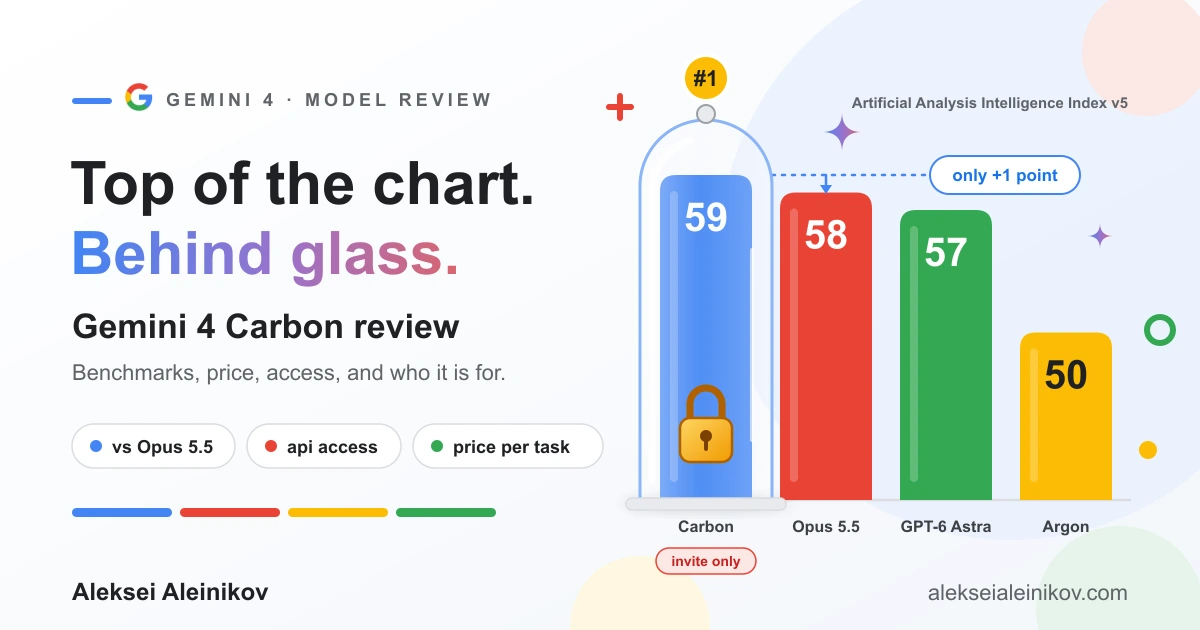
In one minute. Carbon is Google’s strongest model: #1 on the Artificial Analysis index (59), the most convincing results in security and long context, a 1M-token window and a price equal to Opus 5.5 at list. It is not publicly available, it does not win every benchmark, and some of its best numbers were measured by Google itself. If you need something today, use Gemini 4 Argon, Claude Opus 5.5 or GPT-6 Astra, and plan to re-test Carbon when it opens.
Who Is Gemini 4 Carbon For?
Start here, because it decides whether the rest matters to you.
| You are | Carbon today | Use instead, now | Why |
|---|---|---|---|
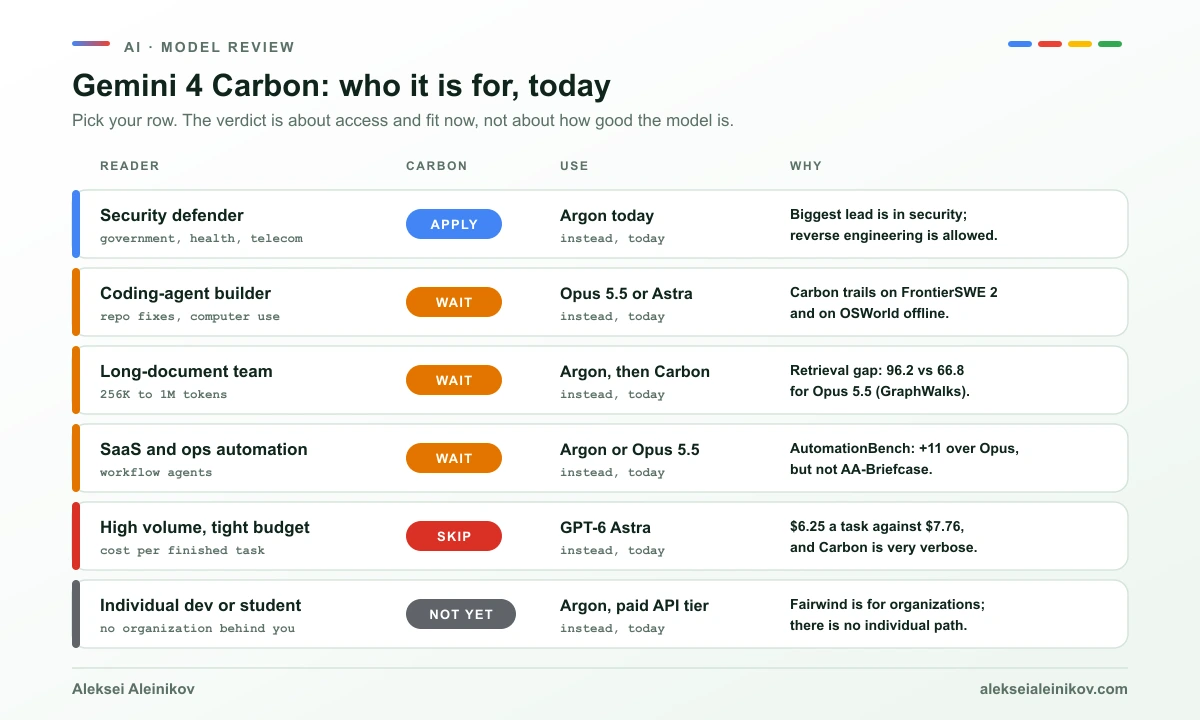
| A defender at a government, healthcare or telecom organization | Apply through your Google Cloud account team (Fairwind) | Gemini 4 Argon | Carbon’s biggest lead is in security benchmarks, and reverse engineering and malware analysis are permitted Fairwind tasks |
| A developer building coding agents | Wait | Claude Opus 5.5 or GPT-6 Astra | Carbon is close but behind on the real-repo and computer-use benchmarks (see the table below) |
| A team with very long documents (256K to 1M tokens) | Wait | Gemini 4 Argon | The largest gap in Google’s table is long-context retrieval (GraphWalks), and Argon already beats Astra and Opus there |
| A team automating SaaS and knowledge-work workflows | Wait | Argon or Opus 5.5 | Carbon leads the private-set AutomationBench by 11 points over Opus, but not AA-Briefcase |
| Someone running high volume on a tight budget | Skip | GPT-6 Astra | Astra has the lowest cost per task of the three, and Carbon is very verbose |
| An individual developer, student or hobbyist | Not possible | Argon on the paid Gemini API tier | No individual path exists |
What Gemini 4 Carbon Is
Google calls Carbon its “strongest model”, built for “sustained agentic workflows” and security work. The details that matter:
- Family. Gemini 4 Argon arrived on October 13 as the flagship. Carbon followed two weeks later as the next step, not a replacement.
- Inputs and outputs. Text, image, speech and video in, text out, with a 1M-token context window.
- Focus. Long-horizon agentic work (Google says it runs internally “for days” on long tasks) and cybersecurity defense: finding vulnerabilities, checking whether they are exploitable and writing the patch.
- Reasoning. Google’s numbers use the highest thinking setting through the Gemini API.
- Safety claims. New claims about prompt-injection resistance and fewer shortcuts such as cheating on benchmarks. More on those below.
Can You Use Gemini 4 Carbon Today? Access, Fairwind and the Waiting Room
This is the question under most of the discussion, and Google’s answer is a staged rollout.
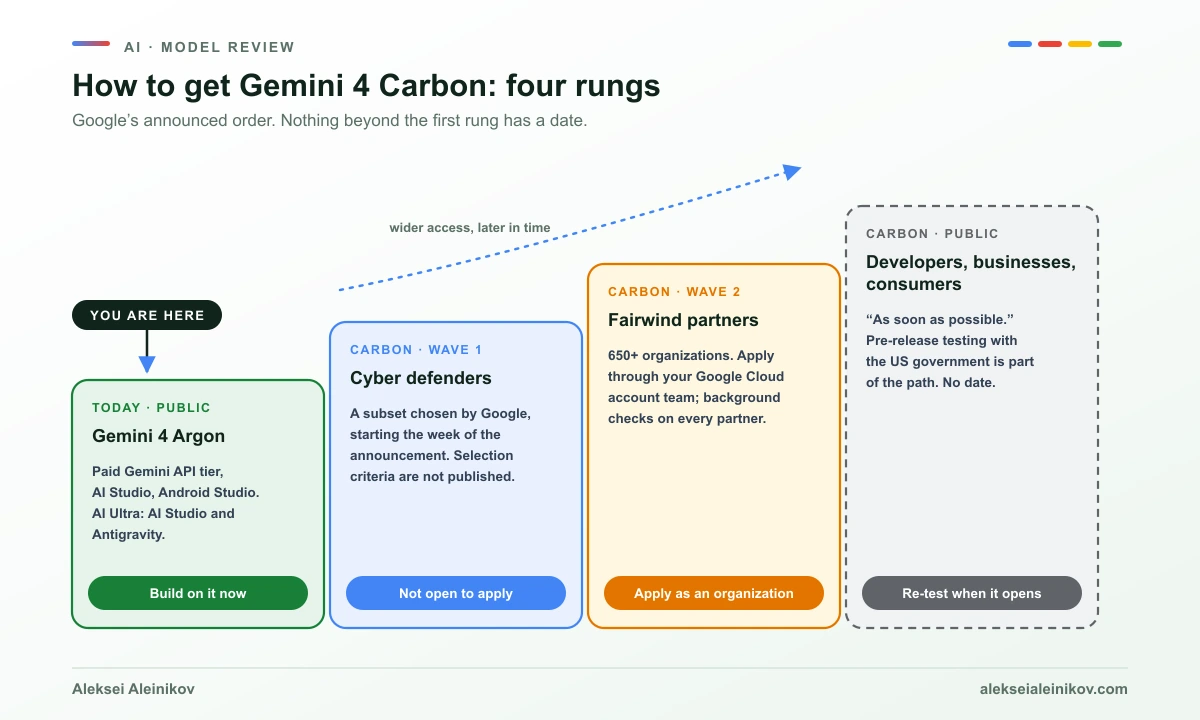
- Today, public: Gemini 4 Argon, via the paid tier of the Gemini API (Google AI Studio, Android Studio). Google AI Ultra subscribers can also use it in AI Studio and in Google Antigravity.
- Carbon, first wave: “a subset of cyber defenders”, starting the week of the announcement. Google does not say how this group was chosen.
- Carbon, second wave: “additional trusted partners” through the Fairwind Program.
- Carbon, public: developers, businesses and consumers “as soon as possible”, while Google collects feedback, iterates on guardrails and takes part in the US government’s voluntary pre-release testing process. No date.
What Fairwind is. A Google DeepMind program that gives high-priority defenders early access to advanced models. Google says it works with more than 650 partners globally, such as governments, healthcare providers and telecommunications services. To apply, you contact your Google Cloud account team. Google runs background checks on organizations, looking at security history and ethical record. Partners agree to specific terms: user-level authentication, phishing-resistant MFA, access limited to internal cybersecurity, incident response or penetration testing teams, tracked use, and no sharing or reselling. The permitted dual-use tasks include authorized threat simulation, reverse engineering and malware analysis for defensive and academic research. (If that last point interests you, Ghidra MCP vs REA looks at how agents do reverse engineering and where the legal lines are.)
Gemini 4 Carbon Benchmarks: Where It Wins and Where It Doesn’t
Here is Google’s own comparison table from its evaluation document, with the best score in each row in bold. Carbon wins 15 of 17 rows. It loses two.
| Area | Benchmark | Carbon | Argon | GPT-6 Astra | Opus 5.5 | Fable 5.1 |
|---|---|---|---|---|---|---|
| General | AA Intelligence Index v5 (with tools) | 59 | 50 | 57 | 58 | 49 |
| General | Vals Index v2.2 | 70.4% | 69.2% | 65.0% | 70.2% | n/a |
| Coding | SWE-sweep | 9.6% | 4.3% | 9.5% | 3.6% | 2.9% |
| Coding | FrontierSWE 2 | 61.2% | 55.0% | 65.5% | 62.3% | 56.3% |
| Coding | Terminal-Bench 4.0 (AA) | 65.2% | 57.1% | 59.1% | 59.6% | 52.0% |
| Computer use | Agents’ Last Exam v1.1 | 77.4% | 69.0% | 73.1% | 71.6% | n/a |
| Computer use | OSWorld 2.1, offline subset | 81.5% | 74.7% | 80.9% | 87.2% | 76.8% |
| Knowledge work | AutomationBench (Zapier, private set) | 53.9% | 51.3% | 41.4% | 42.5% | 31.4% |
| Knowledge work | Vending-Bench 2 (bank balance) | $16,484 | $13,718 | $15,515 | $9,235 | $5,422 |
| Multimodal | Chartography | 72.5% | 71.6% | 71.0% | 66.3% | 46.2% |
| Multimodal | Blueprint-Bench 2 | 58.6% | 54.4% | 49.7% | 51.2% | 41.9% |
| Long context | GraphWalks 256K to 1M (BFS, F1) | 96.2% | 84.2% | 71.8% | 66.8% | 65.0% |
| Science | RiemannBench | 80.0% | 76.0% | 72.0% | 69.6% | 65.6% |
| Science | Terminal-Bench-Science 0.1 (AA) | 64.8% | 52.9% | 63.3% | 59.0% | 43.3% |
| Security | CWE-bench | 71.0% | 68.0% | 68.0% | 67.0% | 58.0% |
| Security | ExploitGym | 54.8% | 42.0% | 42.4% | 34.5% | n/a |
| Security | SEC-bench Pro | 88.2% | 83.4% | 85.4% | n/a | n/a |
Source: Google DeepMind, “Gemini 4 Carbon model evaluation”, October 2026.
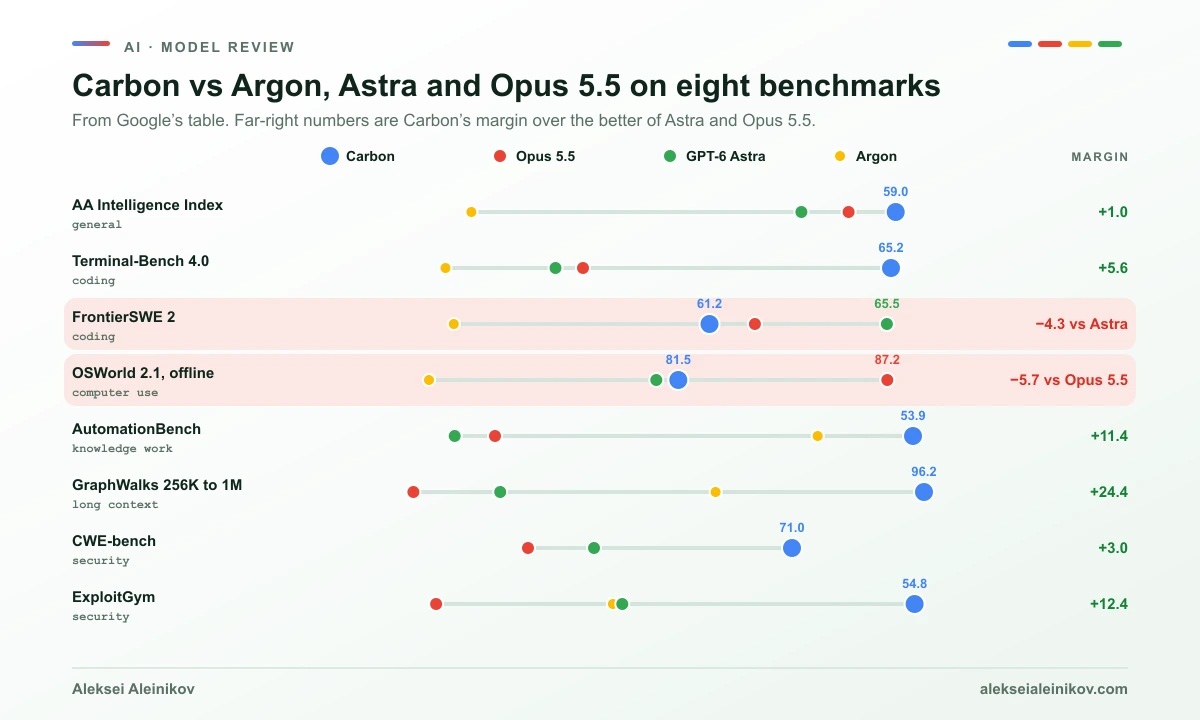
How big are the wins? Sort them by margin over the best competitor:
- Large: GraphWalks long-context retrieval (+12 points over Argon, +24 over Astra), ExploitGym (+12 over Astra), AutomationBench (+11 over Opus), Terminal-Bench 4.0 (+5.6 over Opus), Agents’ Last Exam (+4.3 over Astra).
- Small: CWE-bench (+3), Terminal-Bench-Science (+1.5 over Astra), Chartography (+0.9 over Argon).
- A tie for practical purposes: the AA Index (+1 over Opus), Vals Index (+0.2) and SWE-sweep (+0.1).
- Losses: FrontierSWE 2, where Carbon is third behind Astra and Opus, and OSWorld offline, where Opus 5.5 leads by almost six points.
The pattern is useful. Carbon is exceptional at needle-in-a-haystack work over huge inputs, at security tasks and at structured SaaS automation. On the two benchmarks closest to “agent that fixes issues in a real repo” and “agent that operates a computer”, it is not ahead.
How to Read Google’s Table: Who Ran Each Test
A number is only as comparable as the process that produced it. Google’s methodology notes spell this out, and they change how much weight each row deserves.
The general rules: Carbon and Argon results are run through the Gemini API at the highest thinking setting. Numbers for non-Gemini models come from the providers’ own reports at maximum reasoning where available, otherwise the best published reasoning result. So you are comparing runs Google controlled against runs it did not.
| Benchmark | Who produced Carbon’s number | Where the competitors’ numbers came from | How comparable |
|---|---|---|---|
| AA Index, Terminal-Bench 4.0, Terminal-Bench-Science | Artificial Analysis | Artificial Analysis | High: one independent evaluator |
| Vals Index | Vals AI | Vals AI | High |
| FrontierSWE 2, AutomationBench, Vending-Bench 2, Blueprint-Bench 2, Chartography, RiemannBench | Public leaderboards (Proximal, Zapier, Andon Labs, Surge) | Same leaderboards | High |
| CWE-bench | Collinear’s public leaderboard, run across all models | Same | High |
| GraphWalks 256K to 1M | Google, for all models | Medium: same harness, but Google-run | |
| SWE-sweep | Google, with the mini-swe-agent harness | Public SWE-sweep leaderboard | Low |
| Agents’ Last Exam v1.1 | Google, ALE-Claw harness, 5-hour window, safety filters on | Public leaderboard | Low |
| OSWorld 2.1 offline | Google, best of 3 runs on an 82-task offline subset | Published evaluations and system cards | Low |
| ExploitGym | Google, Antigravity harness, no internet, mitigations off, 6-hour and 10-hour timeouts | Competitors’ system cards and technical reports | Low |
| SEC-bench Pro | Google, 183-task JavaScript-engine split from May 2026, pass@1 averaged over 3 runs | Competitors’ system cards and technical reports | Low |
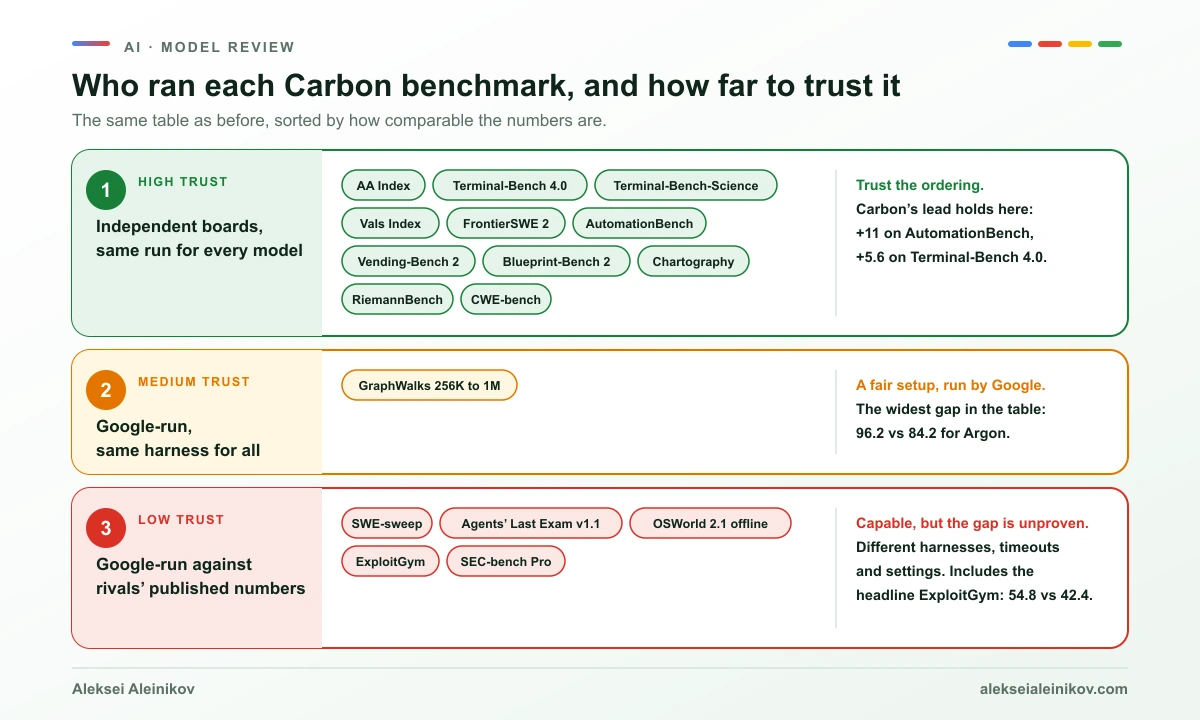
Two things follow.
1. Carbon’s lead survives in the high-comparability rows. AutomationBench on a private set (+11 over Opus), Terminal-Bench 4.0, Terminal-Bench-Science, the AA Index and CWE-bench are all measured by third parties across every model. That is the evidence that Carbon is genuinely strong.
2. The loudest security numbers sit in the low-comparability rows. ExploitGym (54.8% against 42.4% for Astra) and SEC-bench Pro are run by Google on its own harness, while the competitors’ figures come from system cards that used other harnesses, other timeouts and other settings. They show Carbon is capable. They do not prove the size of the gap. The only independently evaluated security benchmark in the table, CWE-bench, shows a gap of three points.
What Independent Tests Say
Artificial Analysis publishes the most useful outside view, and it is less dramatic than the headline.
- Intelligence Index v5: Carbon 59, Opus 5.5 58, GPT-6 Astra 57, Argon 50, Fable 5.1 49. Carbon has the top score on 4 of the 9 index evaluations: HLE-Diamond, Terminal-Bench-Science, AA-Omniscience and AutomationBench-AA. It is not leading in coding and knowledge work.
- Coding Agent Index: Carbon with Antigravity CLI scores 59. Claude Code with Opus 5.5 (max) scores 62. Carbon is second on Terminal-Bench 4.0 (64%) and on FrontierCode v1.1 (51%, behind Opus 5.5 at 56%). That is strong, but not a lead.
- Agentic knowledge work (AA-Briefcase): Carbon scores 1609 Elo, up 126 from Argon (1483), but still behind Grok 4.7 (1638), Muse Wonder (1659) and Kimi K3.1 Pro (1678).
- Knowledge and hallucination (AA-Omniscience v1.1): Carbon 54, ahead of Opus 5.5 (48) and Argon (46). Accuracy rose to 58%, 10 points above Argon. The hallucination rate went from 4% (Argon) to 11%, which is still far below the 50% Artificial Analysis reports for both Opus 5.5 and GPT-6 Astra.
- Speed and verbosity: about 85 output tokens per second, a little above the 81 average. But it produced 200M output tokens to run the index, against a median of 71M, which Artificial Analysis calls very verbose. Per task, it used 123K output tokens, 29% fewer than Opus 5.5 (173K).
Gemini 4 Carbon Pricing and Cost per Task
List price and the price you pay per finished job are different things, and for reasoning models the second one is what matters.
| Gemini 4 Carbon | Claude Opus 5.5 | GPT-6 Astra | |
|---|---|---|---|
| Standard price per 1M tokens (input / output) | $4 / $20 | $4 / $20 | $10 / $50 |
| Launch price | $2 / $10 (same as Argon) | none | none |
| Cached input | 95% off | n/a | n/a |
| Cost per Intelligence Index task | $7.76 | $10.04 | $6.25 |
| Output tokens per task | 123K | 173K | n/a |
| Context window | 1M | n/a | n/a |
Prices for Opus 5.5 and Astra are their standard list prices as reported in our earlier model comparisons; cost per task is Artificial Analysis’s measurement at maximum reasoning.
Read it like this:
- Carbon costs 23% less per task than Opus 5.5 at the same list price, because it spends fewer output tokens.
- It costs about 1.2 times as much as GPT-6 Astra, whose list price is two and a half times higher but which still comes out cheaper per task.
- At the launch price of $2 and $10, the same workload would cost roughly half. Artificial Analysis notes the discount has no confirmed end date, so do not budget around it.
- For 1,000 comparable tasks, that is about $7,760 for Carbon, $10,040 for Opus 5.5 and $6,250 for Astra at standard prices.
The Security Claims, Checked Against Their Sources
Google’s launch post leads with cybersecurity, and it is the part least discussed elsewhere. Here is each claim with its source and its limit.
| Claim | What backs it | The limit |
|---|---|---|
| 88.2% on SEC-bench Pro | Google’s own run on 183 JavaScript-engine tasks | Competitor numbers come from system cards, not the same harness. Opus 5.5 has no number |
| 54.8% on ExploitGym vs 42.4% for Astra | Google’s own run, no internet, mitigations off | Mitigations are switched off and timeouts are 6 and 10 hours. Competitor numbers come from other harnesses, so it is not an apples-to-apples comparison |
| 71.0% on CWE-bench vs 68.0% | Collinear’s public leaderboard, run across models | The only independent security row, and the gap is 3 points |
| 0.0% attack success on Gray Swan’s indirect prompt-injection benchmark (Argon: 0.7%) | Google’s launch post | A benchmark result is not immunity. See the lethal trifecta for why design beats model claims |
| “Cheating” on Terminal-Bench 4.0 reduced to 0.0%, attempts to 0.4% | Google’s internal measurement | Vendor-reported |
| Chrome team saw more than 10x better patches than another lab’s model; Wiz sees Carbon leading web pentest benchmarks | Google quoting partners | No data published |
The honest summary: Carbon is probably very good at security work, and the one independent number agrees. But “state of the art by a wide margin” is currently Google’s statement about Google-run tests.
Carbon vs Opus 5.5 vs GPT-6 Astra: Which to Pick
Decide by what you do, not by who is first on a leaderboard.
- You build or operate coding agents: Claude Opus 5.5. It is the strongest coding agent on Artificial Analysis’s Coding Agent Index (62), leads OSWorld offline, and you can use it today. GPT-6 Astra if you work on large real-repo tasks (it leads FrontierSWE 2) or care about cost per task.
- You process huge documents or codebases in a single prompt: Gemini 4 Argon now, Carbon later. The GraphWalks results suggest the Gemini 4 family handles very long inputs better than the others, and Carbon is far ahead of even Argon.
- You automate SaaS and back-office workflows: Carbon’s AutomationBench lead is real and independently measured, but AA-Briefcase shows others ahead. Wait and test on your own workflows.
- You do security research or defense: apply to Fairwind through your organization, and in the meantime test Argon or Opus 5.5 on your own vulnerabilities.
- You are cost-driven: GPT-6 Astra has the lowest cost per task of the three in Artificial Analysis’s data.
For how the Claude and OpenAI tiers compare among themselves, see GPT-6.1 Sol vs Claude Opus 5.5 and Claude Sonnet 5.5 vs Opus 5.5. If you run Gemini on Google Cloud, what Gemini 4 Argon means for platform teams covers routing and migration.
What the Community Is Saying
The Carbon announcement drew more than a thousand points on Hacker News, and a separate thread on the Artificial Analysis result added several hundred more. Across roughly a thousand comments, the main topics were:
- Access and limits (about one in five comments): a model that tops a leaderboard before anyone can use it. People point to Argon’s limits on the Pro plan, where a handful of messages can trigger a multi-hour cooldown.
- Comparisons with Claude and Opus (about one in six), usually praising Opus 5.5 as the working coding agent.
- Price and trust in benchmarks: complaints that an unreleased model tops the index, and that the launch coincided with an earnings call.
- Hallucination. Several users reported Argon making things up. Google’s own claim for Carbon is that unsupported claims fell by about half.
What is nearly absent from the discussion: the security results Google leads with (about 2% of comments), prompt-injection claims (a single comment) and availability in Europe (under 1%). Those are the topics this review tries to cover.
What to Test the Day You Get Access
When Carbon opens, ignore the leaderboard and run your own small evaluation:
- Your 20 hardest real tasks, with tools. Measure pass rate and cost per solved task, not price per token.
- A long-context test on your own material. Put 500K tokens of your own documents in a prompt and ask multi-hop questions, not just needle lookups.
- A hallucination test. 100 questions with known answers, including questions that have no answer, and count the invented ones.
- A prompt-injection test. Put hostile instructions in tool outputs, web pages and documents your agent reads, and see if it obeys.
- Verbosity. Log output tokens per task. Carbon’s 200M-token index run is a warning to check before you commit to a budget.
- A fallback. Keep the model name in configuration and keep a second model wired in, so switching costs one line.
The Bottom Line
Gemini 4 Carbon is a real step forward, and it is a step you cannot take yet. It is first on Artificial Analysis by a point, convincingly ahead on long context and SaaS automation, probably the best model for defensive security work, and still behind Opus 5.5 and GPT-6 Astra on two of the benchmarks closest to day-to-day engineering. The strongest numbers come with Google’s name on the test.
If you are choosing a model this week: build on Gemini 4 Argon, Claude Opus 5.5 or GPT-6 Astra, keep your model name configurable, and put “re-test Carbon” on the calendar for the day Google opens it to developers. If you work for an organization that defends critical infrastructure, ask your Google Cloud account team about Fairwind now.
For the practical side of Google’s models, Gemini 4 Argon for platform teams shows how to route by task and migrate one rule at a time.
Sources
- Google: Gemini 4 Carbon announcement, model evaluation methodology, Fairwind Program, Gemini 4 Argon for developers
- Artificial Analysis: Carbon is the new number one, model page
- Community discussion: Hacker News threads on the Carbon announcement and on Artificial Analysis’s index result
From the community
Discussion on Mastodon & Bluesky
Replies to this article from the open web, pulled in live. No ads, no tracking scripts.
Reply there — it shows up here automatically.