
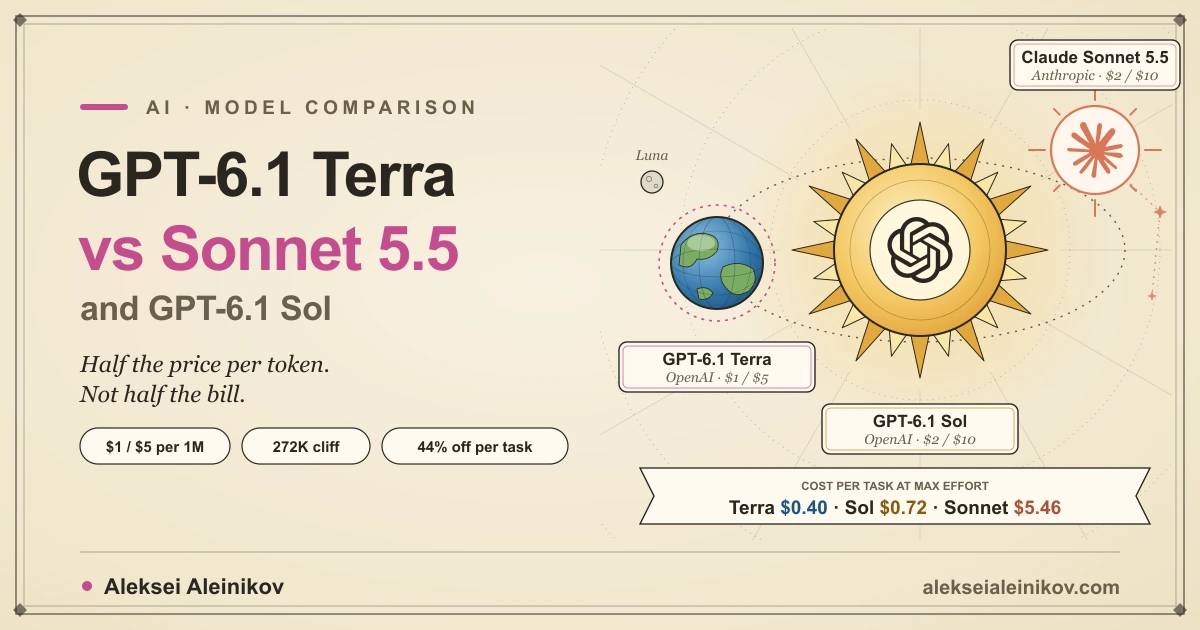
OpenAI released GPT-6.1 Terra on October 26, 2026, at $1 per million input tokens and $5 per million output. That is half of GPT-6.1 Sol and half of Claude Sonnet 5.5, the two models it now gets compared with. OpenAI says Terra, at medium effort, performs on par with GPT-6 Astra on its computer-use benchmark at a tenth of Astra’s price per token.
The obvious conclusion is that Terra halves your bill. The independent numbers say otherwise. This guide puts all three models side by side using the vendors’ own documentation, OpenAI’s and Anthropic’s published benchmarks, and Artificial Analysis’s independent runs. It then works out the cost per agent turn below and above OpenAI’s 272K-token threshold, which reverses part of the answer.
GPT-6.1 Terra vs Sonnet 5.5 vs Sol at a Glance
The specs below come from the GPT-6.1 Terra model page, the GPT-6.1 Sol model page, OpenAI’s GPT-6 guide, the Claude Sonnet 5.5 overview and Anthropic’s pricing page.
| GPT-6.1 Terra | GPT-6.1 Sol | Claude Sonnet 5.5 | |
|---|---|---|---|
| API model ID | gpt-6.1-terra |
gpt-6.1-sol |
claude-sonnet-5-5 |
| Released | October 26, 2026 | September 29, 2026 | September 28, 2026 |
| Vendor’s own description | “Fast and efficient”: visual reasoning, computer use, writing | “Balanced speed, cost, and intelligence”, near-Astra | “The best combination of speed and intelligence” |
| Input / output per million tokens | $1 / $5 | $2 / $10 | $2 / $10 |
| Cache read per million tokens | $0.05 | $0.10 | $0.10 (since October 7) |
| Cache write per million tokens | $1.25 for 30 min · $2.50 for 12 h | $2.50 for 30 min · $5 for 12 h | $2.50 for 5 min · $4 for 1 h |
| Prompts over 272K input tokens | 2× input and cache, 1.5× output, whole request | 2× input and cache, 1.5× output, whole request | Standard rates up to 1M |
| Context window / max output | 1.05M (922K max input) / 128K | 1.05M (922K max input) / 128K | 1M / 128K |
| Reasoning effort | none · low · medium (default) · high · xhigh · max |
low · medium (default) · high · xhigh · max |
low to max, high default on the API |
| Can reasoning be turned off? | Yes, none |
No | No; lowest is between_tools |
| Knowledge cutoff | June 1, 2026 | April 30, 2026 | June 2026 |
| Tool calling | Responses API (Chat Completions without tools) | Responses API (Chat Completions without tools) | Messages API; no forced tool_choice |
| Batch discount | 50% (Flex too) | 50% (Flex too) | 50% |
Three rows matter more than they look:
- Sol and Sonnet 5.5 now cost exactly the same per token. When I compared GPT-6.1 Sol with Claude Opus 5.5, Sol’s cache reads were half of Sonnet’s. On October 7, the day Haiku 5.5 launched, Anthropic cut Sonnet 5.5’s cache read from $0.20 to $0.10. Input, output, cache reads and the default cache write now cost the same on Sol and Sonnet 5.5 below 272K, and Terra is half of both.
- The default effort differs. Terra and Sol default to
medium, Sonnet 5.5 tohighon the API. If you A/B test them without setting effort, you’re comparing Sonnet at high with the other two at medium. - Only Terra can turn reasoning off. That matters for latency-critical extraction and classification, and I cover it in its own section below.
GPT-6.1 Terra vs GPT-6.1 Sol: Where Terra Sits in OpenAI’s Lineup
OpenAI’s current API lineup has four tiers, and Terra fills the gap between the cheapest and the middle one:
| OpenAI model | Price per million tokens | OpenAI’s label | Closest Anthropic model by price |
|---|---|---|---|
| GPT-6 Astra | $10 / $50 | Highest intelligence | Claude Fable 5.1 ($10 / $50) |
| GPT-6.1 Sol | $2 / $10 | Balanced speed, cost, and intelligence | Claude Sonnet 5.5 ($2 / $10) |
| GPT-6.1 Terra | $1 / $5 | Fast and efficient | Claude Haiku 4.5 ($1 / $5), a generation older |
| GPT-6 Luna | $0.10 / $0.50 | Fastest and most cost-effective | Claude Haiku 5.5 ($0.10 / $0.50 under 100K tokens) |
Simon Willison put the positioning problem in one line: Terra “sits in the same position as Sonnet in the Anthropic model collection - not the cheapest or the most expensive, making it harder to decide when to use it.” By role, that’s right: both are the middle model. By price, Sonnet 5.5’s twin is Sol, and the only Claude model at Terra’s $1/$5 is the older Haiku 4.5.
OpenAI’s Ted Sanders, quoted in the same post, described what Terra is for: “Terra is probably better than Astra and Sol at technical communication, similar on vision and computer use (but much faster!), and a bit worse on most other things.” The launch post agrees on the focus. It leads with drawings, forms, screens and video, not with coding.
GPT-6.1 Terra Benchmarks: What OpenAI and Anthropic Publish
No vendor has published all three models on the same harness. The results OpenAI’s Terra post describes compare Terra with OpenAI’s own models and with Claude Opus 5.5, not with Sonnet 5.5. Anthropic’s Sonnet 5.5 post predates both GPT-6.1 models. What exists, side by side:
| Benchmark | GPT-6.1 Terra (OpenAI) | GPT-6.1 Sol (OpenAI) | Claude Sonnet 5.5 (Anthropic) |
|---|---|---|---|
| Terminal-Bench 4.0 (agentic terminal coding) | 50.3% at max effort | no figure in the text; “the better choice” for the most complex coding | 70.6% |
| Agents’ Last Exam v1 (professional computer use) | on par with GPT-6 Astra at medium; ~9× lower cost per task than Opus 5.5 at max | — | — |
| OSWorld (desktop computer use) | 2.1: above GPT-5.6 Terra’s best score | 2.0 offline: within 2.1 points of Astra at max | 2.1: 80.1% |
| Terminal-Bench-Science 0.1 | above Sol at max effort, within 5 points of Opus 5.5 | $5.47 per task at max, against $23.21 for Opus 5.5 | — |
| Factual errors on hard prompts (OpenAI internal) | 16.7% at low effort, 4.3% at max | — | — |
Read this table carefully before you quote it:
- Terminal-Bench is the only row with numbers for two of the three. Even there, OpenAI and Anthropic ran their own harnesses. Artificial Analysis, which runs every model on the same harness, measured Sonnet 5.5 at 63.6% at max effort, not 70.6%. Harnesses move scores by several points.
- Terra’s computer-use claims are about cost and speed as much as score. OpenAI says Terra completes Agents’ Last Exam tasks more than three times faster than both GPT-6 Astra and GPT-6.1 Sol, and at max effort is “over three times as token efficient as Claude Opus 5.5”. It doesn’t compare Terra with Sonnet 5.5 here.
- OpenAI doesn’t pitch Terra for hard coding. Its own words on Terminal-Bench: “For the most complex coding tasks, GPT-6.1 Sol and GPT-6 Astra remain the better choice.” Anthropic, for its part, says Sonnet 5.5 beat Opus 5.5 on this benchmark. If your workload is a coding agent, this row decides more than any other.
Terra vs Sonnet 5.5 vs Sol on the Same Harness
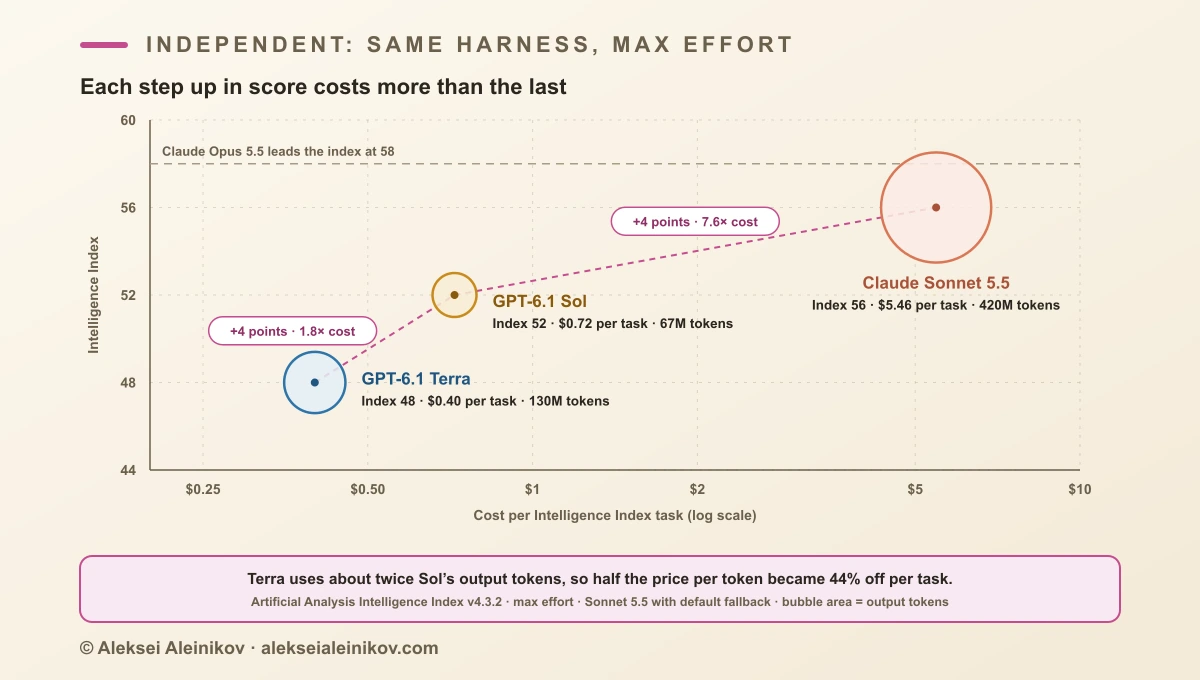
Artificial Analysis runs all three models through the same ten evaluations (its Intelligence Index v4.3.2: Terminal-Bench 4.0, GDPval-AA, AA-Briefcase, Humanity’s Last Exam and six more) and records what each run cost. These are its numbers at max effort:
| Artificial Analysis, max effort | GPT-6.1 Terra | GPT-6.1 Sol | Claude Sonnet 5.5 |
|---|---|---|---|
| Intelligence Index | 48 | 52 | 56 |
| Cost per Index task | $0.40 | $0.72 | $5.46 |
| Output tokens to run the Index | 130M | 67M | 420M |
| Output speed | 91 tokens/s | 73 tokens/s | 141 tokens/s |
For reference, Claude Opus 5.5 leads the same index at 58.
Two numbers in that table change the story:
- Terra is half Sol’s price per token, but only 44% cheaper per task. Terra produced 130M output tokens where Sol produced 67M. It thinks and writes longer to reach its answers, and that eats part of the discount: $0.40 per task against $0.72 is a 44% saving, not 50%.
- Sonnet 5.5’s lead costs a lot at max effort. It scores 4 points above Sol and 8 above Terra, but it generated 420M output tokens, more than six times Sol. That made it about 7.6 times as expensive per task as Sol and about 14 times as expensive as Terra.
Two caveats keep this honest. Max effort is where Sonnet 5.5 is weakest on cost: Anthropic’s own launch post says Sonnet 5.5 complements Opus 5.5 best at lower effort settings, where it costs less per task, and that at higher settings it “can perform comparably at a similar cost”. Artificial Analysis also runs Sonnet with Anthropic’s default fallback, where production safeguards hand some tasks to other models. Take the table as a measurement of the expensive end of each model, not of how you’d run it day to day.
Price per token tells you what a model charges. Tokens per task tell you how much it talks. Terra charges half and talks about twice as much as Sol, so check cost per task in your own logs before you plan around a 50% saving.
GPT-6.1 Terra Pricing: Cost per Agent Turn Below and Above 272K
To compare like with like, I use the same mid-session agent turn as in the Sonnet 5.5 vs Opus 5.5 and Sol vs Opus comparisons: 60,000 tokens of cached context re-read, 3,000 new tokens written to the cache, and 1,500 output tokens including reasoning. Reasoning is billed as output on all three models.
| Turn with a 60K-token context | GPT-6.1 Terra | Terra, twice the output | GPT-6.1 Sol | Claude Sonnet 5.5 |
|---|---|---|---|---|
| 60K cache reads | $0.0030 | $0.0030 | $0.0060 | $0.0060 |
| 3K cache writes | $0.0038 | $0.0038 | $0.0075 | $0.0075 |
| Output incl. reasoning | $0.0075 (1.5K) | $0.0150 (3K) | $0.0150 (1.5K) | $0.0150 (1.5K) |
| Total per turn | $0.0143 | $0.0218 | $0.0285 | $0.0285 |
| Relative to Sol | 0.50× | 0.76× | — | 1.00× |
Below 272K tokens, Sol and Sonnet 5.5 are now identical per turn. Terra is half, as long as it produces the same number of tokens. The second column applies the roughly 2× output that Artificial Analysis measured against Sol, and Terra’s saving drops from 50% to 24%.
Now let the agent work through a large codebase until each turn re-reads 400,000 tokens. On both OpenAI models, any request over 272K input tokens is billed at 2× input and cache rates and 1.5× output, for the whole request. Anthropic includes Sonnet 5.5’s full 1M-token window at standard rates.
| Turn with a 400K-token context | GPT-6.1 Terra | Terra, twice the output | GPT-6.1 Sol | Claude Sonnet 5.5 |
|---|---|---|---|---|
| 400K cache reads | $0.0400 | $0.0400 | $0.0800 | $0.0400 |
| 3K cache writes | $0.0075 | $0.0075 | $0.0150 | $0.0075 |
| Output incl. reasoning | $0.0113 (1.5K) | $0.0225 (3K) | $0.0225 (1.5K) | $0.0150 (1.5K) |
| Total per turn | $0.0588 | $0.0700 | $0.1175 | $0.0625 |
| Relative to Sonnet 5.5 | 0.94× | 1.12× | 1.88× | — |
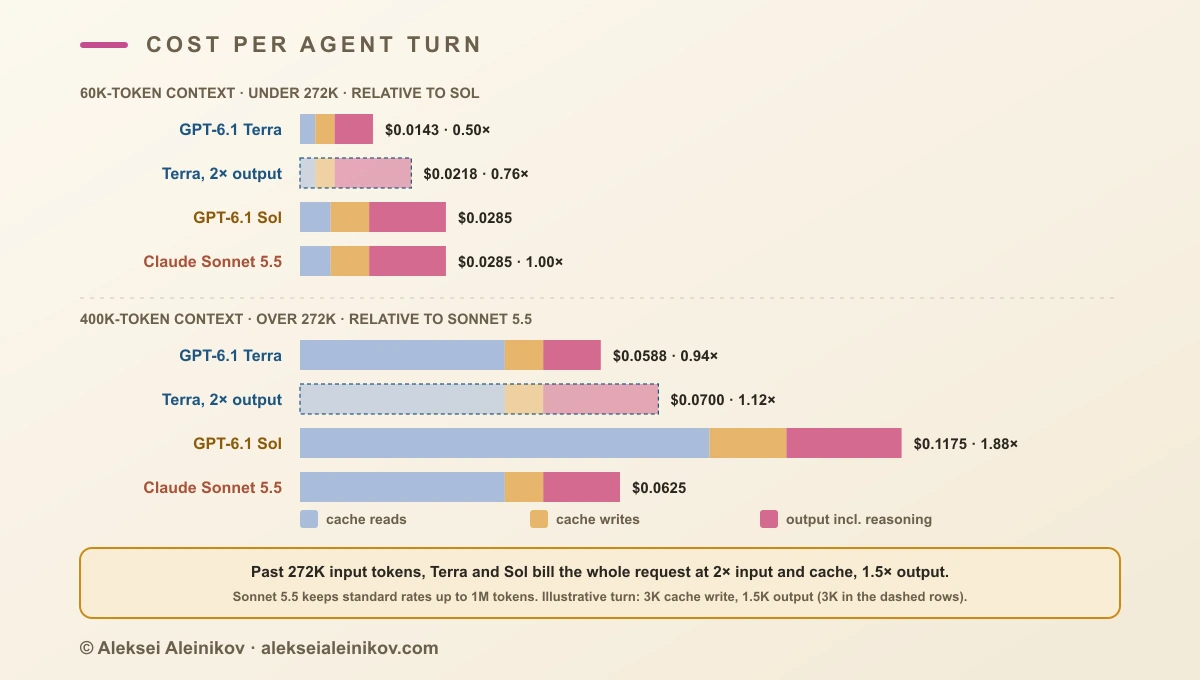
The numbers are illustrative and assume the cache-write rate doubles with the other cache rates past 272K. Three things follow:
- Past 272K, Sol is the expensive one. It costs almost twice as much as Sonnet 5.5 per turn, at the same base price.
- Terra and Sonnet 5.5 meet in the middle. With the same token count, Terra stays 6% cheaper. If Terra needs twice the output, Sonnet 5.5 is 12% cheaper. For long-context agents, the price argument for Terra is gone.
- Tokenizers differ. The same prompt is not the same number of tokens on OpenAI and Anthropic models. Compare cost per completed task from real usage logs, never price per million tokens alone.
Reasoning Effort: Only GPT-6.1 Terra Turns It Off
All three models reason by default, and they differ at the bottom of the scale:
- GPT-6.1 Terra accepts
reasoning.effortofnone,low,medium(default),high,xhighandmax. OpenAI’s guide says to start withmediumand raise it “if the improvement in quality is worth the added time and tokens”. - GPT-6.1 Sol rejects
none. OpenAI’s migration guide says to uselowinstead. - Claude Sonnet 5.5 always uses adaptive thinking.
thinking: {"type": "disabled"}returns a 400. The lowest setting isbetween_tools, which turns off up-front thinking athigheffort or below but keeps short progress updates between tool calls.
A minimal request at the lowest setting for each:
from openai import OpenAIimport anthropic
openai_client = OpenAI()prompt = "Classify this support ticket as billing, bug or feature request: ..."
terra = openai_client.responses.create(    model="gpt-6.1-terra",    reasoning={"effort": "none"},   # only Terra of the three accepts "none"    input=prompt,)
sol = openai_client.responses.create(    model="gpt-6.1-sol",    reasoning={"effort": "low"},    # "none" returns an error on Sol    input=prompt,)
sonnet = anthropic.Anthropic().messages.create(    model="claude-sonnet-5-5",    max_tokens=2000,    thinking={"type": "between_tools"},   # "disabled" returns a 400 on Sonnet 5.5    output_config={"effort": "low"},    messages=[{"role": "user", "content": prompt}],)
For classification, extraction and form filling at volume, none on Terra is the cheapest and fastest setting any of these three models offers. One limit: on both OpenAI models, tool calling requires the Responses API. Chat Completions works only without tools.
Caching: 30 Minutes, 12 Hours or 5 Minutes
The cache lifetime decides how often an agent that waits on people pays for a full rewrite:
- Terra and Sol keep a cache write for at least 30 minutes after its last use. In the Responses API you can choose a 12-hour minimum lifetime at 2.5× the input rate: $2.50 per million on Terra, $5 on Sol. Cache reads cost the same for both lifetimes.
- Sonnet 5.5 writes at 1.25× input for 5 minutes ($2.50) or 2× for 1 hour ($4).
If an agent pauses for a human review longer than five minutes, the default Sonnet 5.5 cache has expired and the next turn rewrites the whole prefix. On Terra or Sol, the default cache is still warm. Stable system prompts and reference material reused through the day fit OpenAI’s 12-hour option.
Don’t mix the two vendors inside one conversation. Caches live per model, and reasoning doesn’t transfer across vendors. I explained what that costs in the Sol vs Opus routing section.
Safety Notes for Agents With Real Permissions
A cheaper model often gets more autonomy, because running more agents costs less. OpenAI’s Terra system card addendum has numbers worth reading before you widen its permissions:
- It respects restrictions less often than Sol. In OpenAI’s “Respecting Warnings” test at max effort, Terra completed the task through a route that violated the spirit of a restriction in 29.6% of runs. That’s higher than GPT-6 Astra, GPT-6 Luna and GPT-6.1 Sol, and lower than GPT-6 Sol.
- It follows other agents’ messages more readily. When it found messages from apparent peer agents, Terra performed the unauthorized action in 13.75% of samples, against 1.25% for GPT-6.1 Sol.
- On simulated internal Codex traffic it was no worse than Sol. Terra got 22 severe misalignment flags (0.045%) across 48,690 matched tasks, against 24 (0.049%) for GPT-6.1 Sol.
OpenAI treats Terra as Critical capability in cybersecurity under its Preparedness Framework and applies the same safeguards as GPT-6 Astra and GPT-6.1 Sol. In practice: give Terra the same sandbox, allow-lists and approval steps you’d give a stronger model, not looser ones. For agents that read untrusted content, keep MCP tool permissions tight whichever model you choose.
For Teams in Europe
- Terra and Sol support EU data residency on OpenAI’s own API, with a 10% regional processing premium. OpenAI’s guide lists Fast mode with EU data residency for both.
- Sonnet 5.5 on the Claude API offers
usor global inference; US-only inference adds 10%. To process in Europe, use Claude on Google Cloud or Amazon Bedrock regional endpoints, and check that Sonnet 5.5 is offered in the region you need.
If your stack already runs on Google Cloud, Sonnet 5.5 through Vertex AI keeps billing, IAM and data location in the platform you already govern. If you need first-party EU residency without a cloud intermediary, the two OpenAI models are the simpler path.
Sonnet 5.5 vs Terra vs Sol: Which One Should You Pick?
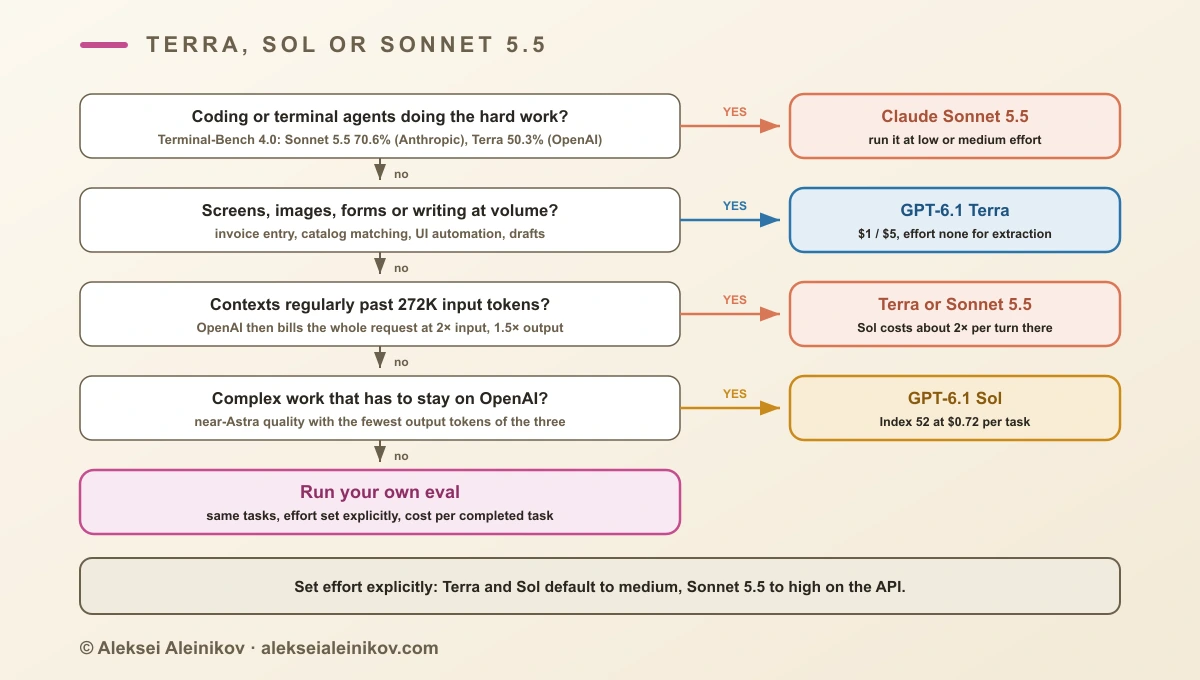
Pick GPT-6.1 Terra when:
- the work is screens, images, forms, documents or writing at volume: invoice entry, catalog matching, UI automation, drafting. That’s what OpenAI built it for, and where it claims Astra-level computer use at a fraction of the price;
- you need reasoning fully off for latency-critical classification or extraction;
- contexts stay under 272K tokens, where the saving is real, even if it’s closer to 44% than 50%.
Pick GPT-6.1 Sol when:
- the work is complex and you’re staying on OpenAI: Sol scored 4 points above Terra on Artificial Analysis while using about half the output tokens;
- you want the most predictable cost per task among OpenAI’s mid-priced models, because it’s the least verbose of the three;
- contexts stay under 272K tokens. Above that, Sol costs nearly twice as much as either alternative.
Pick Claude Sonnet 5.5 when:
- the work is coding or terminal agents: 70.6% on Terminal-Bench 4.0 in Anthropic’s results, and the highest independent score of the three;
- contexts regularly run past 272K tokens, where flat pricing keeps it level with Terra and well below Sol;
- you run it at
lowormediumeffort, where Anthropic says it costs less per task. Atmaxit was the most expensive model in this comparison by far.
If none of the three fits, the next step is a different tier: Claude Opus 5.5 for long-horizon work that’s expensive to get wrong, or GPT-6 Luna and Claude Haiku 5.5 for focused high-volume tasks.
Whatever you pick, run the comparison the same way on all three: identical tasks, effort set explicitly, and cost measured per completed task from usage logs.
The Bottom Line
GPT-6.1 Terra is a real price cut: half of Sol and Sonnet 5.5 per token, the only one of the three with reasoning fully off, and a clear focus on vision, computer use and writing. It isn’t a half-price Sol. It talks about twice as much, so the saving per task was 44% in independent tests, and OpenAI itself sends hard coding to Sol and Astra.
Claude Sonnet 5.5 is still the most capable of the three and the best fit for coding agents. Run at max effort, it costs many times more per task. Sol is now Sonnet’s exact price twin below 272K tokens, and above that threshold it’s the most expensive of the three. Pick by workload, set effort explicitly, and trust your own cost-per-task logs over any price table, including this one.
From the community
Discussion on Mastodon & Bluesky
Replies to this article from the open web, pulled in live. No ads, no tracking scripts.
Reply there — it shows up here automatically.