
A coding agent opens a repository, reads a test failure, edits a file and tries again. The final answer might be five lines. The conversation behind it can be an expanding warehouse of source code, logs and abandoned plans. Every new turn brings that warehouse back to the model.
DeepSeek V4.1 Flash is interesting because of what happens to that warehouse. Its underlying architecture spends less computation reading input and shares compressed attention memory across layers. Understanding those changes is more useful than collecting another leaderboard screenshot: they explain where cheap agents become possible, and where the bill can still escape.
What changed in the latest update?
The release suffix 1017 identifies a particular update, rather than a new architecture version. DeepSeek describes it as an update to V4.1 Flash and reports improvements in agent tasks, coding and vision. Its weights and repository carry the MIT license. The architectural explanation here concerns the base V4.1 Flash design, not a newly documented 1017 architecture. DeepSeek’s release card.
Keep three questions separate when reading a release:
| Question | Evidence that answers it |
|---|---|
| What can be deployed? | License, weights, supported input and serving documentation |
| Why might serving it be efficient? | Architecture and memory accounting |
| Does it solve your work economically? | Accepted results, latency and total spend on your own tasks |
The third answer does not follow automatically from the first two. A warehouse can be cheaper to operate while its workers still take too many trips through it.
Why agent histories make memory expensive
Language-model serving has two useful phases. Prefill processes the supplied context. Decode generates the continuation, one step after another. The KV cache retains attention keys and values for earlier tokens so later steps can use them without rebuilding all their representations from scratch.
Think of weights as the machinery installed in a factory and KV state as the work currently spread across its benches. Adding another customer does not require a second copy of every machine, but it does require room for that customer’s work. Long conversations and concurrent users put pressure on those benches.
A Mixture-of-Experts adds a different kind of selectivity: routing chooses which expert networks process a token. Sparse activation can reduce computation without making all the stored machinery disappear. Consequently, “active parameters” is not a download size or a complete hardware requirement. For the serving side of that distinction, see vLLM vs Ollama.
The architecture: read once, share more
The base model has 552B backbone parameters, with 8B active during prefill and 16B during decode. Its Causal Encoder-Decoder splits 40 layers into two groups of 20. Decoder global KV is projected from the encoder’s final states. CSA2 shares KV and indexing work across layers; FP4 reduces the precision of main KV storage. Base model documentation.
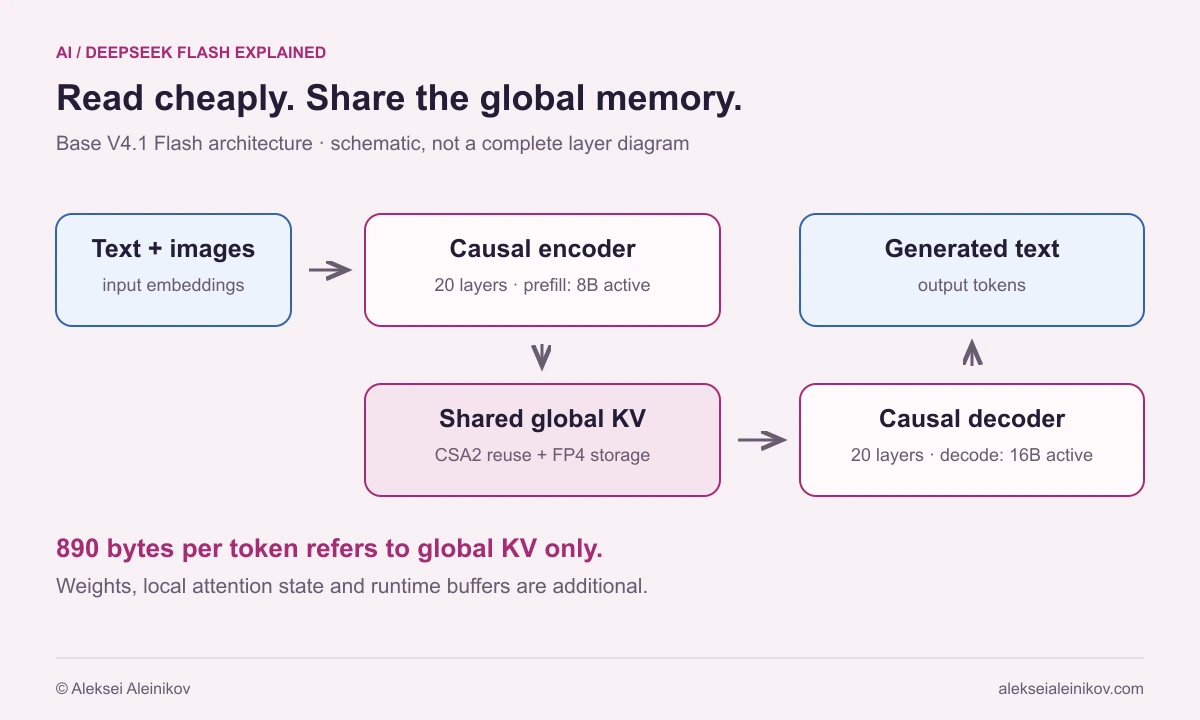
There are three distinct savings in this picture:
- Cheaper ingestion. Reading a large request need not activate the same amount of computation as generating its answer.
- Less duplication. Layers can reuse information instead of each retaining a separate global representation.
- Smaller stored values. Lower precision reduces the bytes needed for those representations.
The distinctions matter. Reusing memory is not the same as dropping half the prompt, and lower numerical precision is not a guarantee of unchanged answer quality. Efficiency has to survive the task you actually need solved.
The technical report gives 890 bytes per token for global KV, approximately a quarter of V4 Flash. Separately, SWA Bounded Replay reconstructs recent sliding-window state and reduces persistent KV storage to roughly one eighth of that predecessor. Those figures describe different memory components. DeepSeek technical report.
Here is the useful arithmetic: at 1,000,000 tokens, 890 bytes per token is 890,000,000 bytes: 890 MB, about 849 MiB. That is one reported component. It excludes weights, local attention state, temporary buffers and other runtime allocations. Concurrent independent histories add their own state unless the serving system can share an identical prefix.
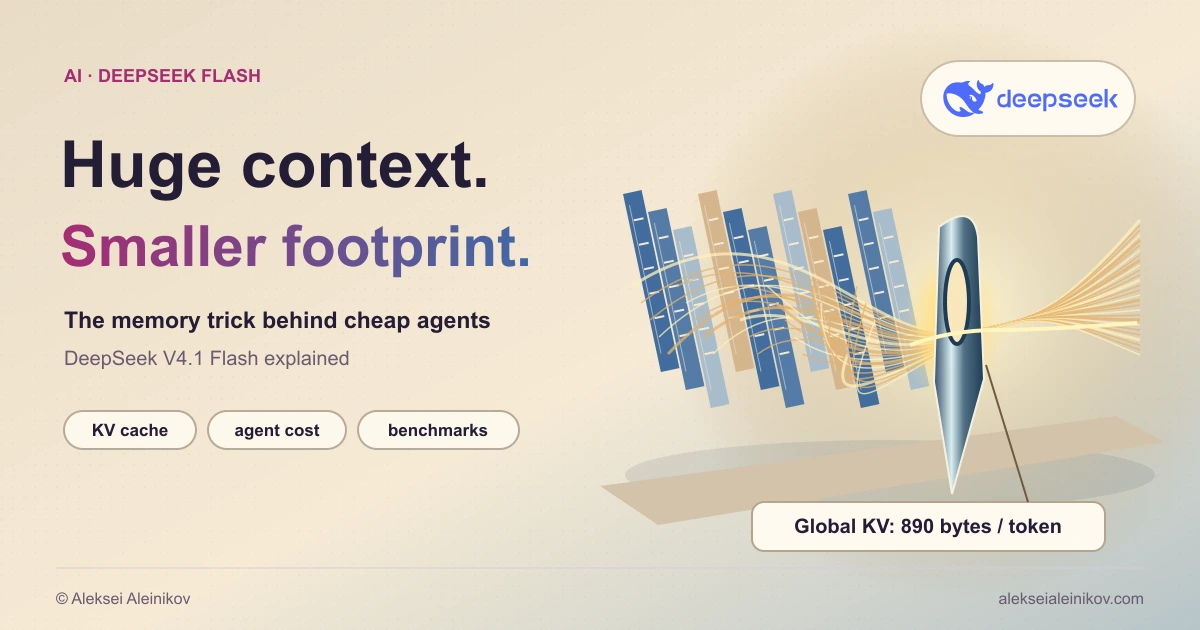
That is why the metaphor on the cover is a compressed archive passing through a needle. It is a picture of one bottleneck being narrowed, not a claim that a huge model has become a tiny executable.
A smaller memory footprint can make long conversations cheaper to serve. It cannot tell you whether the model used the right evidence inside that conversation.
What the benchmark gains actually establish
A compact view of DeepSeek’s release table:
| Benchmark | Base V4.1 Flash | 1017 | Change, percentage points |
|---|---|---|---|
| Terminal-Bench 4.0 | 31.2 | 42.3 | +11.1 |
| DeepSWE v1.1 | 74.2 | 77.0 | +2.8 |
| ProgramBench | 20.3 | 29.1 | +8.8 |
These are publisher-reported scores. DeepSeek identifies Claude Code as the Terminal-Bench harness and Mini-SWE-V2 for DeepSWE. Release table and harness notes.
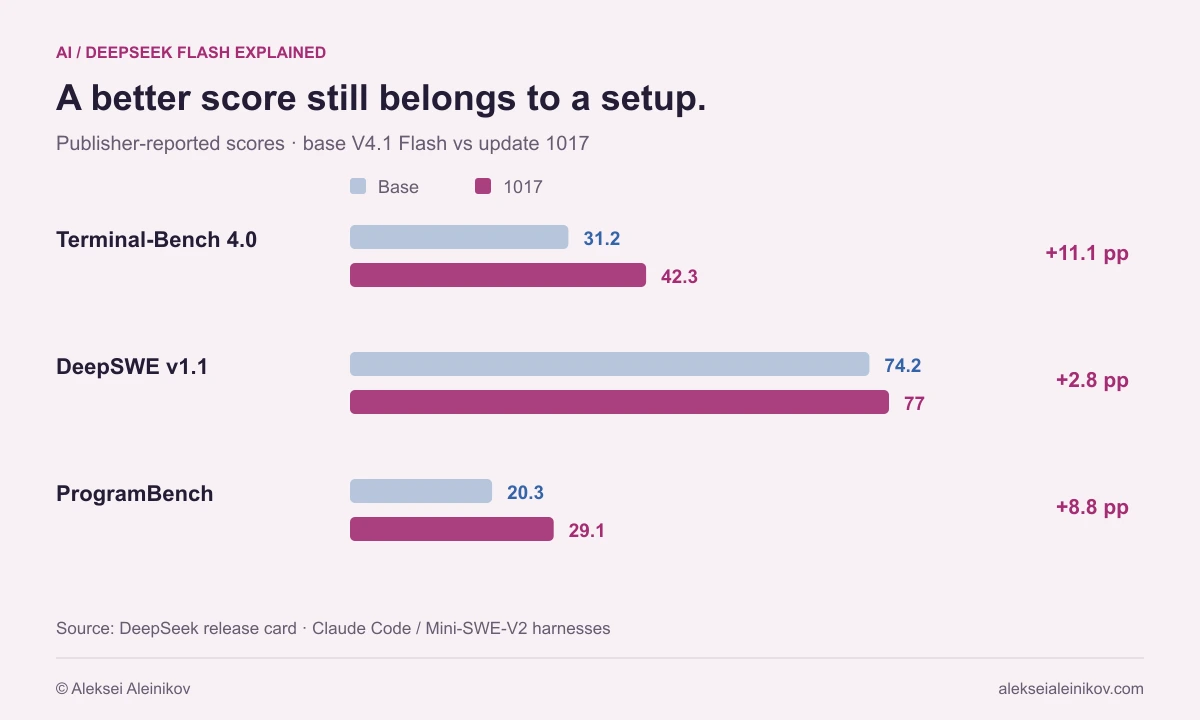
Notice the unit: 42.3 minus 31.2 is 11.1 percentage points. Calling that an “11.1% improvement” would describe a different calculation.
An agent harness is the environment around the model: tool definitions, prompts, context management, stopping rules and recovery behavior. A capable model with a poor harness can waste turns. An effective harness can turn the same model into a better problem solver. A score belongs to that combination.
Use the table to choose what to investigate. For a terminal agent, reproduce the kinds of failures your workflow produces: an ambiguous test error, a command that hangs, a missing dependency, an edit that passes one test but breaks another. A broad score does not tell you which of these remains expensive.
Pricing: the cache discount and the output trap
The official hosted API supports a 1M-token context. Its pricing distinguishes peak and off-peak hours:
| Per million tokens | Peak | Off-peak |
|---|---|---|
| Input, cache miss | $0.30 | $0.15 |
| Input, cache hit | $0.006 | $0.003 |
| Output | $1.20 | $0.60 |
Peak hours are 01:00–04:00 and 06:00–10:00 UTC, Monday–Friday, excluding Chinese public holidays. Other hours are off-peak. These are DeepSeek’s rates; another host can bill differently. Official pricing.
A cache hit is 50 times cheaper than a miss at the same tariff. But a cache hit still has a price, and output can dominate a request with a heavily reused prefix.
Consider a hypothetical call with 100,000 input tokens and 10,000 billed output tokens. At peak rates:
Cold input:   0.100 × $0.30  = $0.0300Output:       0.010 × $1.20  = $0.0120Total:                        $0.0420
All input cached (idealized):Cached input: 0.100 × $0.006 = $0.0006Same output:                  $0.0120Total:                        $0.0126
That is about 3.3× cheaper overall, not 50×. The discount applies to input, and the output bill stayed put. Real turns introduce new tokens, so the fully cached case is an illustrative bound rather than a promised cache-hit rate.
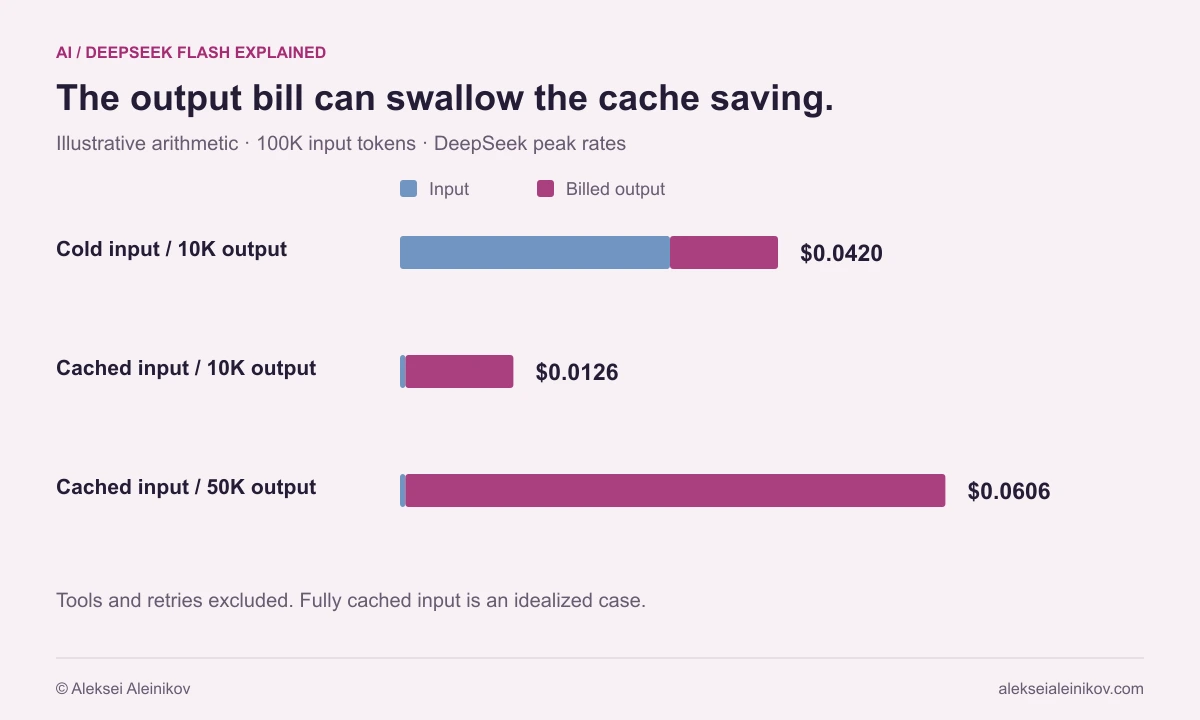
Increase output to 50,000 tokens and the ideal cached case becomes $0.0606. It now costs more than the original cold call. This is how inexpensive tokens can coexist with expensive work.
The operational metric is:
Cost per accepted result = (all model calls + tools + failed attempts) / accepted resultsDefine “accepted” before testing: a patch passes the required tests, a report cites the right passages, an extraction matches the expected schema and values. Otherwise you are measuring how cheaply the system produces something that looks finished. An AI gateway can help collect the per-call accounting needed for this comparison.
Call the right model, preserve the right state
The official API currently maps deepseek-flash to 1017. Record the alias and evaluation date; a stable name can later point to different weights. First-call documentation.
This minimal request follows DeepSeek’s documented Chat Completions format; it has not been executed for this article:
curl https://api.deepseek.com/chat/completions \ -H "Authorization: Bearer ${DEEPSEEK_API_KEY}" \ -H "Content-Type: application/json" \ -d '{ "model": "deepseek-flash", "messages": [{"role": "user", "content": "Explain this failing test."}], "thinking": {"type": "enabled"}, "reasoning_effort": "high", "max_tokens": 4096 }'There is a practical integration trap: requests carrying tools must preserve previous reasoning_content, including turns without a tool call. DeepSeek documents a 400 error when it is omitted. Without tools, previous reasoning is ignored. The hosted effort settings are low, high and max; do not assume the numeric effort controls in local model tooling are interchangeable with this API. Thinking-mode documentation.
A context window is capacity. Your harness still chooses which evidence deserves that capacity. Keeping every old log forever can bury the useful error under irrelevant history; context engineering addresses that selection problem.
How to decide whether it belongs in your agent
Build a small evaluation set from actual work and freeze the harness while comparing models. Include a straightforward success case, an underspecified request that should trigger a question, and a task that must stop rather than take an unauthorized action.
For each run, record accepted or rejected outcome, total tokens by billing category, wall-clock duration, tool failures and retries. Use the same acceptance criteria for every candidate. Then vary reasoning effort and context policy one at a time. This reveals whether a cheaper setting actually saves money or merely shifts spending into retries.
Treat open weights as a deployment option, not a hardware sizing estimate. Treat a benchmark gain as evidence for a specific setup, not permission to give an agent broader access. Keep action permissions explicit and validate results outside the model that generated them.
DeepSeek Flash’s most useful idea is architectural: reduce the cost of carrying yesterday’s work into the next turn. Whether that produces a cheap agent depends on what happens after the model has read it. Count completed work, and the attractive token price becomes a proposition you can test.
From the community
Discussion on Mastodon & Bluesky
Replies to this article from the open web, pulled in live. No ads, no tracking scripts.
Reply there — it shows up here automatically.