
Most Postgres versus MySQL comparisons are a feature checklist from 2015 with the dates changed. Both databases have added most of what the other used to have, so the checklist tells you almost nothing.
What still differs is deeper: how they store rows, how they handle concurrent versions of those rows, how they treat a connection, and what happens when a migration fails halfway. Those differences do not show up in a feature table, and they are the ones you live with.
PostgreSQL or MySQL: the 30-second answer
- Complex queries, analytics, JSON, geospatial, extensions? Postgres.
- Huge numbers of simple connections, key-based lookups, read replicas? MySQL.
- Team already fluent in one of them? That one. Seriously.
- Starting fresh with no constraint? Postgres, because the extension ecosystem gives you more escape hatches later.
- Single process, no network, no ops? Neither — that is SQLite.
PostgreSQL vs MySQL: key differences at a glance
| PostgreSQL | MySQL (InnoDB) | |
|---|---|---|
| Row storage | Heap; every index points into it | Clustered inside the primary key |
| Old row versions (MVCC) | In the table, reclaimed by VACUUM |
In undo logs |
| Connections | Process per connection; pooler needed at scale | Thread per connection; thousands are normal |
| Failed migration | Rolls back: transactional DDL | Half-applied: DDL commits implicitly |
RETURNING |
Yes | No (MariaDB has it) |
| Extensions | PostGIS, pgvector, TimescaleDB in the same database | No comparable mechanism |
| Replication | Streaming physical and logical | Binlog, long-mature tooling |
| Strongest at | Complex queries, analytics, JSON, geospatial, vectors | Primary-key lookups, many connections, read replicas |
Everything below is why.
What actually differs under the hood
Storage: clustered vs heap
This single choice explains most performance differences.
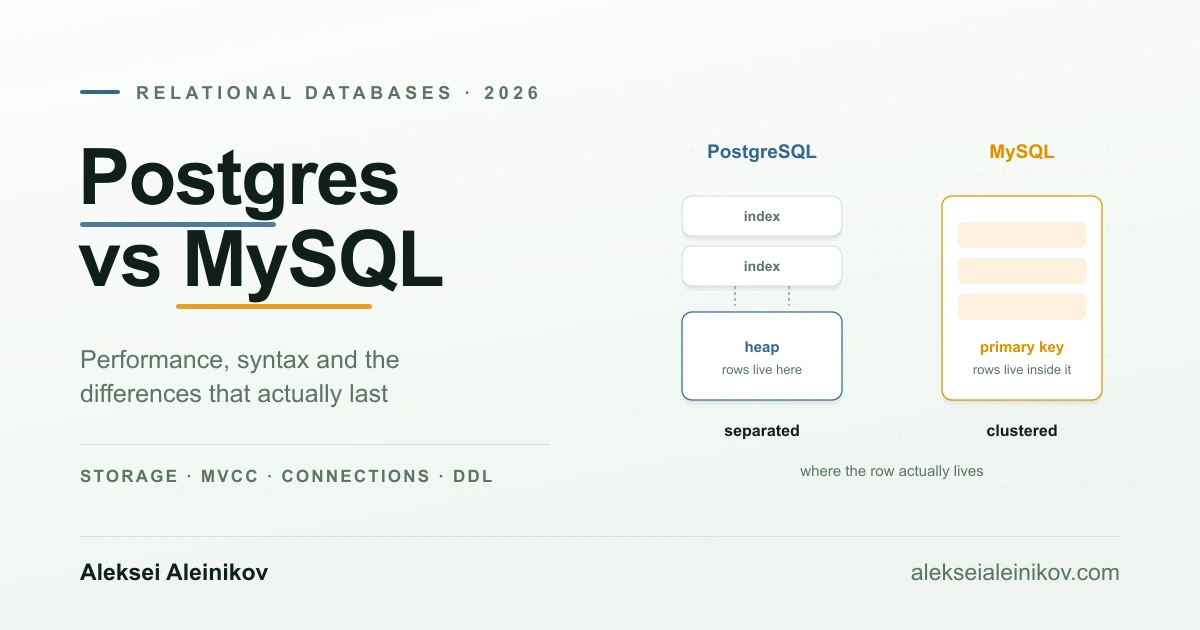
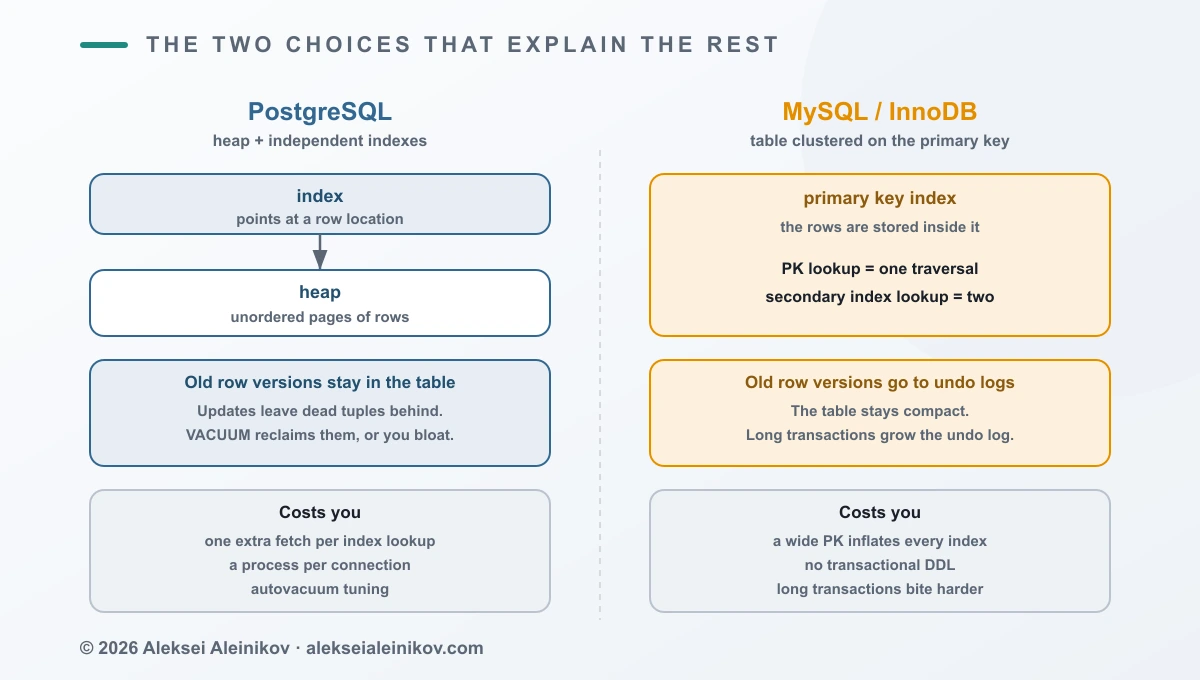
MySQL (InnoDB) clusters the table on the primary key. The row data physically lives inside the primary key index. Look up by primary key and you traverse one B-tree and you are holding the row.
The cost: secondary indexes store the primary key, not a row location. So a lookup via a secondary index traverses that index to find a primary key, then traverses the primary key index to find the row. Two traversals. It also means a wide primary key inflates every secondary index on the table.
Postgres stores rows in a heap — an unordered pile of pages — and every index, including the primary key, points into it. Every index lookup costs an extra fetch to reach the row.
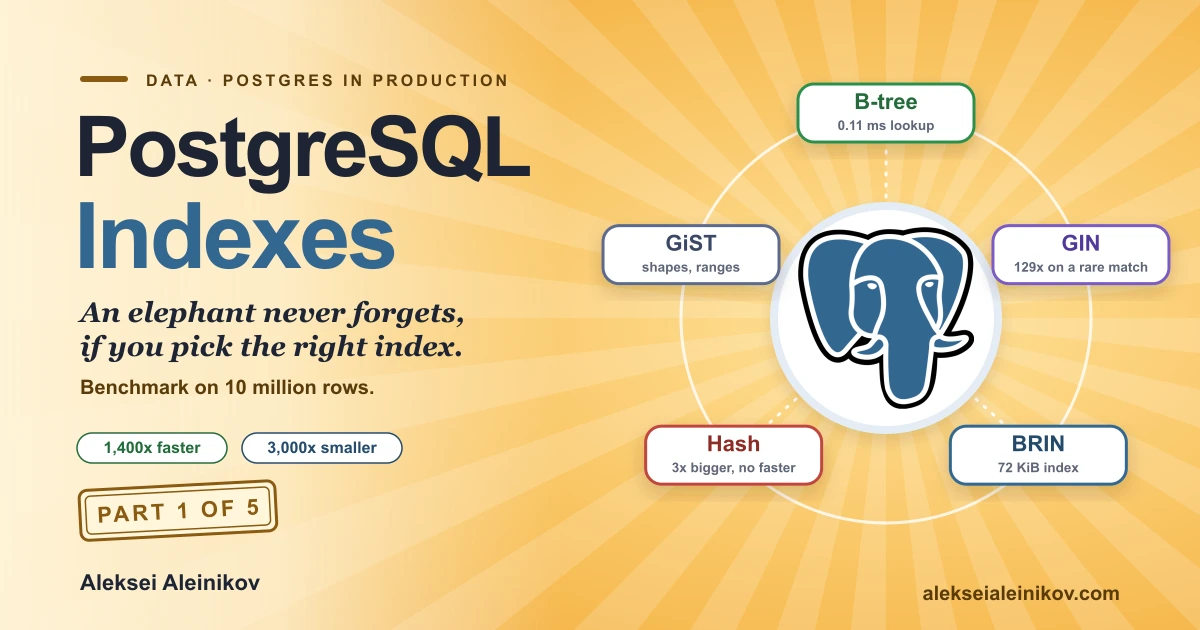
The benefit: all indexes are equal, so a wide primary key does not tax the others, and Postgres can use index-only scans when its visibility map says a page is fully visible. How much that helps, and what it costs in index size, is measured in PostgreSQL Indexes: Which Type to Use.
What this means in practice: MySQL is excellent at “give me the row with this ID”. Postgres is more even-handed when your access patterns are varied.
MVCC: where old row versions live
Both give you readers that never block writers. They pay for it differently.
Postgres writes a new version of the row into the table itself and leaves the old one behind until VACUUM reclaims it. Heavy-update tables therefore bloat, and autovacuum keeping up is a real operational concern rather than a theoretical one.
MySQL writes old versions into undo logs, so the table stays compact. The cost moves elsewhere: long-running transactions force the undo log to grow, and a reader on an old snapshot has to walk back through those versions.
Neither approach is free. Postgres makes you think about vacuum; MySQL makes you think about long transactions and undo growth.
Connections: process vs thread
Postgres forks a process per connection. A process is not cheap. A few hundred mostly-idle connections consume real memory, and you will want PgBouncer or an equivalent pooler in front of any serious deployment. Serverless platforms that open a connection per request make this acute.
MySQL uses a thread per connection, which is dramatically cheaper. Thousands of connections is an ordinary configuration.
If your architecture opens many short-lived connections and you cannot pool, that fact alone may pick your database.
Postgres vs MySQL performance
Nobody can honestly tell you which is faster, because they are fast at different shapes of work. Here is what each actually favours.
MySQL tends to win at:
- Primary-key point lookups — one traversal, row in hand
- Very high connection counts
- Simple, high-volume OLTP where the query plan is obvious
- Read-scaling via replicas, with a long-mature binlog replication story
Postgres tends to win at:
- Complex joins, subqueries and aggregations — a stronger planner
- Analytical queries alongside transactional ones
- Anything with partial, expression or covering indexes
- Write patterns that benefit from
HOTupdates avoiding index churn - JSON, arrays, geospatial and vector work, because of extensions
A word on benchmarks. Any number you read — including any I could publish — is one workload, one schema, one hardware profile and one configuration. Tuning moves results more than the engine choice does. If performance is genuinely your deciding factor, benchmark your queries on your data. Everything else is someone else’s workload.
If you are optimising rather than choosing, the techniques in SQL query optimisation apply to both engines.
Postgres vs MySQL syntax differences
This is the section that matters when you are porting something. These are the ones that actually break.
| What | Postgres | MySQL |
|---|---|---|
| String concatenation | 'a' || 'b' |
CONCAT('a','b') |
| Quote an identifier | "my table" |
`my table` |
| Auto-incrementing key | GENERATED ALWAYS AS IDENTITY |
AUTO_INCREMENT |
| Upsert | INSERT ... ON CONFLICT DO UPDATE |
INSERT ... ON DUPLICATE KEY UPDATE |
| Return the inserted row | INSERT ... RETURNING * |
not supported |
| Boolean | real BOOLEAN type |
alias for TINYINT(1) |
| String comparison | case-sensitive by default | case-insensitive in common collations |
| Limit with offset | LIMIT 10 OFFSET 20 |
LIMIT 10 OFFSET 20 or LIMIT 20, 10 |
| Current timestamp | NOW(), CURRENT_TIMESTAMP |
NOW(), CURRENT_TIMESTAMP |
| Arrays | native array types | not supported |
| Regex match | ~, ~* |
REGEXP, RLIKE |
Three of these cause most of the pain:
RETURNING. Postgres hands you back the row you just wrote in the same statement. MySQL does not support it, so you insert and then select, which is a second round trip and a race unless you are careful. MariaDB does support it.
-- Postgres: one statementINSERT INTO users (email) VALUES ('a@b.com')RETURNING id, created_at;Case sensitivity. In Postgres, WHERE email = 'Bob@x.com' will not match a stored bob@x.com. In MySQL with a typical collation, it will. Ports in either direction silently change behaviour, and the bug surfaces in production as “login sometimes doesn’t work”.
Unquoted identifier folding. Postgres lowercases unquoted identifiers, so CREATE TABLE MyTable produces mytable. Once you quote something as "MyTable", you must quote it forever. The usual advice — stick to lower_snake_case and never quote — is worth following in both.
Operations: the difference nobody mentions
Postgres has transactional DDL. You can wrap schema changes in a transaction and roll them back:
BEGIN;ALTER TABLE orders ADD COLUMN status text;-- something fails hereROLLBACK; -- the column never existedMySQL commits implicitly on DDL. A migration that fails on step four of six leaves you with three applied changes and no way back except a hand-written down migration.
If you deploy schema changes often, this is a bigger day-to-day quality-of-life difference than any query benchmark.
Two more operational notes:
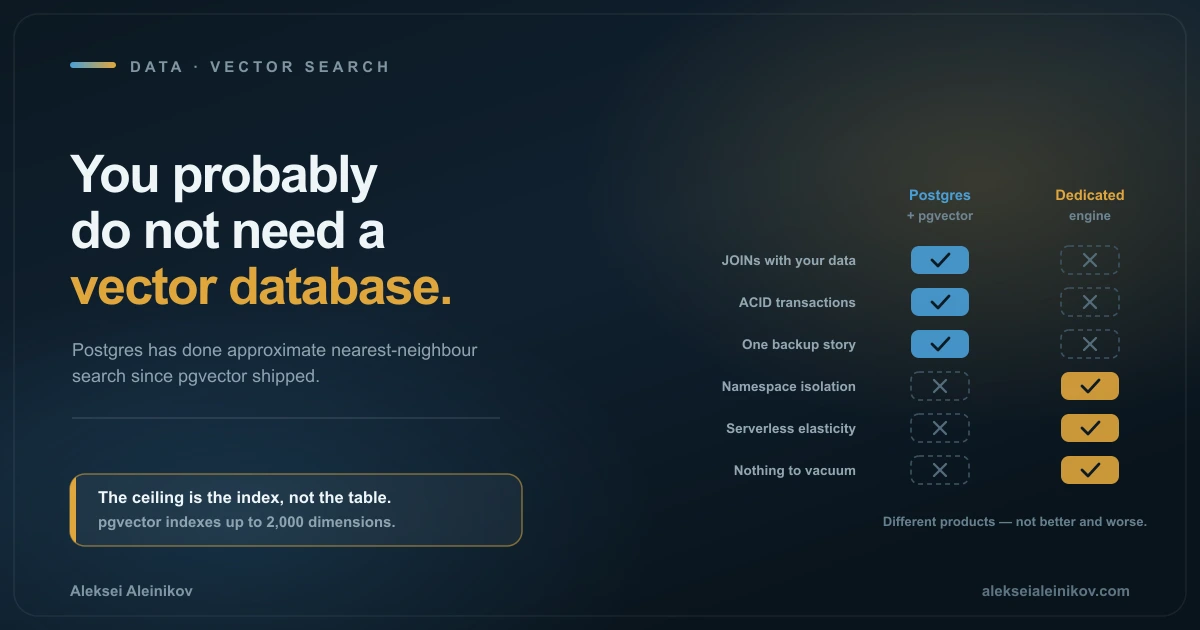
- Extensions. Postgres lets you add PostGIS for geospatial, pgvector for embeddings, TimescaleDB for time series — inside the same database, with the same backups and the same transactions. MySQL has no comparable mechanism. If you might need a vector database, this matters.
- Replication. MySQL’s binlog replication is old, well understood and has excellent tooling. Postgres has streaming physical replication and logical replication; both work well, and logical replication has improved substantially in recent releases.
Where SQLite fits
SQLite is frequently put in this comparison, and the framing is usually wrong.
SQLite is not a small server database. It is a library that runs inside your process. There is no server, no port, no user accounts and no network round trip — a function call reads a file.
That makes it excellent for:
- Application-local state, caches and config
- Test suites, where a database per test costs microseconds
- Edge and embedded deployments
- Read-heavy workloads served from a single machine
And unsuitable the moment you need several application servers writing concurrently. SQLite serialises writers: one at a time.
The honest rule: if exactly one process ever touches the data, SQLite is likely the right answer and the simplest one. If two might, you want a server.
MariaDB vs MySQL
MariaDB began as a MySQL fork after Oracle’s acquisition. Years later, “drop-in replacement” is no longer accurate.
They have diverged: separate optimiser development, different storage engines, and features on each side the other lacks. MariaDB has RETURNING; MySQL does not. Version numbers no longer correspond at all.
Drivers and basic dumps are largely interchangeable. Replication between them and any recent syntax are not.
Choose MariaDB for community governance and its specific feature set. Choose MySQL if you depend on Oracle’s ecosystem, a managed offering built on it, or its exact replication semantics.
Which versions to run
As of September 2026:
| Database | Current | Notes |
|---|---|---|
| PostgreSQL | 18 (18.6) | 19 in beta; 14 reaches EOL Nov 2026 |
| MySQL | 9.7 LTS (9.7.3) | 8.4 LTS supported to 2029; 8.0 hit EOL Apr 2026 |
| MariaDB | 12.3 LTS (12.3.3) | 11.8 and 11.4 LTS still supported |
Two things to act on: if you are on MySQL 8.0, it is out of support — plan the move to 8.4 or 9.7. If you are on Postgres 14, you have until November.
Postgres ships a major version yearly with five years of support. MySQL splits into quarterly Innovation releases and roughly biennial LTS releases; unless you need a specific new feature, run LTS.
The decision table
| Your situation | Pick |
|---|---|
| Complex queries, reporting alongside OLTP | Postgres |
| Geospatial, vectors, time series in one database | Postgres — extensions |
| Frequent schema migrations | Postgres — transactional DDL |
| Thousands of connections, no pooler possible | MySQL |
| Key-value style access by primary key | MySQL — clustered index |
| Heavy read scaling via replicas | MySQL — mature binlog tooling |
| One process owns the data, no network | SQLite |
| Want community governance over Oracle | MariaDB or Postgres |
| Team already deeply fluent in one | That one |
The bottom line
The feature gap that made this an interesting argument a decade ago has mostly closed. What is left is structural: clustered versus heap storage, old row versions in the table versus in undo logs, a process versus a thread per connection, and whether a failed migration can roll back.
Those four differences will shape your operational life far more than any feature checklist. Pick on those, and on which one your team can debug at 3am.
And if you find yourself deciding on a benchmark you did not run, you are choosing based on someone else’s workload.

From the community
Discussion on Mastodon & Bluesky
Replies to this article from the open web, pulled in live. No ads, no tracking scripts.
Reply there — it shows up here automatically.