
Few technical questions get asked more — or answered worse — than “should I use SQL or NoSQL?” It sounds like a clean either/or, and almost every answer treats it that way. Both instincts are wrong.
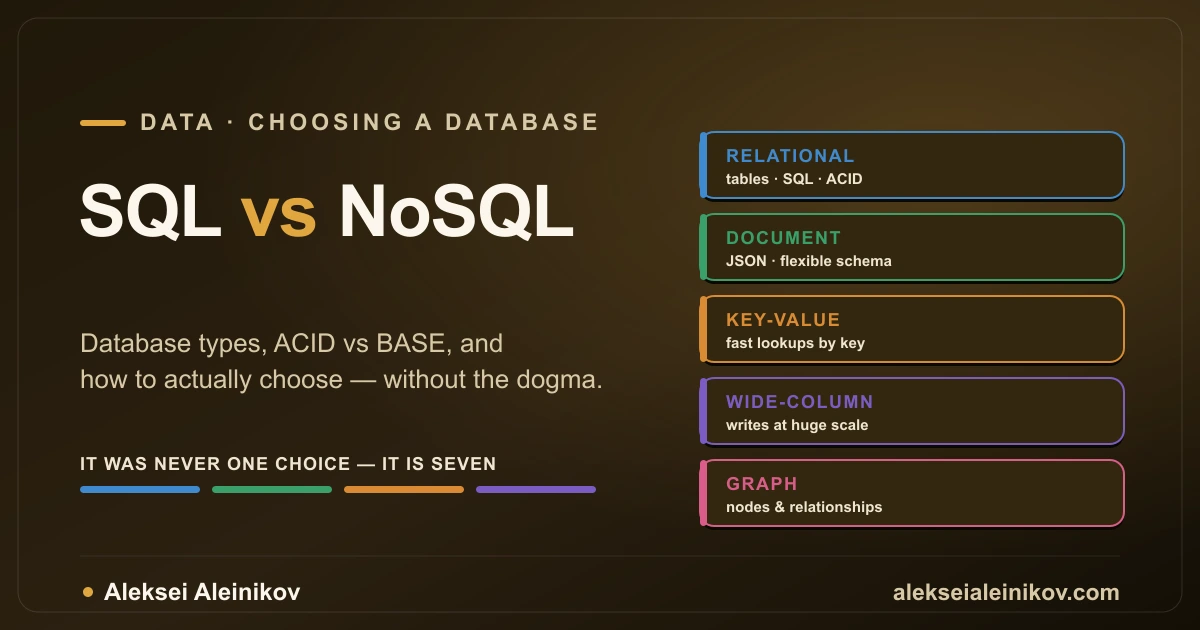
Here’s the honest version: “SQL vs NoSQL” is a false binary. SQL is a query language. NoSQL means “not only SQL” — an umbrella over half a dozen very different database models. Comparing them directly is like asking “sedan or not-a-sedan?” The real question is about data models and consistency guarantees, and once you see the landscape that way, choosing a database stops being a coin flip and becomes an engineering decision.
This guide lays out the database family tree, the ACID-versus-BASE trade that actually separates them, and a framework to choose by your access patterns instead of by fashion.
First, What “Relational” Actually Means
Strip away the branding. A relational database stores data in tables — rows and columns — where each table has a defined schema (which columns exist and what type each holds). Tables link to each other through keys, and you ask questions with SQL, a declarative language: you describe what you want, and the database figures out how to get it.
That model, invented in 1970 and refined for half a century, gives you three things that are easy to undervalue until you lose them:
- A schema that documents your data and rejects malformed writes.
- Transactions — the ability to change several things as one all-or-nothing unit.
- Ad-hoc queries — you can answer questions you never planned for, with joins, filters, and aggregation, without rewriting your storage.
PostgreSQL and MySQL are the popular examples. When people say “SQL database,” this is what they mean.
NoSQL is everything that deliberately steps away from part of this model — usually to gain flexibility, scale, or a shape that fits one access pattern extremely well.
The Database Family Tree
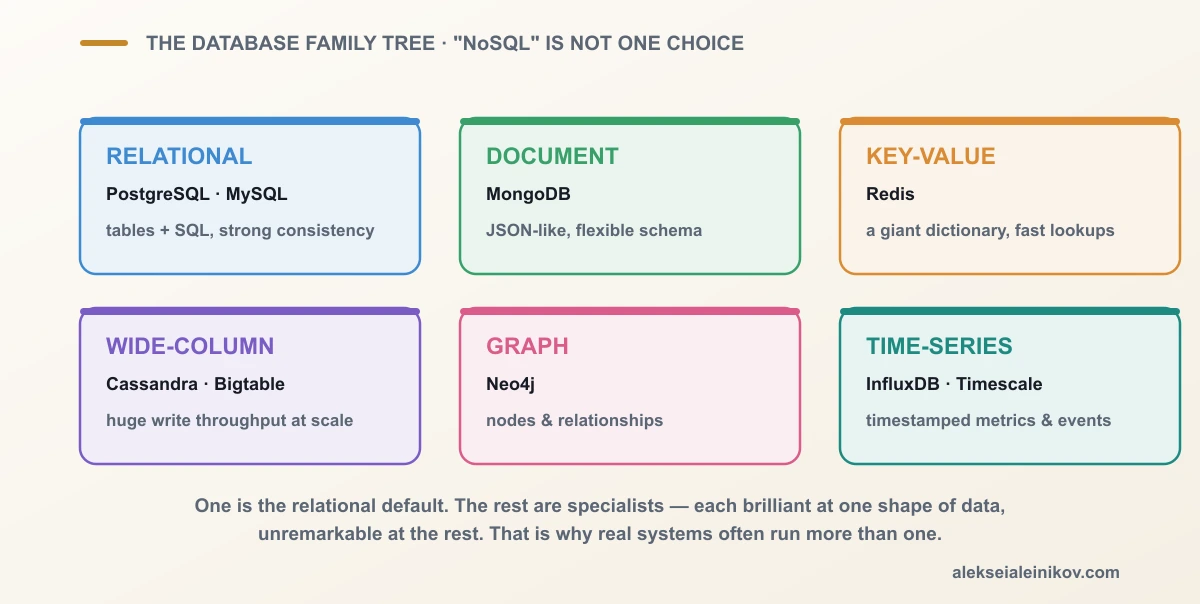
“NoSQL” hides enormous variety. Here are the families that matter, each with what it is and when it wins:
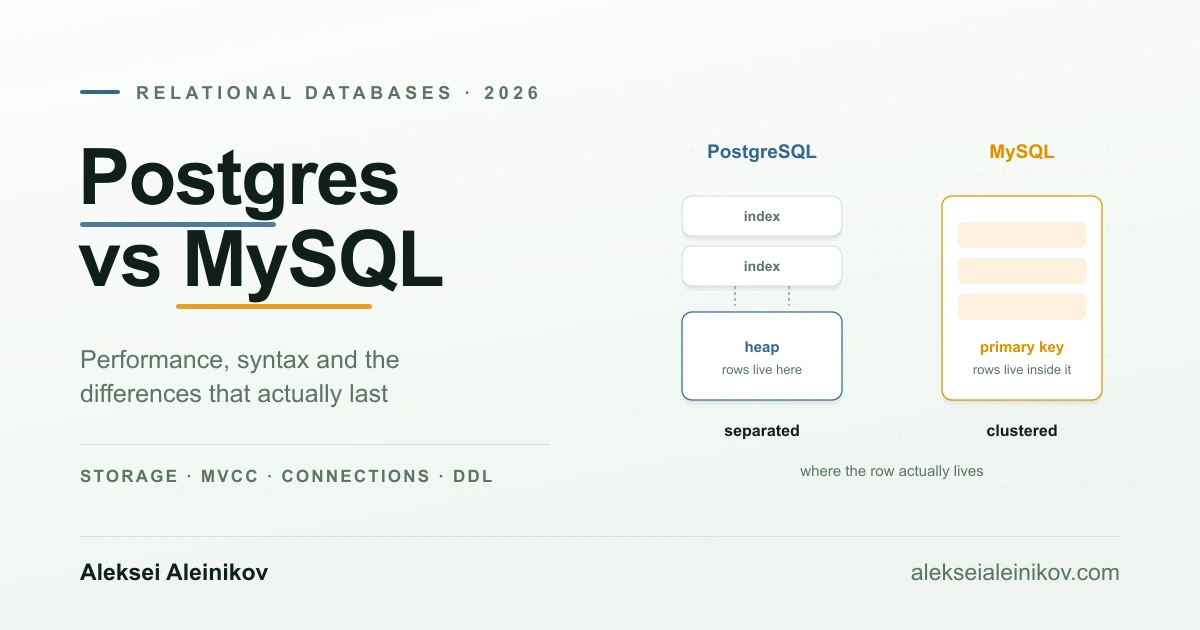
- Relational (PostgreSQL, MySQL) — tables, schema, SQL, strong consistency. The default for most applications.
- Document (MongoDB) — stores JSON-like documents. Flexible schema, data that’s naturally nested. Great when your records vary and evolve.
- Key-value (Redis) — a giant dictionary: a key maps to a value. Blazing-fast lookups by key, nothing else. Perfect for caching, sessions, rate limits.
- Wide-column (Cassandra, Bigtable) — enormous tables partitioned by key for massive write throughput and predictable queries at scale. Built for volume, not for joins.
- Graph (Neo4j) — nodes and the relationships between them. Wins when the connections are what you query: social graphs, fraud rings, recommendations.
- Time-series (InfluxDB, TimescaleDB) — optimised for timestamped data written in order and queried by range. Metrics, sensor readings, events.
- Search (Elasticsearch) — full-text search and relevance ranking, not exact lookups.
- Vector (pgvector, Pinecone) — similarity search over embeddings, the backbone of AI retrieval.
Two things fall out of this list immediately. First, “NoSQL” is not one choice — it’s seven. Second, several of these aren’t rivals to relational at all; they’re specialists you add alongside it.
The Axis That Actually Matters: ACID vs BASE
Data model is what you store. Consistency guarantee is how strongly the database promises your data is correct — and this is where the real dividing line runs.
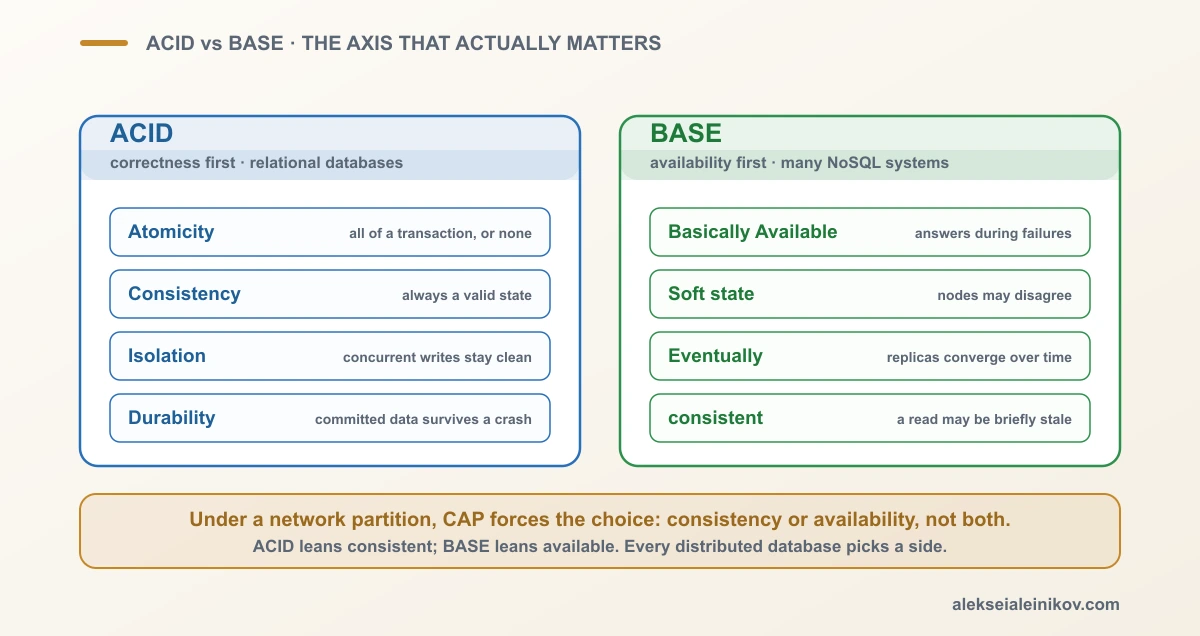
ACID — correctness first
Traditional relational databases give you ACID:
- Atomicity — a transaction happens fully or not at all. Transfer money between two accounts, and either both sides change or neither does.
- Consistency — the database moves from one valid state to another; constraints are never violated.
- Isolation — concurrent transactions don’t step on each other; the result is as if they ran one at a time.
- Durability — once committed, data survives a crash.
ACID is why banks, orders, and inventory live in relational databases. When “wrong” is expensive, these guarantees are worth their cost.
BASE — availability first
Many distributed NoSQL systems make the opposite trade, summarised as BASE:
- Basically Available — the system keeps answering, even during failures.
- Soft state — data may be in flux; nodes don’t have to agree at every instant.
- Eventually consistent — after a write, different replicas may briefly disagree, then converge to the same value.
BASE is what lets a database span hundreds of machines and stay up when some of them don’t. The price is that a read right after a write might return slightly stale data. For a social feed or a product catalogue, that’s fine. For a bank balance, it isn’t.
CAP: the reason you must choose
Underneath sits the CAP theorem: when a network partition splits your nodes, a distributed database can guarantee consistency (every read sees the latest write) or availability (every request gets an answer) — but not both. Every distributed system picks a side, and that pick surfaces directly in how your application behaves under stress.
This is the single most important idea for choosing a database, and it deserves its own treatment — I go deep on it in what the CAP theorem really means for choosing a database. ACID and BASE are, in large part, two answers to the question CAP forces.
So What Does “SQL vs NoSQL” Really Trade?
Now the comparison means something. Line up the relational default against the NoSQL alternatives and the real trade-offs appear:
| Dimension | Relational (SQL) | NoSQL (varies by type) |
|---|---|---|
| Schema | Fixed, enforced, self-documenting | Flexible or schema-less |
| Consistency | Strong (ACID) | Often eventual (BASE), sometimes tunable |
| Queries | Rich, ad-hoc, joins across tables | Fast for the designed access pattern; joins limited |
| Scaling writes | Harder across machines | Often horizontal by design |
| Best when | Relationships and correctness matter | One access pattern must be extreme (scale, latency, shape) |
The pattern is the same one that runs through every real architecture decision: you are not choosing simple versus complex — you are choosing which trade to make. Relational trades some scaling flexibility for correctness and query power. NoSQL trades some of that power for a shape that does one job exceptionally well.
How to Actually Choose
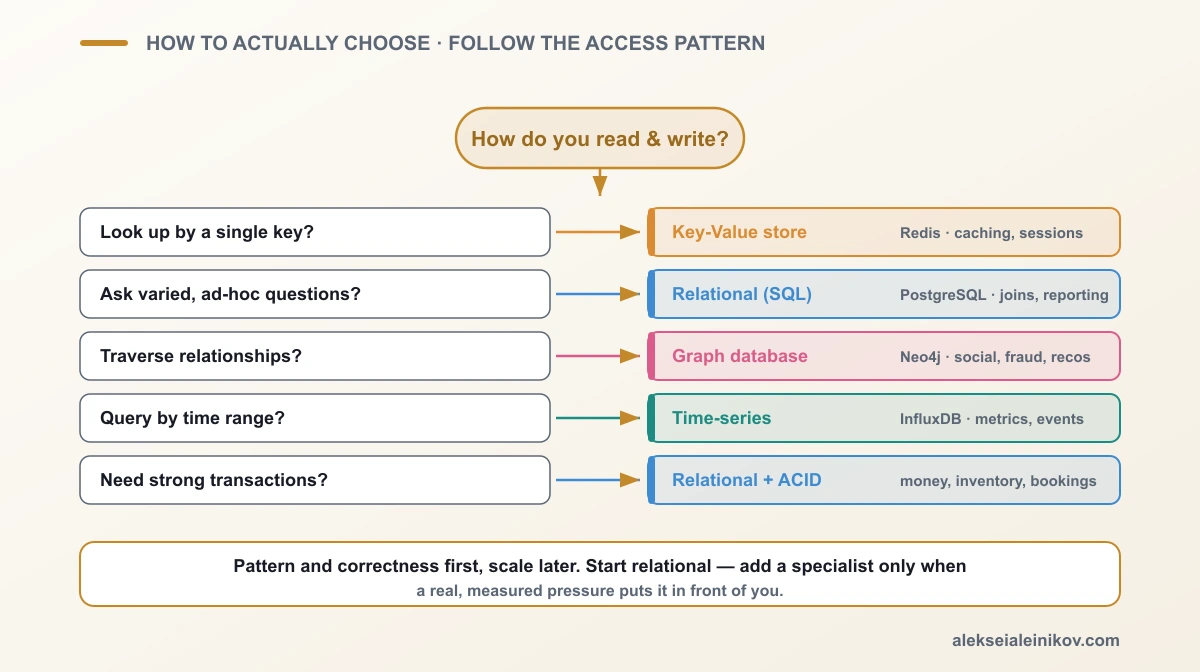
Ignore the marketing. The database follows from how your application reads and writes data. Work through these questions honestly:
-
What does an access pattern look like? If you mostly look things up by a single key, a key-value store is a scalpel. If you ask varied, ad-hoc questions, you want SQL’s query power. If you traverse relationships (“friends of friends who bought X”), a graph database earns its place.
-
How strong must consistency be? Money, inventory, bookings → ACID, relational. A “likes” counter or an activity feed → eventual consistency is fine, and BASE buys you scale.
-
What’s the shape of your data? Uniform, related records → tables. Deeply nested, varying documents → a document store. A firehose of timestamped points → time-series.
-
What’s your real scale? Be honest. Most applications never outgrow a well-run relational database with replicas. “It won’t scale” is the most common — and most often wrong — reason to reach for NoSQL. Solve the problem you have, not the one you imagine.
-
Does one workload need to be extreme? Extreme write throughput, microsecond lookups, similarity search over millions of vectors — a real, specific extreme is the honest reason to add a specialised store.
Notice the order: pattern and correctness first, scale later. That order alone prevents most database mistakes.
The Honest Reality: It’s Rarely One Database
Here’s what experienced teams actually do: they use more than one. This is polyglot persistence — the sane recognition that different data has different shapes. A single product might run PostgreSQL as its source of truth, Redis for caching and sessions, Elasticsearch for search, and a vector store for AI features. Each does the one thing it’s best at.
But polyglot persistence is a destination, not a starting point. Every extra database is another system to run, monitor, back up, and reason about. The disciplined path is:
- Start with a relational database. PostgreSQL alone handles relational data, JSON documents, key-value patterns, full-text search, and vectors — often for years, one system.
- Add a specialised store only when a specific, measured pressure demands it — not because a blog post said relational won’t scale.
- Extract, don’t guess. When a real bottleneck or access pattern appears, move that one workload to the database built for it.
And remember: even inside a relational database there’s a lot of headroom before you need to leave — most “the database is slow” problems are really missing indexes and unoptimised queries, not a signal to switch paradigms. When you genuinely do outgrow a single relational box for a write-heavy workload, that’s exactly where a wide-column store like Bigtable starts to earn its keep.
The Bottom Line
“SQL vs NoSQL” was never the real question. The real questions are: what shape is my data, how strong must my consistency be, and what does my access pattern look like? Answer those and the database chooses itself.
SQL — the relational model — remains the right default for most applications, because a schema, real transactions, and ad-hoc queries are worth more early than any single optimisation. NoSQL is a set of specialists, each brilliant at one job and unremarkable at the rest. ACID and BASE are the two honest answers to the consistency question that CAP forces on every distributed system.
Choose by your patterns, start relational, and add a specialist only when a real problem — not a fashionable one — puts it in front of you.
From the community
Discussion on the Fediverse
Replies from Mastodon and Bluesky — straight from the open web, no tracking.
Loading replies …
No replies yet. Start the conversation:
Replies could not be loaded right now.