
Few debates in software are as tired — or as misunderstood — as monolith versus microservices. One camp treats microservices as the obvious modern default; the other treats them as needless complexity. Both are selling you a conclusion instead of a decision.
Here’s the honest version: neither is better. A monolith and a set of microservices trade different kinds of complexity, and the right call depends entirely on your team, your domain, and your scale. This guide lays out the real trade-offs with no dogma — so you can choose with your eyes open instead of following fashion.
What Each One Actually Is
Strip away the branding:
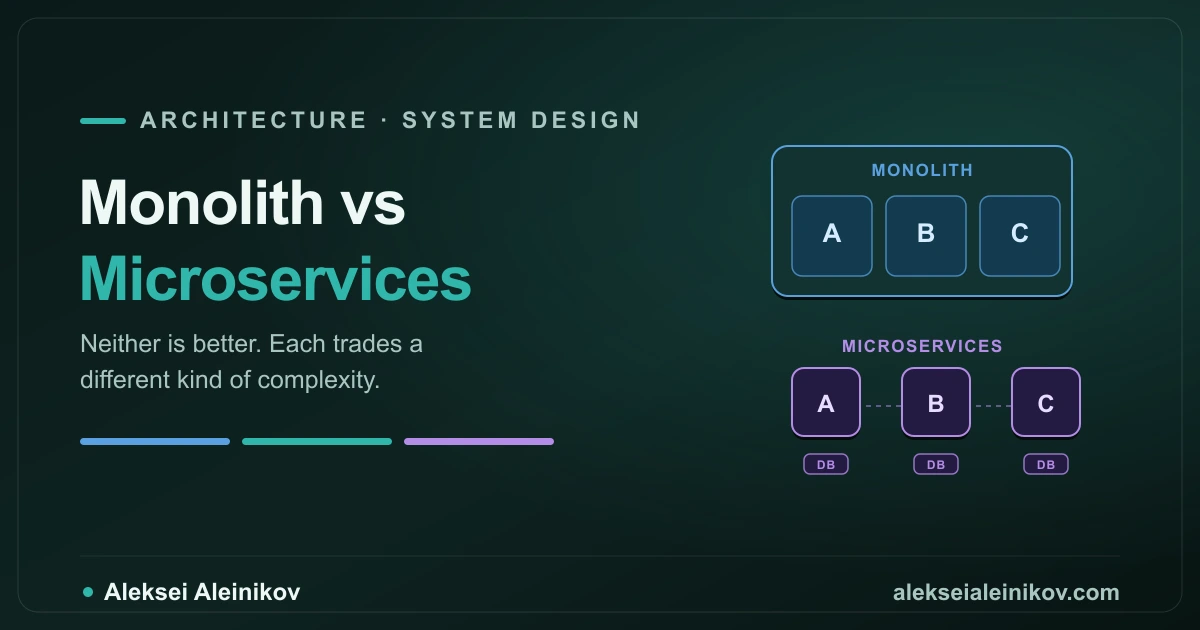
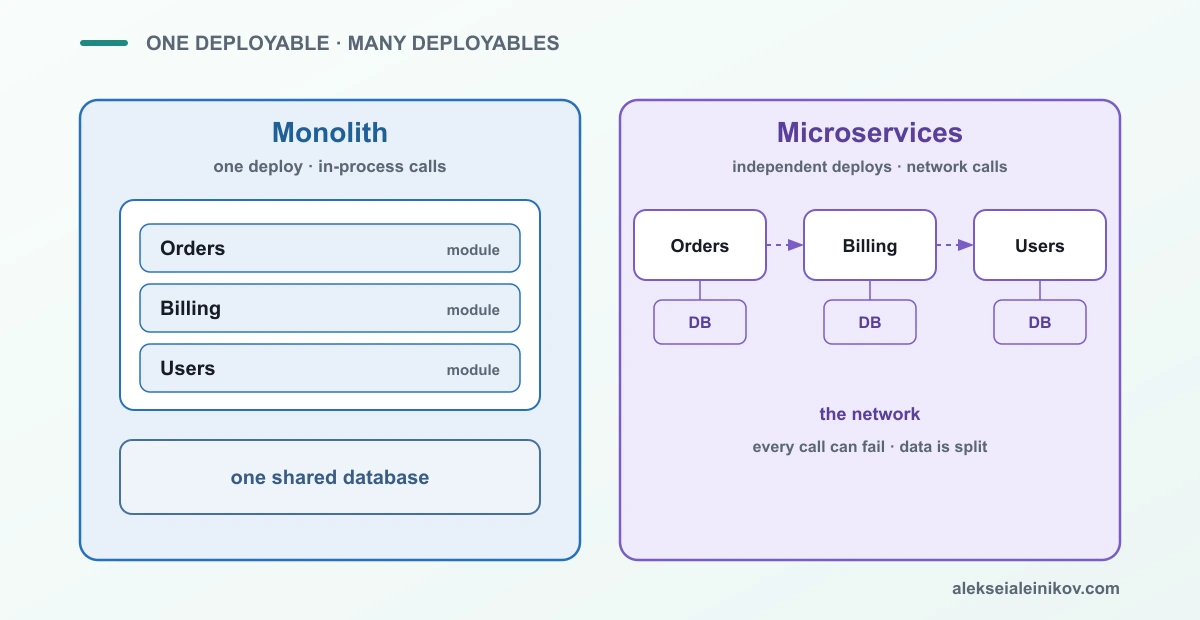
- A monolith is a single deployable application. Components call each other in-process, usually share one database, and ship together as one unit. One build, one deploy, one thing to run.
- Microservices split the system into many small, independently deployable services. Each owns its own data and communicates with the others over the network. Many builds, many deploys, many things to run.
That’s the whole structural difference — and every trade-off flows from it.
The Core Trade-off: Which Complexity Do You Want?
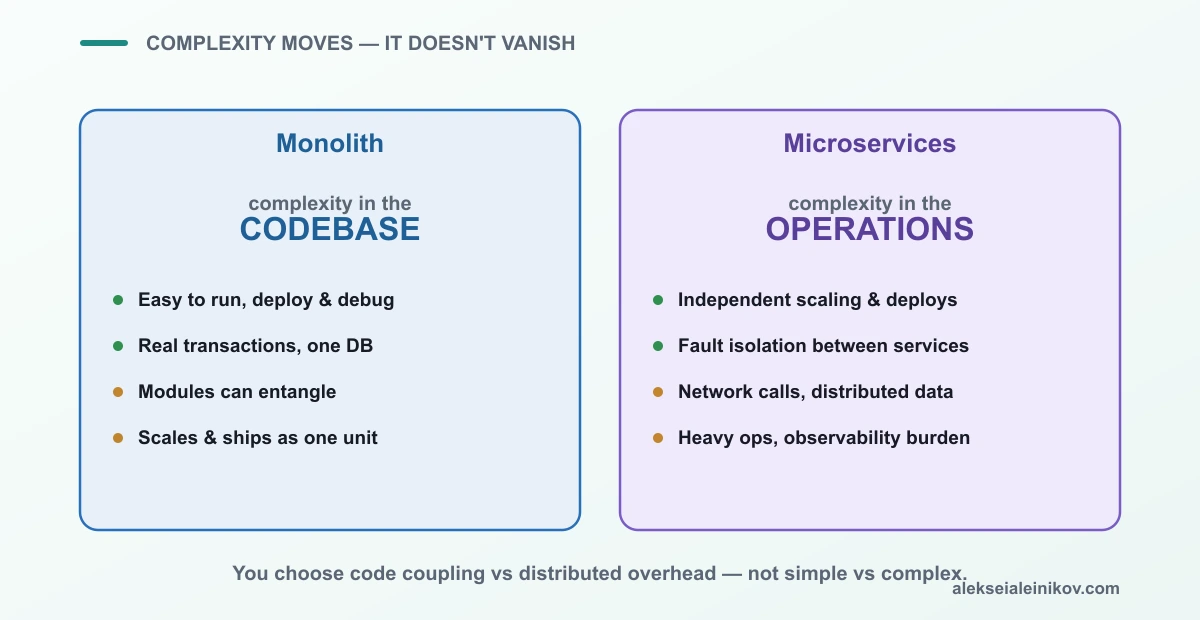
Complexity doesn’t disappear when you pick an architecture — it moves. This is the single most important idea in the whole debate:
- A monolith concentrates complexity in the codebase. Everything is in one place, so it’s easy to run and debug, but modules can grow entangled if you’re not disciplined, and the whole thing scales and deploys as a unit.
- Microservices concentrate complexity in the operations. Each service is small and focused, but now you have a distributed system: network calls that can fail, data spread across services, transactions that span boundaries, and a deployment and observability burden that grows with every service.
You are not choosing “simple vs complex.” You are choosing code coupling vs distributed-systems overhead — and deciding which one your team is better equipped to carry.
Where a Monolith Wins
A monolith is the stronger choice when:
- The team is small. One or a few engineers move fastest in one codebase with one deploy. Coordination overhead is near zero.
- The product is early. Domain boundaries aren’t clear yet, so committing to service lines now means drawing them in the wrong places.
- Transactions matter. A single database gives you real ACID transactions for free — no sagas, no eventual-consistency gymnastics.
- You value simplicity of operation. One thing to deploy, monitor, and debug. A stack trace crosses the whole request instead of stopping at a network boundary.
And critically: a monolith is not a synonym for a mess. A modular monolith — clear internal modules, explicit boundaries, each owning its data, talking in-process — captures most of the structure people want from microservices without the network in the middle.
Where Microservices Win
Microservices earn their cost when:
- Many teams deploy independently. At organizational scale, letting each team own and release its service without coordinating a shared deploy is a genuine speed-up.
- Components scale differently. If one part of the system needs ten times the capacity of the rest, scaling it independently is far cheaper than scaling the whole monolith.
- Fault isolation is critical. A crash or memory leak in one service doesn’t take the others down with it.
- Tech stacks genuinely differ. A CPU-bound service in Go and an ML service in Python can each use the right tool instead of a lowest-common-denominator stack.
Notice the pattern: these benefits are mostly about scale and organizational independence. If you don’t have those pressures yet, you’re paying the cost without collecting the return.
The moment services own separate data, you inherit the hardest problem in distributed systems: consistency during a partition. For the theory that governs it, see The CAP Theorem, Honestly: What It Really Means When You Pick a Database.
The Anti-Patterns on Both Sides
Each approach has a failure mode worth naming:
- The big ball of mud (monolith gone wrong): no internal boundaries, every module reaching into every other, until nothing can change without breaking something else. The fix isn’t microservices — it’s modules.
- The distributed monolith (microservices gone wrong): services split apart but so tightly coupled they must deploy together. You pay the full network-and-distributed-data tax and get none of the independence. This usually comes from carving services along the wrong boundaries before the domain was understood.
The distributed monolith is the more expensive mistake, and it’s the strongest argument for starting modular and splitting later — once you actually know where the seams are.
A Decision Framework, Not a Verdict
Instead of asking “which is better,” ask these:
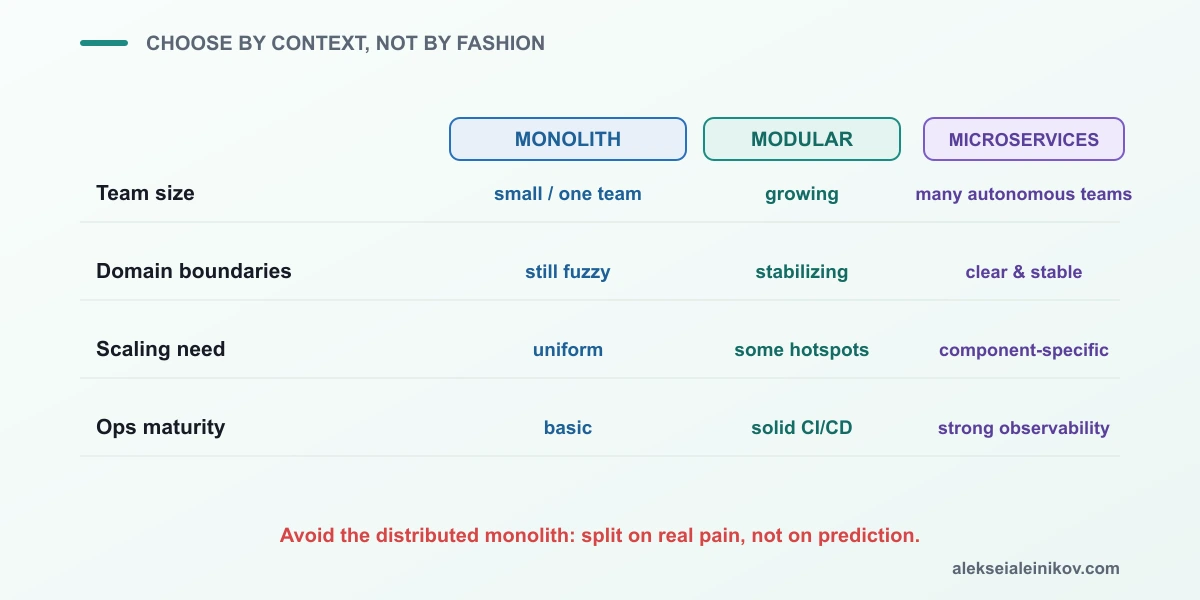
- How big is the team, and how is it organized? By Conway’s Law, your system tends to mirror your org. One small team → one monolith. Many autonomous teams owning distinct areas → services can follow those boundaries.
- How clear are your domain boundaries? Fuzzy domain → stay modular; you’ll draw service lines wrong. Well-understood, stable boundaries → services can be carved cleanly.
- Do you have a real scaling or isolation need? A specific component that must scale or fail independently is a concrete reason to extract it. “It might scale someday” is not.
- How mature are your operations? Microservices demand solid CI/CD, observability, and on-call maturity. Without them, the distributed complexity will bury you.
Start Where the Pain Is Lowest, Move When It’s Real
The pragmatic path most experienced teams converge on: begin with a modular monolith, and extract a service only when a specific, real pressure justifies it — a component that must scale alone, a team that needs to deploy independently, an area that must be isolated for reliability. Splitting on real pain gives you correct boundaries; splitting preemptively gives you guesses.
The industry evidence cuts both ways, which is exactly the point. Netflix and Uber run enormous microservice fleets because their scale and org structure demand it. Amazon Prime Video publicly consolidated a service back into a monolith and cut infrastructure cost dramatically. Shopify runs a famous “majestic monolith” at massive scale. None of these is a universal lesson — each is the right answer for that team’s context.
Between services, how you communicate matters as much as whether you split. For getting event-driven boundaries right, see Pub/Sub or Eventarc? Event-Driven GCP Without the Spaghetti.
The Field Rule
Monolith versus microservices isn’t a battle with a winner — it’s a trade between code coupling and distributed complexity, and the right pick depends on your team size, domain clarity, scaling needs, and operational maturity. A modular monolith is the pragmatic default for most teams: it keeps clean boundaries without the network tax, and it leaves the door open to extract services later. Reach for microservices when scale or organizational independence gives you a concrete reason — not because they feel modern. Match the architecture to your context, avoid the distributed monolith, and split on real pain rather than on prediction. Do that, and the decision stops being a religious war and becomes what it always was: an honest trade-off, made on purpose.



From the community
Discussion on the Fediverse
Replies from Mastodon and Bluesky — straight from the open web, no tracking.
Loading replies …
No replies yet. Start the conversation:
Replies could not be loaded right now.