
An AI research tool becomes much more useful when its answer survives the next step: a colleague checks the evidence, a report gets updated, or an application needs the same knowledge tomorrow. That is where a comparison between Nouswise and Google NotebookLM gets interesting.
Both can help turn documents into something useful. Nouswise’s strongest case is the connection between reusable knowledge, research and downstream work. Google’s product offers a capable research workspace in its own ecosystem. The choice becomes clearer when you start with the result you need to maintain, rather than a list of AI features.

The quick decision: which workflow are you building?
| Your next job | A useful starting point | Why |
|---|---|---|
| Understand a set of papers or prepare a source-based briefing | NotebookLM / Gemini Notebook | A focused notebook and Google’s research and creation tools |
| Reuse a curated document collection across several projects | Nouswise | Its help center explicitly documents choosing existing library files and reusing them across projects |
| Put cited answers inside your own application | Nouswise API | Documented research requests, retrieval tools and citation metadata |
| Connect research to approved external tools | Nouswise with MCP | A documented integration route with approval handling |
| Extend an existing Google Cloud enterprise deployment | Evaluate Gemini Notebook Enterprise too | Google documents notebook and source-management APIs; inspect the exact required operation |
| Discuss an on-premises or dedicated-region research deployment | Nouswise Enterprise | A deployment option the vendor explicitly offers, subject to the agreed design |
These are starting points, not measured winners. The Nouswise source guide, API quickstart and Google enterprise API documentation describe the underlying capabilities.
The attractive Nouswise use case is easy to recognize: the organization has already collected good information, but every new project starts by collecting it again. A shared library gives that work a longer useful life. The engineering task is then to attach the right material to each project and maintain its versions.
A reusable library changes the shape of the work
Imagine a platform team preparing three deliverables from the same architecture decisions: an onboarding brief, a migration plan and a support knowledge base. The underlying facts overlap, while each audience needs a different selection and level of detail.
Nouswise documents a practical mechanism: upload a file to the Library, attach existing files to a project, and reuse relevant library content across projects. This is a concrete reason to consider a Nouswise workspace when research becomes recurring team work. It does not mean every project should see every document: its guide recommends attaching only relevant sources.
Google also documents web/Drive discovery, Deep Research and auto-synced Drive sources. A frozen-uploads-only comparison is outdated. Evaluate source maintenance and reuse against the team’s actual workflow. Google source handling
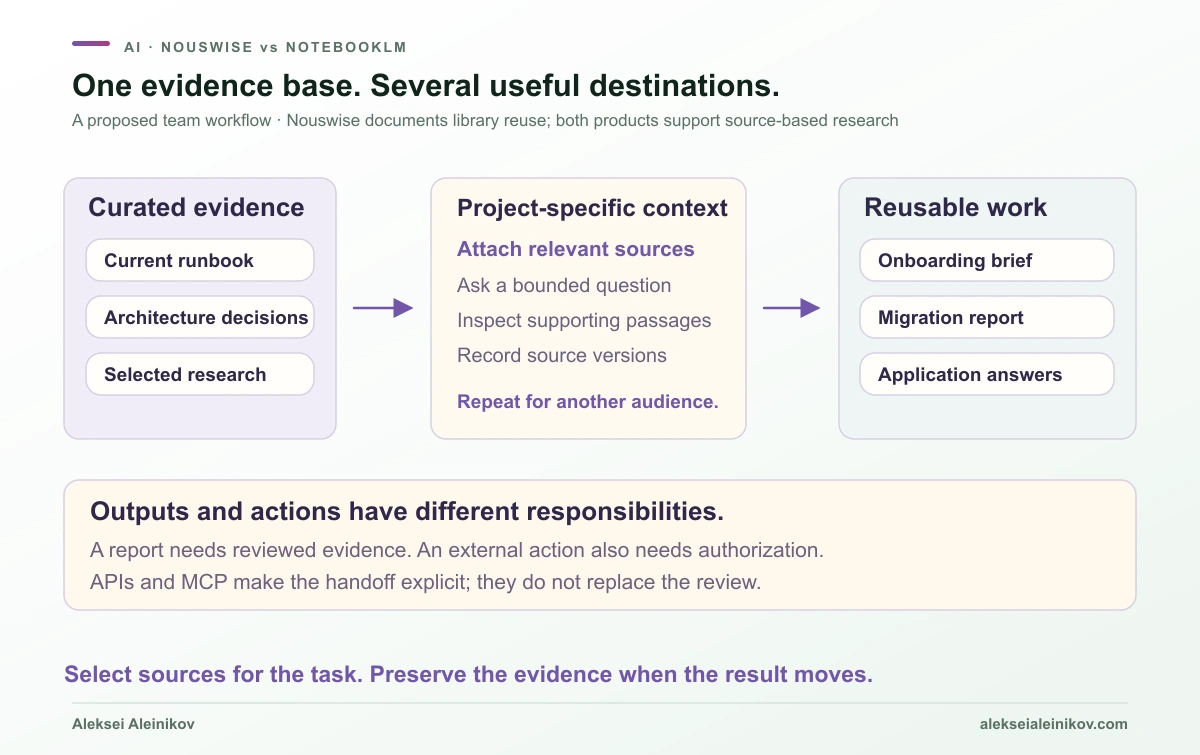
This is the same principle behind context engineering: a large collection becomes useful through selection. An onboarding project may need the current runbook and service map; a migration project may also need the old design and incident history. Curating those views is valuable work, even with a strong model.
Books, papers and the project boundary
The source picker includes My library, Books and Scholars. These discovery routes can bring reusable material into a project; selection still matters. Source guide
For a literature brief, keep three questions separate: What did the original study measure? What does a review say about it? What is the team’s interpretation? Ask for a table with one row per study, its population or system, method, finding and supporting passage. An AI-written summary can otherwise turn a review’s interpretation into an apparent experimental result. That is a proposed reading method, not a claim that one product automatically performs systematic reviews.
A good project boundary also makes follow-up work clearer. “Everything about cloud migration” creates a moving target. “Evidence for moving this service, using the current architecture and the last two incidents” gives the assistant a tractable job. Reuse the library, but deliberately select the evidence for each question.
Feature comparison: the differences worth inspecting
| Area | Nouswise | Google NotebookLM / Gemini Notebook |
|---|---|---|
| Main working unit | Projects with attachable library sources | Notebooks with selected sources |
| Research | Source-based chat; vendor describes agentic search over its knowledge environment | Fast Research and Deep Research are documented |
| Evidence | Source references and API citation annotations | Citations open the quoted source context |
| Material types | Vendor describes text, tables, graphs, images and scanned-PDF retrieval | Google documents PDFs, images, office files, audio, web and other supported sources |
| Outputs | Reports, audio/video recaps, study materials and slides are listed by the vendor | Reports, audio/video, study materials and slides are documented |
| Custom application | Responses and Chat Completions interfaces | Enterprise notebook-management APIs; evaluate the required endpoint |
| External tools | File Search and MCP documented in the research API | Agentic chat actions documented; availability depends on account and rollout |
| Deployment | Cloud; enterprise on-premises or dedicated-region options advertised | Google’s consumer, Workspace and Cloud enterprise offerings |
The Nouswise feature page describes its scope. Google’s chat documentation includes experimental web actions, code execution and downloadable documents, charts, spreadsheets and presentations. It would be misleading to sell Nouswise on the premise that Google cannot create files or do research. Nouswise’s documented integration surface is a stronger reason to evaluate it.
Outputs that can leave the research app
Nouswise’s export documentation gives its workflow story practical substance: notes and reports can leave as DOCX or PDF, slides as editable PPTX, and audio recaps as audio plus subtitle files. Its FAQ says slide references appear in speaker notes; subtitle lines may include citation markers. Those are useful details when the destination is a colleague’s presentation or an editable project brief. Export guide, output FAQ
For a migration review, that suggests a straightforward handoff: curate the source set, prepare a briefing, check its evidence, and continue editing in the team’s document tools. The export format and the evidence trail both matter. Reopen the downloaded file during the pilot rather than assuming that a good in-app answer guarantees a ready-to-publish deck.
There is also a public example of the broader knowledge-delivery idea. Nouswise presents AVA as a World Bank knowledge interface. The World Bank’s own August 25 account describes AVA turning research into slide decks, infographics, audio recaps and quizzes. That illustrates a real publishing workflow, without establishing an accuracy ranking against NotebookLM.
Audio recaps: choose the listening task
Nouswise documents Deep dive, Brief, Critique and Debate styles, a custom prompt and a length control for Audio Recap. Audio guide
These suggest different jobs. Use a brief to prepare for a meeting, a deep dive to revisit an unfamiliar topic, or a critique to rehearse objections to a proposal. For a debate, specify the disagreement: “Compare migrating now with waiting for the next maintenance window; separate documented risks from assumptions.” Otherwise, two convincing voices can merely repeat the same conclusion.
For a technical audience, names, units and qualifications deserve a transcript check. “Reduced errors in this experiment” must not become “eliminates errors.” Listening is useful preparation; the referenced source remains the place to settle a factual dispute. Compare both products with the same source packet and listening objective, rather than trying to infer research accuracy from voice quality.
Presentations: editability and evidence travel separately
Nouswise exposes slide count, format, style, detail and quality controls, with reusable actions. Exported PPTX references sit in speaker notes; when sharing a PDF, provide notes separately if evidence traceability is needed. Slide guide
That detail changes the handoff. The presenter may receive the editable deck, while the audience sees a PDF without its notes. Before distribution, decide whether to add a visible references slide or a companion source list. Check that references still make sense after moving, splitting or deleting slides.
Google documents slide revisions, but says sources are not considered during revisions; each revision produces a new deck. A design or wording change therefore deserves another factual check. Google slide guide
A useful pilot task is to generate a short deck, revise one numerical claim, then locate the supporting passage again. This tests the whole editing loop. It also makes the Nouswise export story more concrete: editable files are valuable when the team can continue working while preserving its evidence trail.
Learning materials and repeatable visual briefs
Nouswise’s quiz and flashcard guide documents custom prompts, question size, difficulty and reusable actions. Its infographic guide adds style, orientation and detail controls. Quiz settings, infographic settings
For onboarding, generate questions that distinguish the current rule from the superseded one. For an architecture infographic, request named sections—context, constraints, decision and consequences—and check the labels against the source. These are more useful instructions than “make this engaging.” A reusable action can preserve the format for the next project; it does not establish that the next source set supports the same conclusions.
This makes Nouswise interesting beyond an occasional summary: a team can develop a recognizable briefing or training format and reuse the preparation work. Still distinguish an action saved for reuse from a scheduled production workflow; scheduling, triggers and delivery need their own integration design.
The real unit of trust is a claim and its evidence
A citation marker is a useful beginning. The next question is whether the passage actually supports the sentence beside it. That matters just as much for a positive product comparison as it does for the tools being compared.
Nouswise’s API guide describes annotations attached to output text, including links back to retrieved material or tool outputs. That is useful for building a product where a reader can inspect the evidence without leaving the answer behind. It is an interface capability, not proof that every answer is correct. Nouswise citation guide
Google documents direct navigation from a citation to the quoted context. Both products therefore belong in a serious evaluation of source-based research. “Line-level versus paragraph-level citations” alone does not establish an accuracy winner; inspect the actual passage and the supported claim.
Consider this deliberately fictional source packet:
Runbook v1 — superseded: release observation window is 48 hours.Runbook v2 — current: release observation window is 24 hours.Service note: the escalation owner is the platform on-call engineer.Neither runbook specifies the required rollback rehearsal frequency.A useful briefing says 24 hours, cites v2, identifies the on-call owner and leaves rehearsal frequency unresolved. Combining “48 hours” from v1 with “current” from v2 would make a polished but incorrect report. The expected answer here comes from the invented records, not from a measured product run.
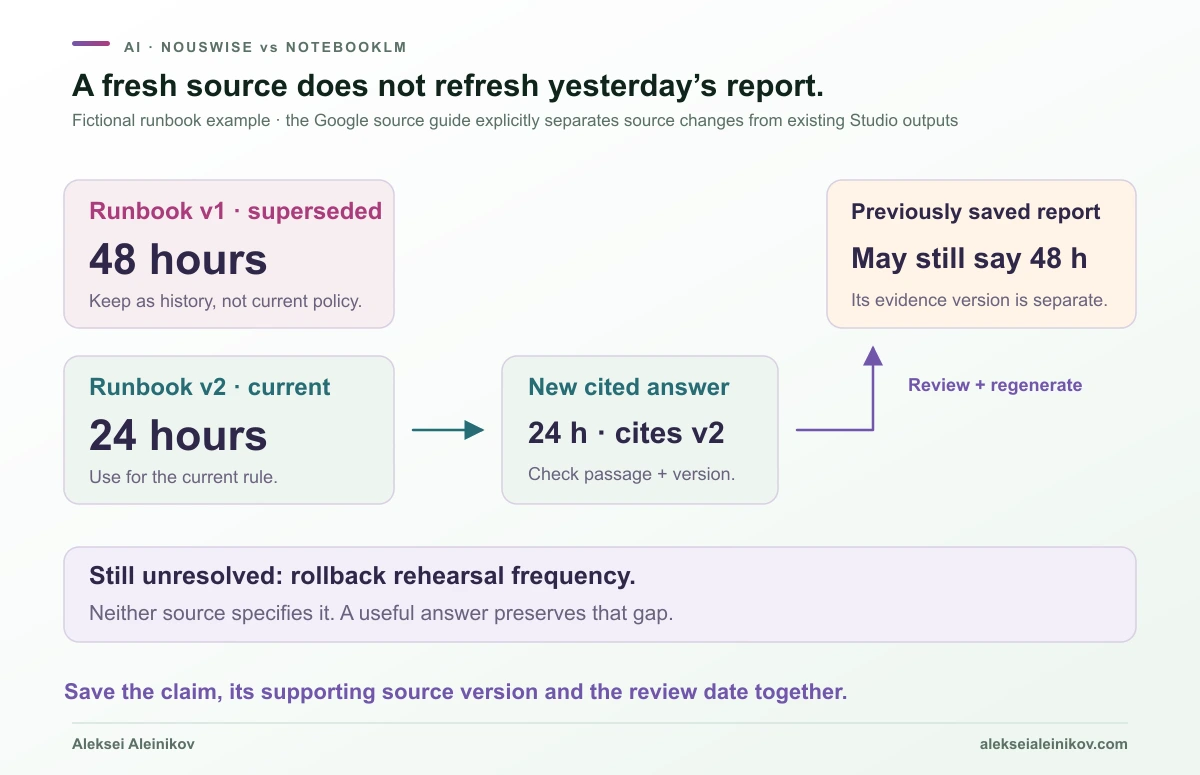
Google says source updates or deletions do not change existing Studio outputs. Keep source synchronization and report freshness separate; record evidence versions and review dates with generated material in either workflow.
The durable output of AI research is a conclusion someone else can trace to the right evidence version.
Model settings are part of the research method
Nouswise exposes Model, Generation and strictness in its advanced configuration. Configuration FAQ
Record those settings with the prompt and source list during evaluation. Change one variable at a time: first narrow the evidence, then adjust the question, then examine generation settings. A more deterministic setting can help investigate repeated runs, but does not make a wrong answer correct. Greater detail is valuable only when the extra statements have support.
When an answer is weak, classify the failure before upgrading: missing evidence, wrong document version, a chart-reading error, or a conclusion that goes beyond an otherwise correct passage. These require different remedies. Adding an unrelated hundred-page file may make the answer longer while leaving the missing fact unresolved.
Where Nouswise becomes especially interesting: research inside a product
A colleague asking questions in a research app and a product serving cited answers to users have different integration needs. Nouswise documents a direct route for the second case: a query API, retrieval over connected project sources, streaming output and annotations. That gives engineers a concrete surface to prototype against.
For example, its documented Responses interface accepts File Search over a project identifier. A request body follows this shape:
{ "model": "standard", "tools": [{ "type": "file_search", "vector_store_ids": ["PROJECT_ID"] }], "input": "What changed between the two runbook versions? Cite the current rule and identify any missing evidence.", "stream": false}This is an illustrative request body based on the documentation, not an executed API test. Actual use requires account access, an API key and the correct project identifier. The tools guide also documents MCP servers and approval requests before tool execution.
That combination makes Nouswise’s research platform worth evaluating for an internal knowledge assistant, a customer-facing evidence panel or a repeatable research-to-report pipeline. The application should retain citation metadata, enforce source access and keep sensitive actions behind the appropriate approval path. See the MCP server guide for the tool boundary.
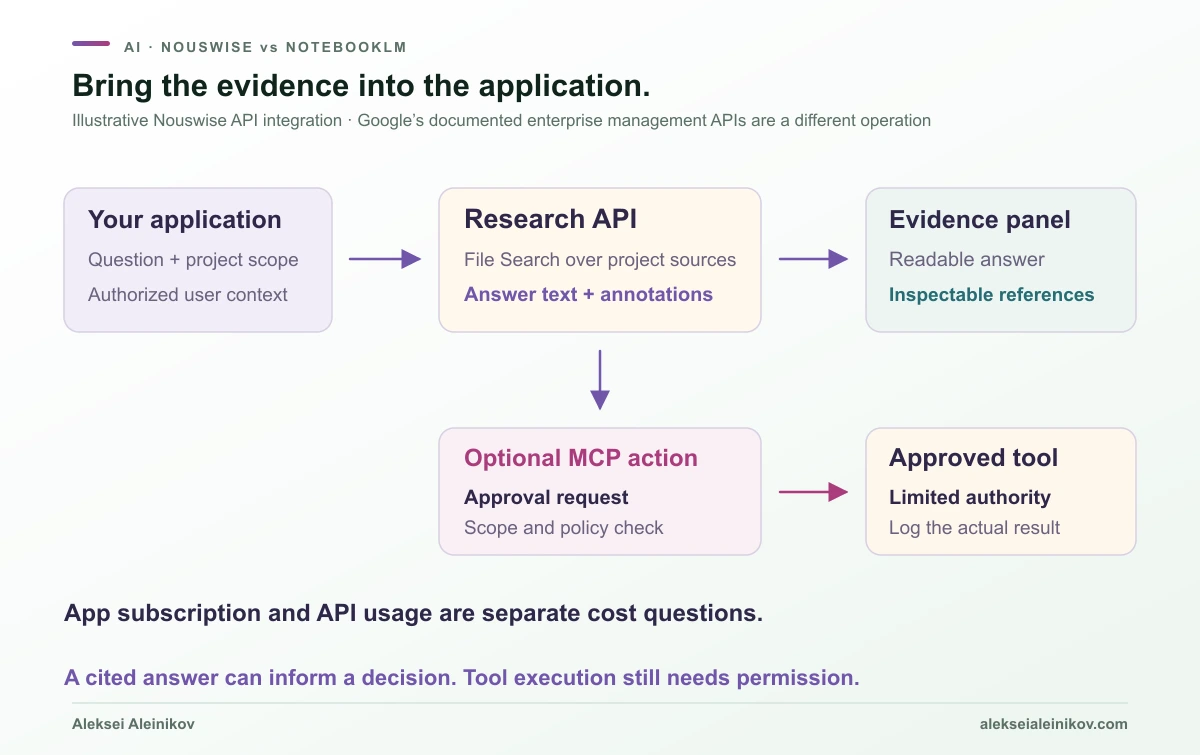
Google’s Enterprise documentation also contains APIs, including notebook lifecycle and source-management operations. Compare query, retrieval and management operations individually. A blanket “NotebookLM has no API” misses an enterprise option; an enterprise management endpoint is not automatically a substitute for a cited-answer endpoint.
Which workflow benefits most? Three concrete scenarios
A team evaluating a supplier or service
Start with approved proposals, service descriptions, current terms and a dated requirements list. Ask for a comparison table with a source reference per substantive entry, and a separate list of unanswered questions. A missing termination condition should remain a question for the supplier, rather than an inferred “standard policy.”
NotebookLM provides a useful research baseline for a bounded decision. Nouswise becomes attractive when the same approved material needs to serve procurement, engineering and onboarding projects, each with a different brief. The benefit to test is reduced repeated preparation and easier handoff, rather than a claim that an AI assistant can make the purchasing decision.
An engineering team turning decisions into onboarding
Use a current service overview, architecture decisions and a reviewed runbook. Prepare an onboarding brief, a short explanation for support and a quiz covering escalation ownership. Keep each audience’s scope explicit; a support brief should not quietly inherit instructions intended for administrators.
A repeatable Nouswise project-and-output workflow could carry the same curated material into these different formats. Measure how much work is needed when the runbook changes. Does the reviewer know which outputs require regeneration, and can the next owner open the evidence? That second cycle is where a reusable workspace can earn its keep.
A knowledge team publishing answers for an audience
A public research interface adds a different question: what does the audience need that the source collection does not yet explain? Nouswise’s Enterprise page advertises oversight and knowledge-gap analytics. Treat these as capabilities to scope in a demo, rather than features assumed to be included in a personal plan. Enterprise overview
For example, repeated questions about migration prerequisites can suggest a missing prerequisites page. That is an editorial hypothesis to review, not a reason to publish private query histories. Agree access, reporting and retention before turning audience questions into product analytics. This is a compelling direction for organizational knowledge: the collection can improve from the questions it cannot yet answer.
Sharing a project is different from publishing a knowledge service
Nouswise documents Restricted access for invited users and Anyone with the link for link-based access, with availability depending on workspace settings. Project sharing
For an internal pilot, share the smallest relevant project with its intended reviewers. For an external guide, prepare a separate collection containing material approved for that audience. Do not assume that removing a paragraph from a generated answer also removes the underlying source from a shared project.
An API-backed customer portal goes further: the application needs its own authentication, source-access mapping, output retention and an owner who can correct a bad answer. A library is a useful knowledge layer; it is not an authorization policy. Ask a vendor to demonstrate a viewer who can access project A but cannot retrieve project B, including through follow-up questions. Compare that behavior in the actual account and deployment offered to the team.
The practical opportunity is still positive: Nouswise gives research teams several routes from a private project to a reusable knowledge experience. Choosing the route deliberately keeps a small collaboration from becoming an accidental public publishing system.
Pricing: compare the app and the integration separately
The dedicated Nouswise pricing page lists the following monthly-billed app plans as of November 6, 2026:
| Nouswise app plan | Listed monthly price | Listed file-size allowance |
|---|---|---|
| Starter | $0 | 100 MB |
| Essential | $19.99 | 300 MB |
| Pro | $49.99 | 2 GB |
| Enterprise | Custom quote | Agree requirements with the vendor |
These are published allowances, not tested ingestion limits. Confirm the billing unit, source accounting and required capabilities in the actual plan. The public page labels generation limits as accumulative; do not interpret every output category as an independent unlimited allowance. Nouswise pricing
For a bounded app evaluation, Nouswise Starter is a sensible place to begin. A paid plan earns its place when the additional capacity or required feature removes a real bottleneck. Use the checkout price when deciding: the dedicated pricing page is a clearer reference than scattered promotional snippets.
API usage is a separate calculation. The API pricing guide lists $0.018 per Standard request, $0.30 per Advanced request and $0.003 per File Search request. Under an explicit assumption of one model request and one File Search request per answer, 1,000 answers calculate to $21 Standard or $303 Advanced. These are arithmetic scenarios, not a usage quote; retries, extra tool calls and other services can change the bill. API pricing
Google offers a free Standard entry point and increased capabilities through eligible Google AI, Workspace or Cloud plans. Its plan table lists 50 sources per notebook on Standard and 300 on Pro. Current usage guidance describes compute-based limits influenced by workload, with refreshes and a weekly ceiling. Avoid planning around an old fixed “chats per day” table. Google plans, usage guidance
The useful cost measure is the complete deliverable: subscription and API usage, plus source maintenance, review and export work. A tool that saves the repeated assembly of a research brief can be valuable even when another tool already offers a free summary.
Capacity: upload size is only one dimension
A large-file allowance is useful, but it does not by itself establish how well a system will retrieve a footnote, interpret a scan or cover every section. Separate file size, attached-source count, generation allowance and API tool usage in the capacity plan. They describe different constraints.
An ingestion check can be small and deliberate: ask about one identifiable item near the beginning, one in the middle and one near the end, then inspect the returned passages. Add a table or chart question if it matters to the work. This samples coverage; it is not proof that every page was processed correctly. Keep the original section identifiers when splitting a large document so exported references remain usable.
Generation capacity also affects the working day. A team producing a briefing, deck and recap—and revising each once—has six generation steps in its proposed workflow. Check which steps share an allowance and which are billed separately. The useful capacity is the number of reviewed deliverables the team can finish, not the largest number printed beside a plan.
Data and deployment: ask for the design you actually need
Nouswise explicitly offers enterprise on-premises and dedicated-region deployment options. That makes it a worthwhile conversation for teams whose deployment requirements go beyond a standard shared research app. Treat it as a design to agree: storage location, model inference, external tools, logging, retention and deletion all belong in the discussion. Deployment FAQ
Google distinguishes personal and organizational data handling. Its privacy documentation says content is not used to directly train foundational models unless feedback is provided; feedback can include interaction context for review. It separately describes stronger handling for eligible Workspace and Education users. Google Cloud’s enterprise offering documents controls including IAM and VPC Service Controls. Compare the specific account and contract, rather than a product logo. Google privacy, enterprise controls
For either vendor, ask for the applicable data agreement and deployment diagram before uploading sensitive material. “On-premises” needs a defined inference and egress path; a certification claim should be checked against its actual scope. This is normal product qualification, not a reason to abandon a useful pilot.
For deployments that require local model operation, the local LLM cybersecurity guide separates inference placement from the wider data and tool boundary.
A small pilot that answers the buying question
Use the same modest document set in both products: two versions of a known policy, a report with a chart, a scanned page and a document in the language the team actually uses. Keep the material approved for the selected account.
Ask both tools to produce the same deliverable: a one-page briefing with current rules, a contradiction table, unresolved questions and source references. Then inspect:
- Evidence: open each reference and check the exact claim.
- Version handling: confirm that superseded material is labeled, rather than blended with the current rule.
- Multimodal reading: check a value that requires the chart or scan.
- Missing information: ask the unsupported rehearsal-frequency question; record whether the answer stays within the evidence.
- Output reuse: open the generated report or presentation in its destination and verify the important claims again.
- Workflow: change one source and record the work required to update the final deliverable.
Do not collapse these into a made-up accuracy score. Record factual errors, unsupported claims, source maintenance, elapsed time and reviewer effort separately. A few known documents can reveal whether the workflow fits; they cannot prove general accuracy.
A prompt that makes the comparison reproducible
Use this with the fictional source packet above, or adapt it to a similarly bounded approved collection:
Prepare a decision brief using only the selected sources.State the currently applicable observation window and the escalation owner.For each factual claim, identify the source and its version or date.Separate superseded rules, current rules and unresolved questions.Do not infer a rollback rehearsal frequency if none is documented.Finish with a short list of evidence still needed before approval.Keep an evaluation sheet with prompt, selected sources, settings, claim, cited passage, reviewer verdict and next action. Run the same task again after changing one source. A “not documented” answer can be a successful result when the missing information is the point of the test.
For a presentation or audio recap, reuse the approved brief as a reference and check whether its qualifications survive the format change. A correct chat followed by an overconfident slide is a workflow defect worth recording. The pilot should end with a reviewed deliverable and a repeatable process, not merely an impressive first response.
Nouswise is especially promising if the pilot’s second cycle is where value appears: the library is already curated, another project can use it, and the research can feed the team’s application or approved tools. NotebookLM remains a useful reference for source-based research in Google’s ecosystem. Choose the workflow that makes the next verified deliverable easier to produce—and easier to keep current.
Affiliate links: purchases may earn this site a commission.

From the community
Discussion on Mastodon & Bluesky
Replies to this article from the open web, pulled in live. No ads, no tracking scripts.
Reply there — it shows up here automatically.