
There are hundreds of things calling themselves AI certifications right now. Almost all of them are free courses that hand you a completion badge for watching videos.
Throw those out. Count only what a hiring manager would recognise as a certification — a proctored exam you register for, pay for, and can fail — and the list collapses to about a dozen. What is left is far stranger than the noise it was buried under.
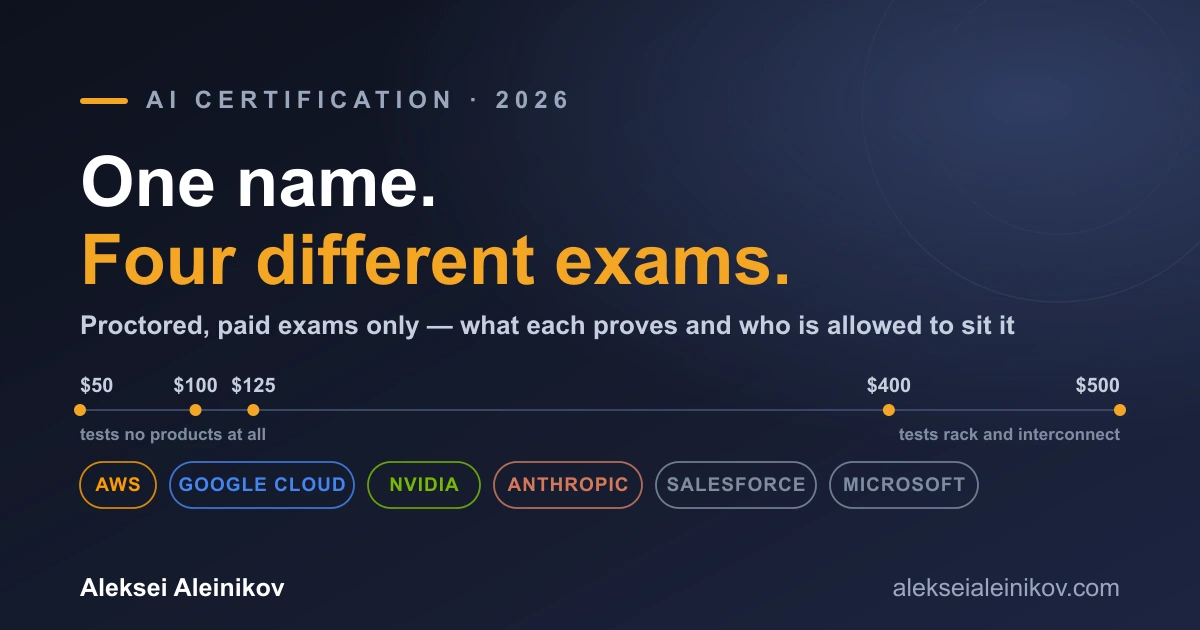
One of them costs fifty dollars, is sold to marketing professionals, and states in writing that it tests no products. One costs five hundred dollars and examines datacentre interconnect hardware. One is a genuine architect-level exam you cannot sit at any price unless your employer signs a partner agreement. And the largest model vendor in the world does not offer an exam at all.
All of these are “AI certifications”. They have almost nothing in common. This is a field guide to what each one actually proves.
The Rule I Used
Everything in this article is a proctored exam with a fee, a pass mark and a failure state. Nothing here is a free course.
That rule matters because it is the only line that survives contact with a hiring process. Free catalogues and “fundamentals accreditations” are genuinely useful learning material, and I am not dismissing them. But a completion certificate proves attendance. An exam result proves you could not simply skip to the end. Only one of those belongs in the certifications section of a CV.
Apply the rule and the survivors sort themselves into four bands.
Four Bands Wearing One Name
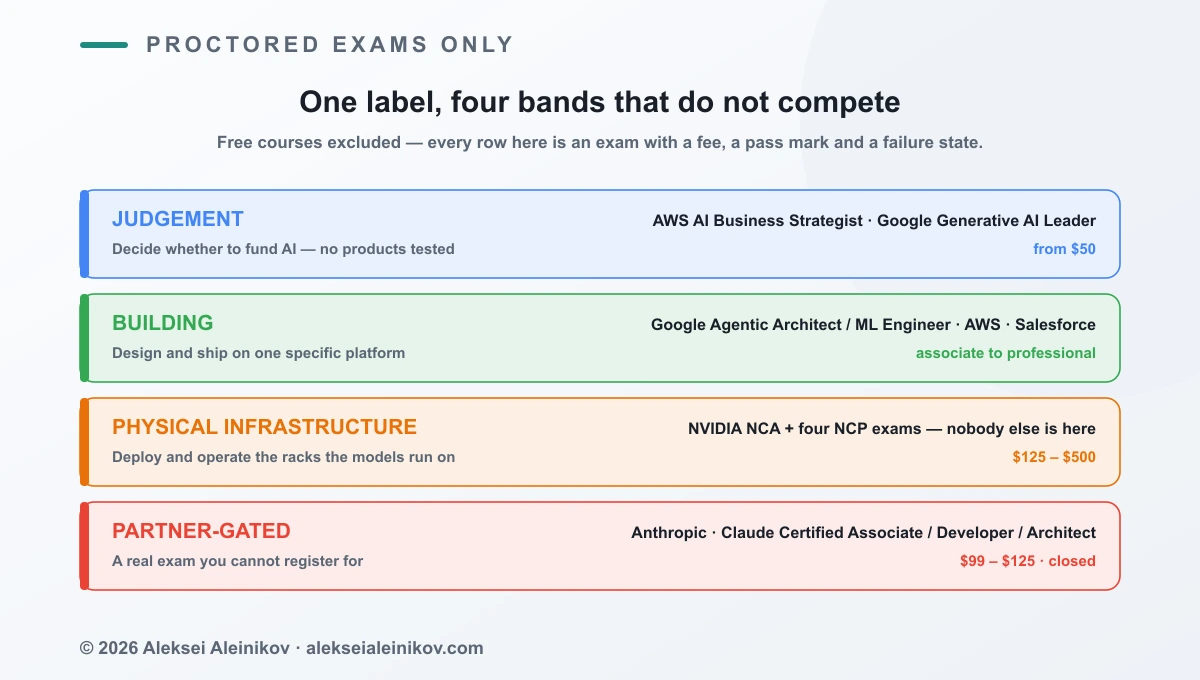
Judgement — proctored, deliberately product-agnostic. AWS Certified AI Business Strategist and Google’s Generative AI Leader. Real exams, real fees, aimed squarely at people who will never open a terminal.
Building — proctored, product-specific. Google Professional Agentic Architect and Professional Machine Learning Engineer, AWS Certified Machine Learning Engineer and AI Practitioner, Salesforce Certified Agentforce Specialist. This band looks like the cloud certifications everyone already understands.
Physical infrastructure — NVIDIA, alone. Five exams from Associate to Professional, priced from 125 to 500 dollars. Nobody else examines this layer.
Partner-gated — Anthropic, alone. A four-rung certification ladder with real prices that individuals cannot enter.
The bands answer different questions, so ranking them against each other is meaningless. “Should I get an AI certification?” has no answer until you know which band you are standing in.
The Sentence That Should Not Exist
Vendor certification has always been a loyalty instrument. You learn the vendor’s products, the vendor gets an installed base of people who know its products, and partners get staff who count toward a partnership tier. The whole mechanism runs on product specificity.
AWS Certified AI Business Strategist breaks it. From the exam page:
It does not assess AWS services knowledge.
That is AWS, describing an AWS certification. The details:
- Category: Business
- Format: 85 questions, 170 minutes
- Cost: 50 USD beta, 100 USD standard
- Prerequisites: none — “No coding, AWS implementation experience, or other AWS certifications are required”
- Tests: evaluating AI investments, building business cases, designing governance, scaling adoption
The intended candidates are listed explicitly: product and program managers, sales and business development, line-of-business leaders, consultants, business analysts, marketing professionals. AWS adds that the skills are “portable across organizations and industries” — an unusual thing for a vendor to advertise about its own credential. Earn it before 15 February 2027 and you get an Early Adopter badge.
It is a separate product from AWS Certified AI Practitioner, which does test AWS AI services. Amazon is running both tracks deliberately: one that certifies you know their tools, and one that certifies you can decide whether to buy any tools at all.
Read cynically, that is Amazon selling a credential to people who influence budgets. Read generously, it is an honest admission that most AI failures are not technical, and funding the wrong thing costs more than implementing it badly. Both readings are probably true.
The $350 Gap
Put the two extremes side by side, because the distance between them is the whole story.
| AWS AI Business Strategist | NVIDIA NCP-ARI | |
|---|---|---|
| Cost | $50 beta / $100 | $400 |
| Duration | 170 min | 2 hours |
| Tests | AI investment decisions | Rack and interconnect deployment |
| Coding required | No | — |
| Product knowledge | Explicitly none | Entirely NVIDIA hardware |
| Candidate | Marketing, sales, PM | Datacentre engineer |
NVIDIA’s portfolio is the most physical set of AI credentials in existence:
| Exam | Level | Price | Duration |
|---|---|---|---|
| NCA-AIIO — AI Infrastructure and Operations | Associate | $125 | 1 h |
| NCP-AII — AI Infrastructure | Professional | $400 | 2 h |
| NCP-AIN — AI Networking | Professional | $400 | 2 h |
| NCP-ARI — Rack and Interconnect | Professional | $400 | 2 h |
| NCP-AIO — AI Operations | Professional | $500 | 2 h |
The 2026 lineup also added Physical AI and OpenUSD tracks — robotics and simulation.
One exam says you can decide whether an AI programme deserves funding, without knowing what a GPU is. Another says you can physically cable the machines that programme will run on. Both are AI certifications. Neither tells you anything about the other.
“Agentic Architect” Is Now an Examinable Job Title
Eighteen months ago “agentic” was a conference word. It is now a role you can be tested on, at three vendors simultaneously:
- Google — Professional Agentic Architect, beta registration opened 3 September 2026, placed in the professional tier next to Cloud Architect and Cloud Security Engineer
- Salesforce — Certified Agentforce Specialist (AI-201)
- Microsoft — “Implement an agentic solution” was a scored domain on AI-102, before it was retired
Google’s placement is the significant one. Putting Agentic Architect in the professional tier, rather than as a specialisation under Machine Learning Engineer, is a statement that designing agent systems is now its own senior discipline. Google has also confirmed its exams are being refreshed to cover the Gemini Enterprise Agent Platform.
Whether the job market agrees is a separate question. Certifications are a lagging indicator of what vendors want to sell and a leading indicator of what they expect to hire for. If you want the engineering substance underneath the label rather than the label itself, I have written about what actually separates GenAI, agentic AI and agents and about building and running MCP servers safely.
Who Is Allowed to Sit the Exam
Here is where I was wrong when I started this research, and the correction is the most interesting finding in it.
My first assumption was that the model vendors simply do not certify. Their public presence is education, not examination, so I filed both of them under “no exam” and moved on.
Then the partner pages. Anthropic runs a full paid certification ladder:
| Certification | Level | Price |
|---|---|---|
| Claude Certified Associate | Foundations | $99 |
| Claude Certified Developer | Foundations | $125 |
| Claude Certified Architect | Foundations | — |
| Claude Certified Architect | Professional | — |
The Architect track is for people who “design Claude solutions end to end — choosing deployment platforms, shaping agentic architectures, and planning for evaluation, cost, and safety.” That is a serious scope, and Anthropic is building a subject-matter-expert network to write the questions.
And it is closed. The page states the credential is “built exclusively for Anthropic Partners”, with a link inviting everyone else to apply to become one. One further detail: the Associate certification explicitly does not count toward Claude Partner Network tier eligibility, while the others do. The exam is wired directly into partner economics.
OpenAI went further in the other direction. It runs a partner network with the same shape — enroll, enable, grow, co-sell — and offers no certification exam whatsoever, at any price, to anyone.
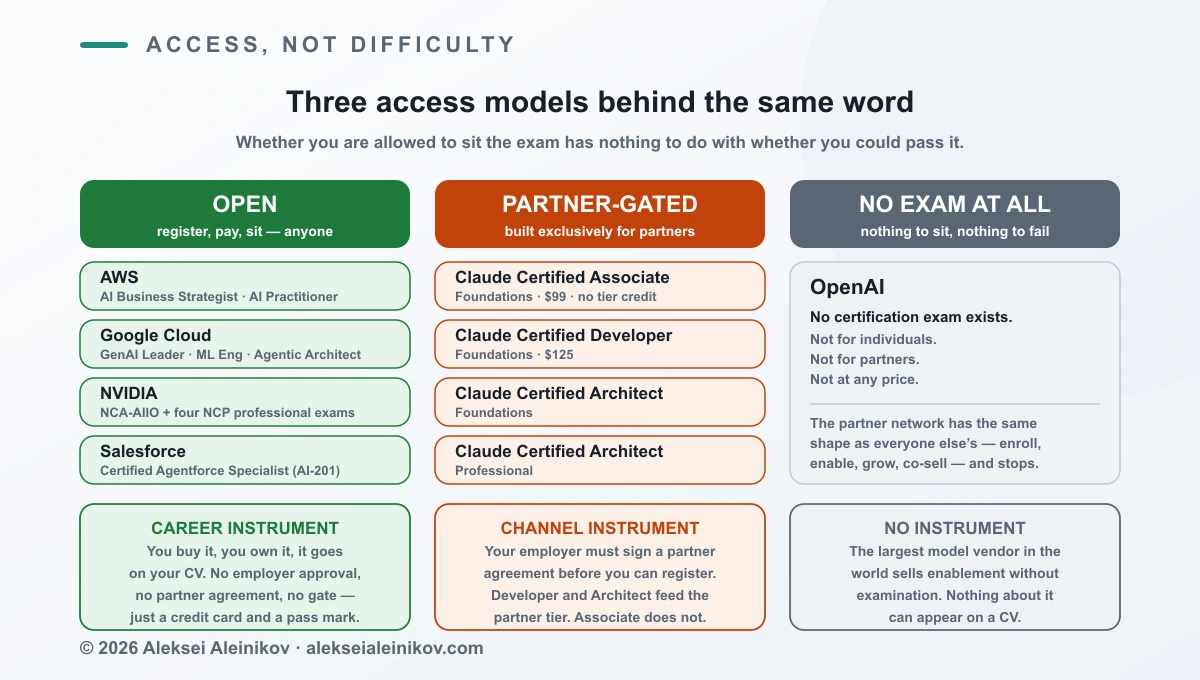
So the honest version of the pattern is not “model vendors don’t certify”. It is that where a model vendor does certify, the exam is a channel instrument rather than a career one. Neither company offers a track an independent practitioner can enter. You are either outside the programme entirely, or you are a partner company’s employee earning a credential that feeds your employer’s tier.
That is a meaningfully different world from AWS, Google and NVIDIA, which sell exams directly to individuals with a credit card and no gatekeeping.
Microsoft Went the Other Way
One vendor is moving against the current. The Microsoft Certified: Azure AI Engineer Associate page now carries a plain warning: this certification and its renewal assessment are retired.
That was Microsoft’s flagship AI engineering exam — AI-102, covering generative AI solutions, agentic solutions, computer vision, NLP and knowledge mining. Retired during the loudest AI hiring cycle in a decade, by the vendor with the deepest model partnership in the industry.
Microsoft points to a wider refresh of its skilling programme rather than explaining the decision directly. I am not going to invent a motive. But when several vendors launch AI exams in a single year and one withdraws its flagship, that is worth noticing rather than smoothing over.
What Each One Actually Proves
Stripped of marketing, here is the honest column:
| Exam | Actually proves | Who can sit it |
|---|---|---|
| AWS AI Business Strategist | You can reason about AI investment and governance. Not that you can build. | Anyone |
| Google Generative AI Leader | You understand AI concepts well enough to lead the conversation. | Anyone |
| AWS AI Practitioner | You know what AWS’s AI services do. | Anyone |
| AWS ML Engineer – Associate | You can build and operate ML systems on AWS. | Anyone |
| Google Professional ML Engineer | You can build and operate ML systems on Google Cloud. | Anyone |
| Google Professional Agentic Architect | You can design agent systems on Google Cloud. | Anyone |
| Salesforce Agentforce Specialist | You can configure agents inside Salesforce. | Anyone |
| NVIDIA NCA / NCP tiers | You can deploy and operate physical AI infrastructure. | Anyone |
| Claude Certified Architect | You can design Claude solutions — and your employer is a partner. | Partner staff only |
Two practical rules fall out of this.
Match the band to the job title, not to the hype. A platform engineer taking the Business Strategist exam has bought a credential their hiring manager will not weigh. A product manager attempting Agentic Architect has bought an exam they will struggle to pass and cannot use.
Check who the exam is really for. Some of these are career instruments sold to individuals. Others are channel instruments that happen to carry your name. Anthropic’s is explicitly the latter. AWS’s Business Strategist, sold at fifty dollars to marketing professionals with an Early Adopter badge attached, sits somewhere in between.
The Bottom Line
Even after you throw out every free course and count only exams with a fee and a fail state, “AI certified” is a phrase with no fixed meaning. It can describe a hundred-dollar business exam that tests no products, a five-hundred-dollar hardware exam on rack interconnects, or a partner-gated architect credential you cannot buy as an individual.
None of that makes any of them worthless. It makes the label useless as shorthand — which matters most for the person reading your CV, who has to guess which of four very different things you mean.
So say which one. And before you register for anything, work out whether you are buying a career instrument or funding somebody’s partner tier. Both can be worth it. They are just not the same purchase.
From the community
Discussion on Mastodon & Bluesky
Replies to this article from the open web, pulled in live. No ads, no tracking scripts.
Reply there — it shows up here automatically.