
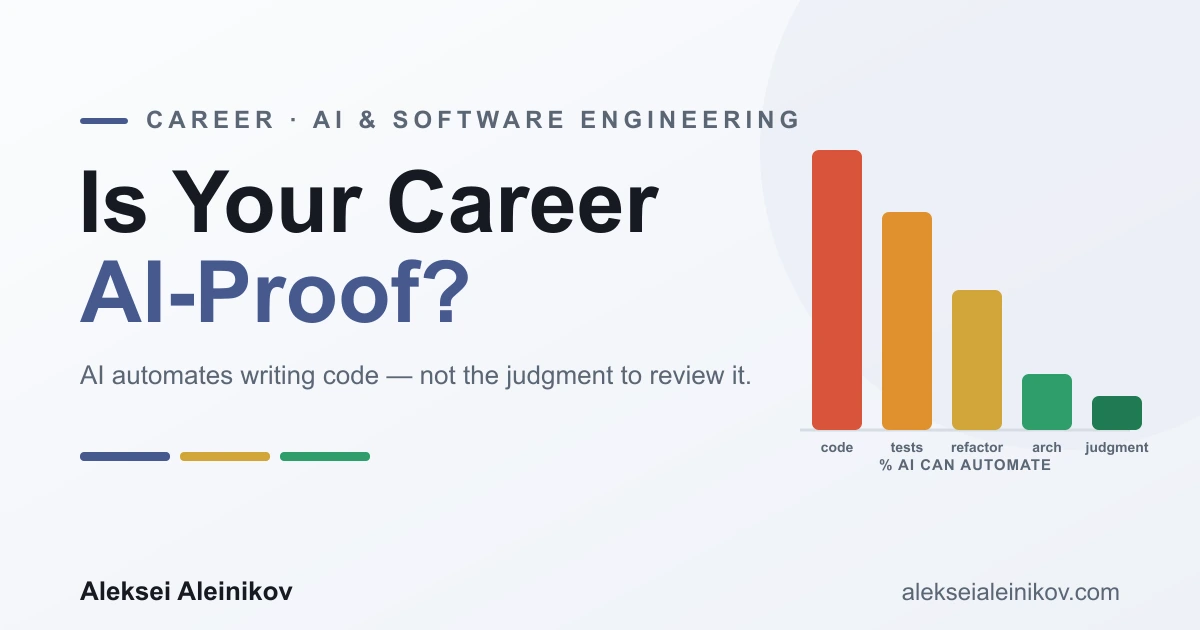
There’s a question quietly being googled hundreds of thousands of times a month, and advertisers are paying over ten dollars a click to sit next to it: “Will AI replace software engineers?” Right behind it: “Is my career AI-proof?”
So here’s the honest answer — not the hype-merchant one, and not the it’s-all-fine one.
AI has automated the part of engineering that was never actually the hard part. And a lot of companies are about to learn that the expensive way.
What AI Actually Automates
Here’s the thing nobody selling you a course wants to say plainly: producing code was never the scarce skill. Typing out a CRUD endpoint, a test file, a bit of glue between two APIs — that’s the work AI does brilliantly, because it’s pattern-dense and low-judgment. It’s exactly where large language models shine.
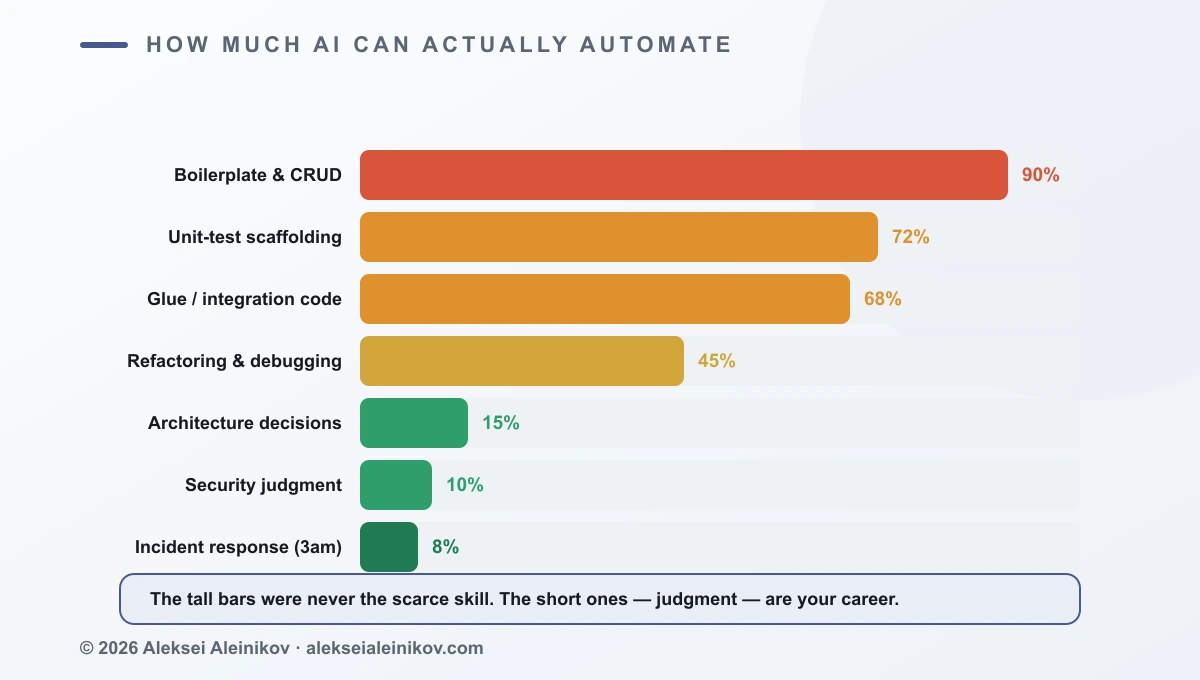
Look at the bottom of that chart. Architecture decisions, security judgment, incident response — the things that decide whether a system survives Black Friday or leaks a million records — sit near the floor. Not because AI is bad, but because those tasks are judgment, not production. They require holding the whole system in your head, weighing trade-offs with no clean answer, and owning the consequences.
The uncomfortable implication: if your entire value was writing the code at the top of that chart, yes, you should be nervous. If your value is deciding which code belongs there and why, AI just became the best assistant you’ve ever had.
The Competence Companies Are Confusing
Now the expensive mistake. A lot of companies looked at AI coding agents and did this math: junior developer + AI = senior developer, at half the price. Hire a thousand juniors, give them Copilot and Claude Code, skip the expensive seniors.
That math confuses two completely different competences:
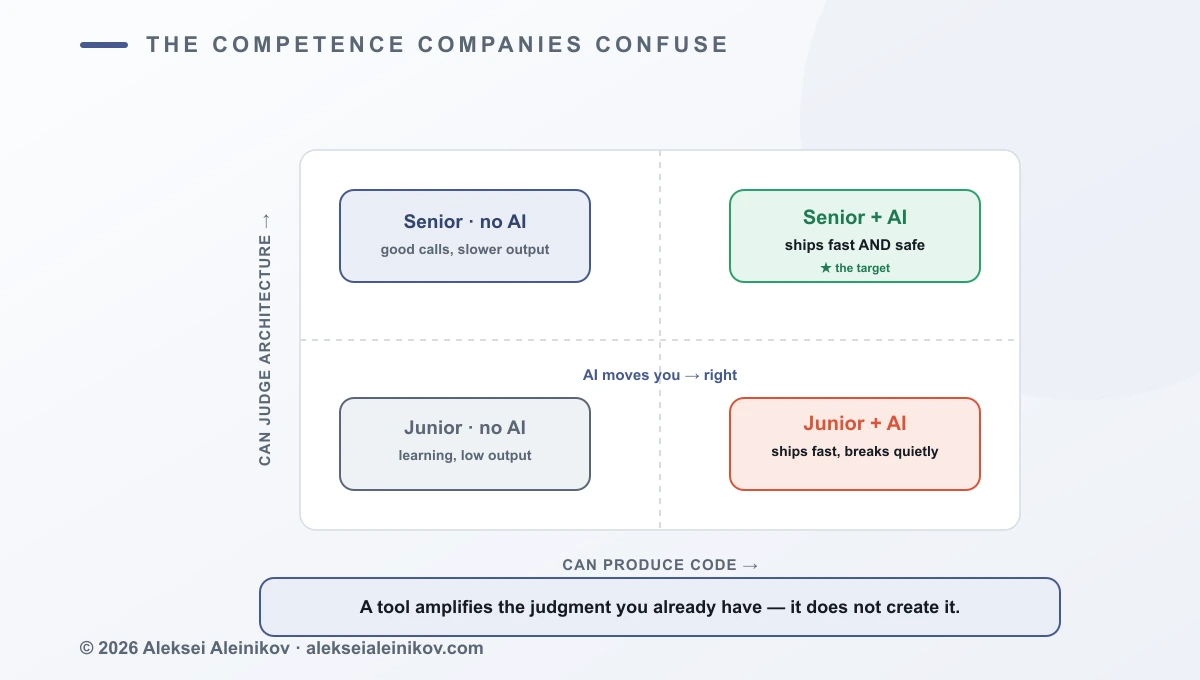
AI moves a junior horizontally — it dramatically raises how much code they can produce. It does not move them vertically — it does not give them the judgment to know if that code is right. A junior with AI lands in the bottom-right: high output, low judgment. They ship fast, and they break things quietly, because the failure isn’t a syntax error the AI catches — it’s a missing index that melts the database at 10× traffic, an auth check in the wrong layer, a migration that isn’t reversible.
A tool doesn’t create judgment. It amplifies the judgment you already have. Give the same agent to a senior and they land top-right — fast and safe — because they can look at the generated architecture and know, in seconds, whether it will hold.
Spending Tokens Is Not the Skill
This is where “prompt engineering” gets oversold. Using AI well is not about spending more tokens. It’s about asking better questions — and a good prompt is really a precise specification of the problem.
Writing that specification requires understanding the problem deeply: the constraints, the failure modes, the trade-offs, what “done” actually means under load. That’s the exact judgment a senior has spent years building and a beginner is still forming. Two engineers with the identical model get wildly different results, because the model amplifies the reasoning you bring to it — it doesn’t supply the reasoning.
So “learn to prompt” is not a career strategy. The durable skill sits underneath the prompt: knowing enough about systems to ask the question that gets a good answer, and knowing enough to tell when the answer is confidently wrong.
It’s Not the Junior’s Fault
Let me be clear, because this topic invites the wrong reading: none of this is a knock on junior engineers. A junior handed an AI agent, no mentor, no review culture, and a mandate to “just ship” is not the problem — they’re the result of a problem. The problem is a hiring decision made a level above them.
Companies in the middle of a digital transformation are under pressure to move fast and cut cost, and “AI lets us hire cheaper and skip the seniors” is a seductive story. But you cannot buy judgment as a subscription. When you remove the seniors, you don’t just remove typing speed — you remove the review, the mentoring, and the architectural taste that used to catch the missing index before it hit production.
Hiring juniors is one of the best things a company can do. Hiring them as a replacement for senior judgment — expecting AI to fill a gap that AI structurally cannot fill — is the mistake. Grown well, a junior plus AI plus a strong senior and a good platform is how you build the next generation of engineers. Grown as a cost cut, it’s a pipeline of unreviewed decisions heading straight for production.
What’s Actually AI-Proof
So here’s the honest map of what survives — and what to build your career on.
| The work | What AI does to it | Where your value goes |
|---|---|---|
| Boilerplate, CRUD, glue, first-draft tests | Automates it | Stop selling this as your edge |
| Refactoring, debugging, learning a new API | Amplifies you — if you can judge the output | Bring the judgment; move faster than ever |
| Architecture trade-offs, security calls, data modeling | Can’t do it — no clean answer to pattern-match | Own this; it’s the scarce skill |
| Incident response, “why is prod down at 3am” | Can’t do it — needs system-level reasoning | This is career insurance |
| Deciding what to build and why | Can’t do it — that’s product + engineering judgment | The most durable skill of all |
Notice the pattern: everything AI can’t touch is judgment about systems, not knowledge of syntax. That’s why “learn the cloud”, “learn platform engineering”, “learn distributed systems” is such durable advice — those fields are made almost entirely of the trade-off decisions AI can’t make for you.
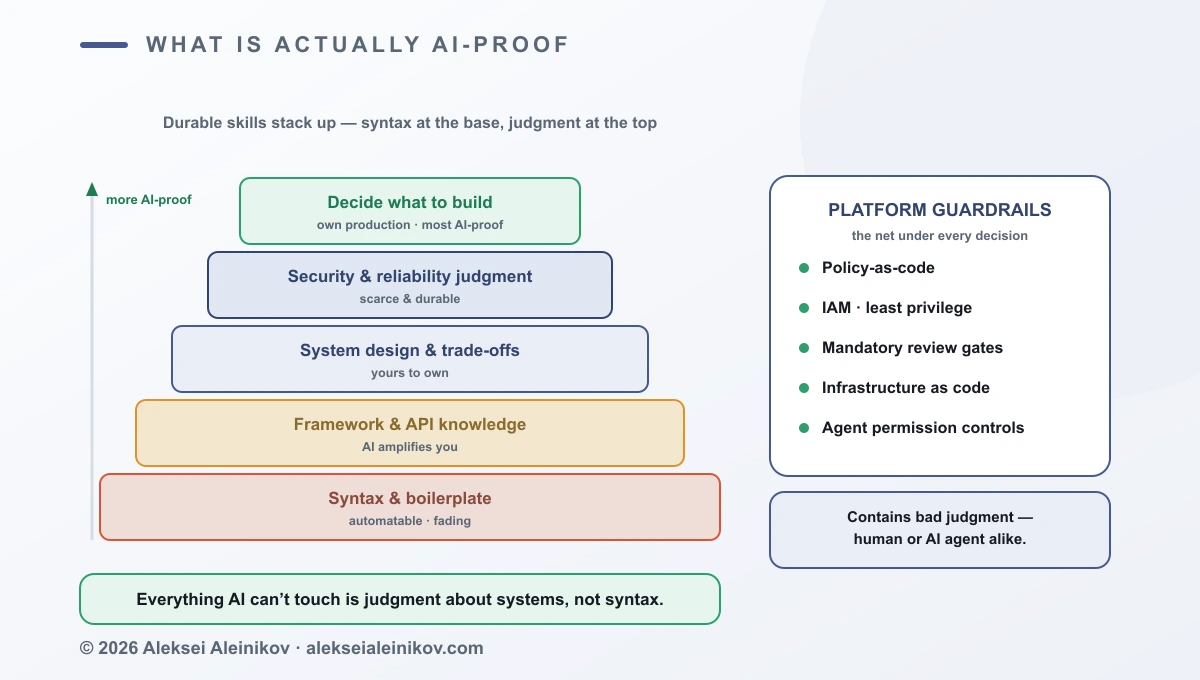
And there’s a second, quieter answer — one about how you protect an organization from this whole problem. The real defense against a bad decision reaching production isn’t “hire only seniors” (you can’t, and you shouldn’t). It’s platform guardrails: policy-as-code, IAM and least privilege, mandatory review gates, infrastructure as code, permission controls on what any agent or account can even do. A strong platform contains the blast radius of a bad decision regardless of whether a junior, a senior, or an AI agent made it.
It’s the same idea behind user-level permission controls for AI tool access and secure-by-default infrastructure: you don’t make systems safe by trusting everyone to have perfect judgment. You make them safe by building rails that make the safe path the easy path. In an AI-heavy org, that platform work is more valuable, not less.
The Honest Verdict
Is your career AI-proof? Here’s the truth: AI didn’t come for engineers. It came for one task engineers used to do — producing code — and it’s genuinely great at it. What it can’t do is decide whether that code should exist, whether the design survives failure, and who answers when production burns. That judgment is the whole job now.
Companies that understand this will use AI to make good engineers faster and to grow juniors into good engineers. Companies that don’t will spend the next two years learning, through outages and rewrites, that a tool without judgment is just a faster way to reach the wrong answer — and that “digital transformation” was never about writing code quicker. It was about deciding well.
Build the judgment. Learn the systems. Let AI handle the typing. That’s the AI-proof career — not prompting faster, but being the person who knows which answer is right.
Related reading: why coding alone isn’t enough in 2026 and how platform engineering turns judgment into guardrails everyone benefits from.
From the community
Discussion on Mastodon & Bluesky
Replies to this article from the open web, pulled in live. No ads, no tracking scripts.
Reply there — it shows up here automatically.