
Over the last year, more than 100,000 people at the world’s biggest tech companies were pushed out onto the street. We were promised the opposite. The robots would take the heavy lifting — hauling boxes, driving taxis, doing the grunt work — while we humans got to create.
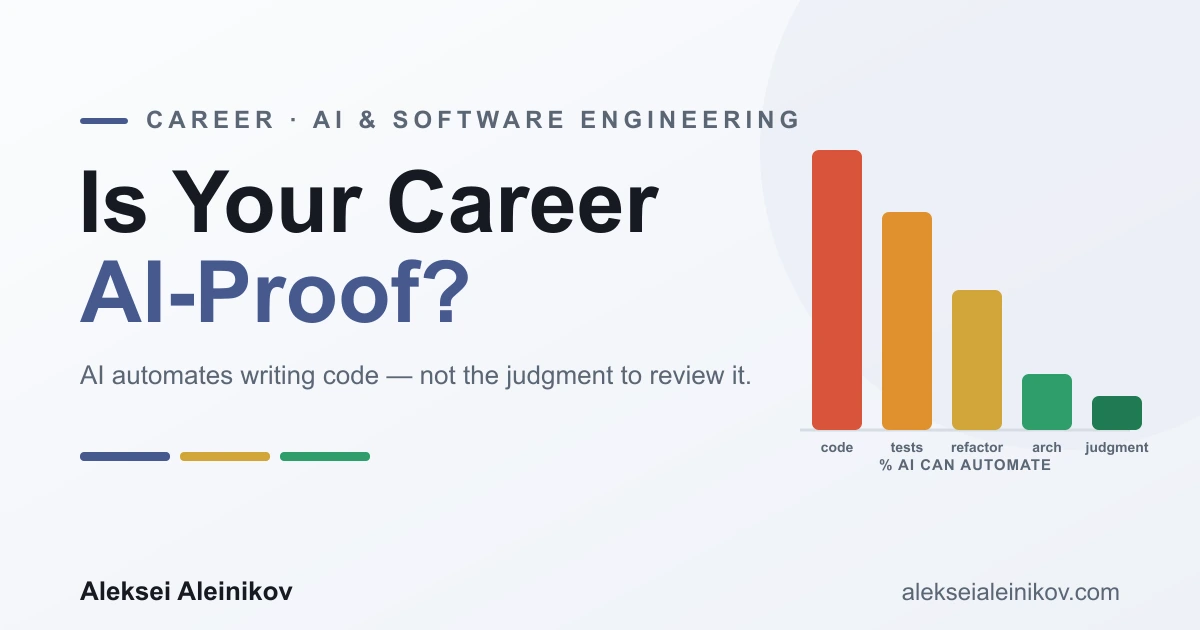
It turned out exactly backwards. AI now writes the first draft of the code, the tests, the migration script, the release notes. What survives is the messy, judgment-heavy part we assumed would be automated last: deciding what to build, why, and what to do when it breaks. There’s a pattern under that inversion — and it tells you precisely what to do next.
What AI Actually Came For
Drop the illusions and look at who’s most exposed. Three clusters show up in every serious analysis.
Routine white-collar work — data entry, basic bookkeeping, simple spreadsheet analysis, boilerplate contract drafting. US postings for routine data-entry roles have already fallen by roughly a quarter. When a job is essentially moving numbers from one cell to another, the automation case writes itself.
Scripted customer service — Gartner expects agentic AI to autonomously resolve up to 80% of common customer service issues by 2029. With millions of people working in call centers today, a large share of purely script-driven contact is on the path to automation. Work that a script fully captures is, almost by definition, the easiest thing to hand to software.
Content on autopilot — routine translation, SEO filler, mechanical rewriting. Machine translation already clears 90%+ on technical text, and a language model drafts a generic article faster and cheaper than an average freelancer. Around 37% of US companies report already using AI to replace human content work, at least in part.
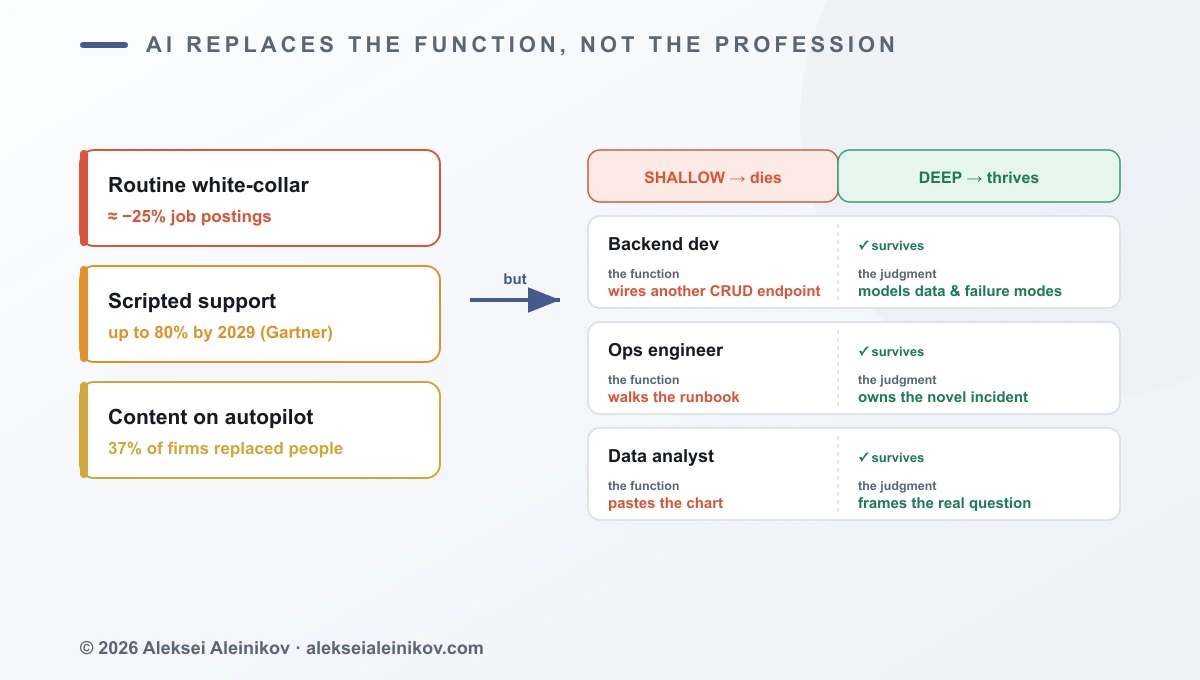
Here’s the twist the raw statistics hide: AI is not killing these professions. It is killing their shallow, mechanical version.
Stay in our own field for a second. The developer whose job is really just wiring up another CRUD endpoint — copy a controller, swap the field names, ship it — is exposed; a model does that in seconds. But the developer who decides how the data should be modelled, where the system will buckle under load, and which trade-off is worth its future cost is not going anywhere. The ops engineer who only walks the documented runbook step by step is replaceable by automation that walks it faster. The one who owns the incident nobody wrote a runbook for — forming a hypothesis at 3am from three contradictory dashboards — is not. The analyst who pulls a query and pastes the chart is exposed; the one who works out which question the business should even be asking is not.
Catch the pattern: AI replaces the function. The human stays where judgment, ownership, and non-standard decisions under limited information live. Every word in that sentence matters.
The Skill That Actually Survives: Orchestration
So if the function is automatable and the judgment isn’t, what’s the concrete skill you build a career on? It’s orchestration — and it’s the thing HR departments are quietly starting to screen for.
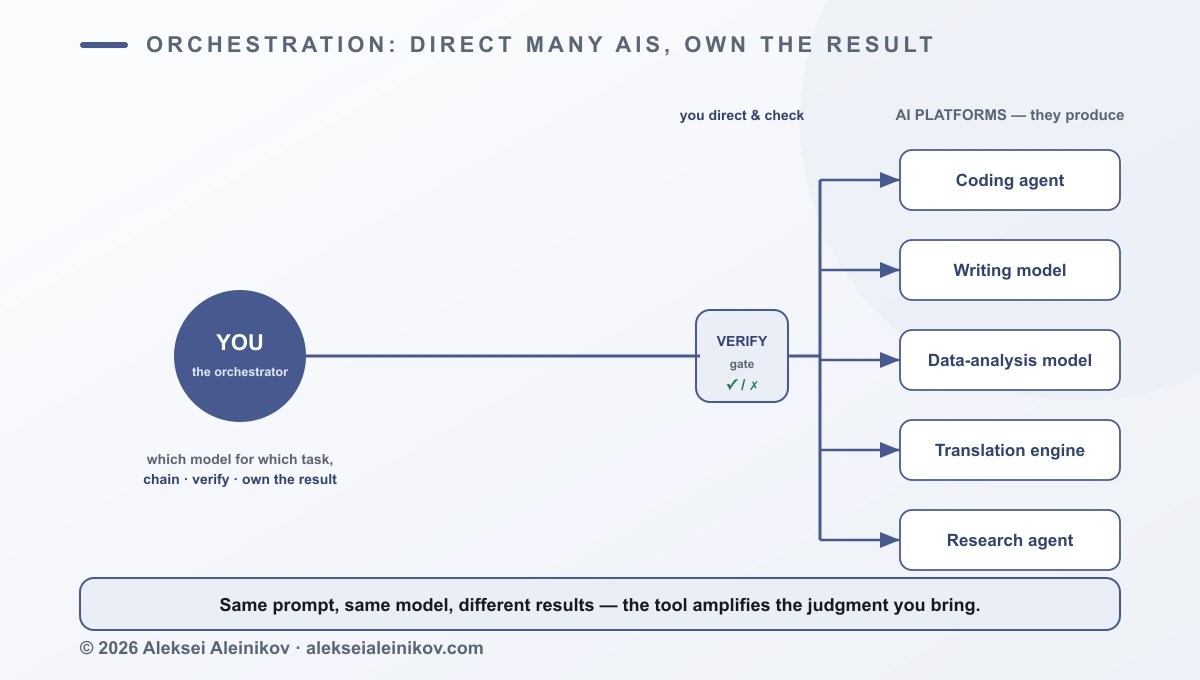
Here’s the shift. The value isn’t in producing an output anymore; the machine does that. The value is in directing several AI systems toward an outcome: knowing which model or agent fits which task, chaining them together, checking what comes back, and owning the result. Two people hand the identical prompt to the identical model and get wildly different results — because the tool amplifies the judgment you bring to it. It doesn’t supply the judgment.
This is why “prompt engineering” gets oversold as a standalone skill. Writing a good prompt is writing a good specification — and specifying a problem well requires understanding it deeply: the constraints, the failure modes, what “done” actually means. Spending more tokens doesn’t create that understanding; it just produces more output, faster. The durable skill sits underneath the prompt.
And the higher-order version is coordinating multiple, different AI platforms at once — a coding agent here, a data model there, a research agent feeding both. That orchestration across a fleet of tools is exactly the muscle that governing what those tools can even touch demands; it’s the same discipline behind user-level permission controls for AI tool access. As one way to put it: fighting the elements is pointless, leading them is already too late, but understanding them is non-negotiable.
Why Chaos Is Job Security
There’s a consistent finding in the research on AI exposure: the safest work is the work drowning in real-world mess — the tasks where conditions never match the diagram and no two situations are quite the same. A model is superb on clean, well-specified inputs and clumsy the moment reality stops matching the spec.
For engineers that safe zone has a name: production. AI is excellent at the well-formed task — generate this function, refactor that module, draft this config. It is nearly helpless in the 3am incident where the system fails in a way nobody documented, the runbook doesn’t apply, and you have to reason from first principles under limited information while real money drains away. That messy, system-level ownership is some of the best career insurance you can hold. It’s also why building secure-by-default infrastructure and platform guardrails — the rails that contain chaos before it reaches production — only grows in value as AI spreads.
The Five Skills That Became Hard Currency
We used to call them soft skills. Forget that word. They’re now hard currency — the human layer on top of AI that you actually get paid for.
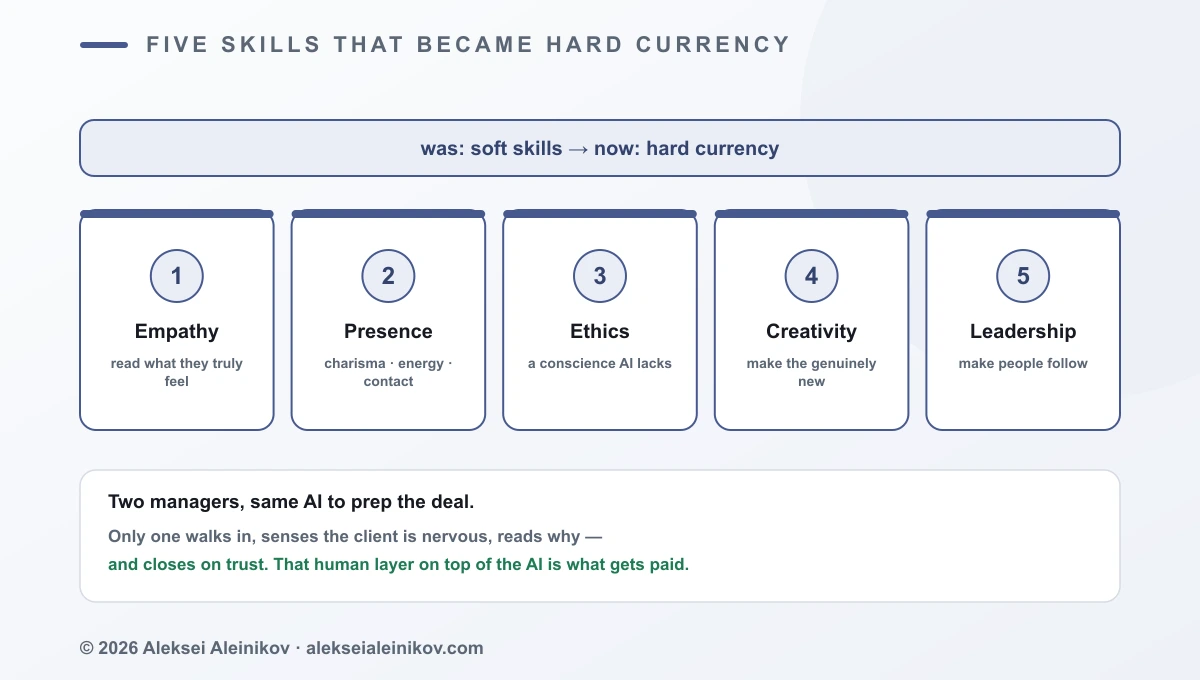
- Empathy — the ability to understand what your counterpart actually thinks, and more importantly, feels.
- Presence — personal contact, charisma, energy. We still depend, consciously and unconsciously, on the whole impression a person makes on us.
- Ethics and a point of view — AI has no conscience. It can’t say “this is wrong,” let alone feel it. The decision, and the values under it, are yours.
- Creativity — it knows a great deal and recombines the old brilliantly. A human can create something fundamentally new.
- Leadership — the ability to make people follow you, especially when everything is going badly and nothing is obvious.
Two managers can use ChatGPT identically to prep a report or a deal. But only one of them walks into the room, senses the client is nervous, works out why, and closes the deal on trust. That human layer on top of the AI is the thing that pays — and unlike a diploma on the wall, it doesn’t depreciate.
Two Moves and a Brand
So what do you actually do tomorrow morning? Three things.
Ride the wave. Learn to work with AI, not against it. Understand how the machine works. Write down three routine tasks — emails, reports, content — and set AI up to handle them. Your goal: cut the time in half, then to a third, then put a real line on your resume: “increased efficiency 50% with AI tools.” HR are still (for now) human beings, and they’re hunting for exactly the people who can orchestrate AI — especially across several different platforms at once.
Go T-shaped. Go deep in one domain until you’re excellent, then add the head of the nail: one adjacent skill. The marketer who can write a little Python. The doctor who understands data science at a working level. The designer who reads business analytics. Hybrid specialists — people who synthesize skills across disciplines wherever a task demands it — are the new elite. This is the same argument for why coding alone isn’t enough anymore: depth plus one deliberate adjacency beats narrow mastery.
Build your brand — today, not tomorrow. One post a week, minimum. LinkedIn, a blog, anywhere. About what you do, what problems you solve, what puzzles you. Document the path; don’t wait until you’re a great expert to start. An expert is mostly someone who started documenting the work sooner than you did — often not by much.
A personal brand is the one asset AI can’t copy. Reputation compounds: the more the internet fills with generated, interchangeable content, the more a known name with a real track record stands out — and the harder it gets for a new name to break through the noise. Being early is the whole advantage. People who already have an audience and a reputation pull ahead faster, because trust attracts trust; starting from zero into a saturated, AI-flooded feed is brutally hard, sometimes near impossible.
You have maybe two to three years while the window is still open. And no — you don’t need millions of followers. You need a few hundred, a couple of thousand, who know you, trust you, and value you as an expert and as a person. That asset doesn’t depreciate, unlike the diploma on your wall.
The Verdict: Direct, Don’t Compete
Here’s the honest bottom line. IBM estimates around 40% of the global workforce — well over a billion people — will need to reskill within the next three years. You are not alone in this — it’s just that some people have already picked up the oars while others wait for the current to carry them. It won’t.
The future is not a war of humans against machines; it’s humans pairing with them. The machine produces; you direct, judge, and own the outcome. AI replaces the function; you move to the ownership, the chaos, and the non-standard call. Learn to orchestrate it, go deep-plus-adjacent, and start building the reputation that no model can generate for you.
Understanding this is not enough, though. You have to act — and what stops people acting is old habits and inertia. Pick the three routine tasks. Orchestrate the AI. Write the first post this week. The tool isn’t coming for the engineer who knows how to conduct it.
Related reading: is your career AI-proof? for the deeper take on judgment versus production, and why developers should learn the cloud first in 2026.
From the community
Discussion on Mastodon & Bluesky
Replies to this article from the open web, pulled in live. No ads, no tracking scripts.
Reply there — it shows up here automatically.