
You can code. Ten years ago that was the edge. Today it is table stakes.
Because in 2026, practically every application, every AI feature, and every data pipeline lives in the cloud. The developer who only writes code ships half a product — someone else has to deploy, scale, and secure it. The developer who masters the cloud owns the whole path from idea to production. That is the most in-demand skill of the year.
I am not writing this from the outside. I run the first Google Cloud platform in production at Deutsche Telekom — under real load. I am certified multiple times as a GCP Professional and a Google Cloud Ambassador for Infrastructure. And I see every day who comes out ahead: not the best coder, but the one who connects code and cloud.
The 2026 shift: code is no longer standalone
There was a time when a developer wrote a function, threw it over the wall, and an ops team did the rest. That wall is gone. Today it is: you build it, you run it.
That is not a burden — it is leverage. Whoever understands how their code runs — on what compute, in what network, with what identity, at what cost — makes better decisions the moment they write it. And those are exactly the people who get hired, paid, and promoted in 2026.
The cloud is not “another framework.” It is the ground everything stands on now.
From code to cloud — in six steps
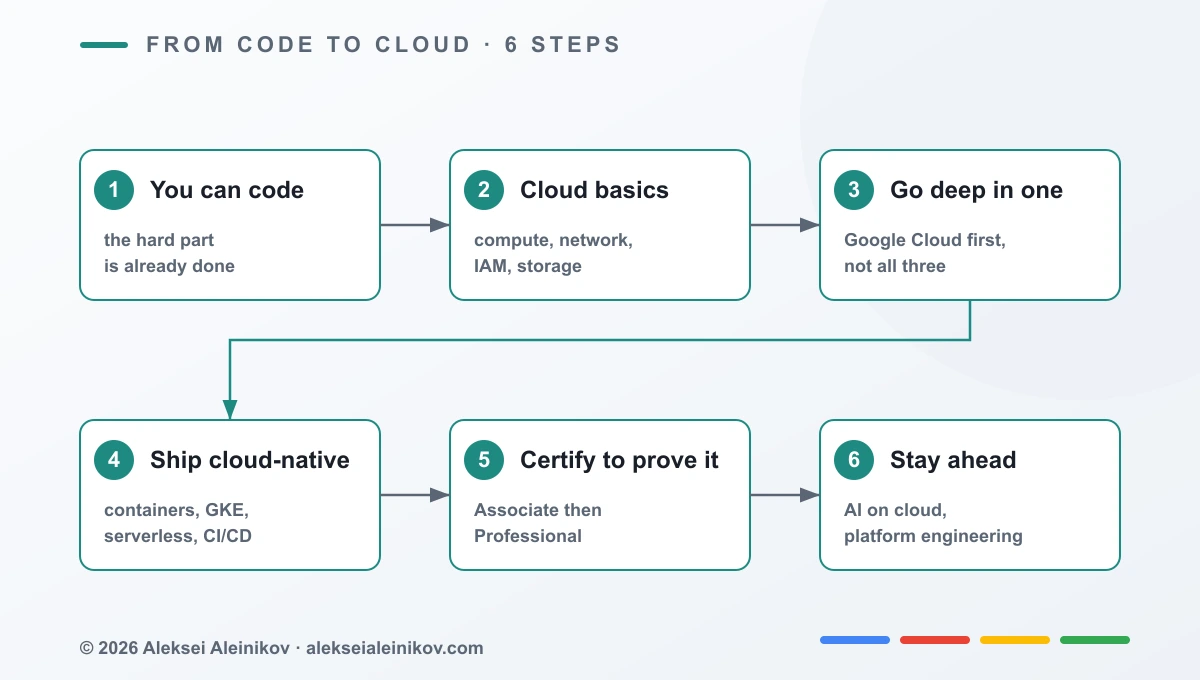
The path is shorter than you think — because step one is already done for you.
Step 1 — You can code
The hard part is behind you. Logic, data structures, debugging, version control — that is the foundation cloud competence builds on. Use that head start instead of underrating it.
Step 2 — Cloud fundamentals
Four building blocks carry everything else: compute (where your code runs), networking (how it is reachable), IAM (who can do what), and storage (where data lives). Understand those four and you understand 80 percent of any cloud.
Step 3 — One cloud, in depth
The most expensive mistake is starting AWS, Azure, and Google Cloud at once — each one shallowly. Pick one and go deep. My recommendation is Google Cloud; why, in its own section below.
Step 4 — Ship cloud-native
Now it gets concrete: containers, GKE (Kubernetes), serverless with Cloud Run, CI/CD pipelines. Not in theory — build something, run it, break it, fix it. This is exactly where the knowledge asked about in interviews comes from.
Step 5 — Certify to prove it
As an experienced developer you do not need the certificate to learn — you need it as a signal. More on that below.
Step 6 — Stay ahead
The cloud never stands still. AI workloads, platform engineering, new managed services — once you are in, you stay current through small, steady projects.
T-shaped: your code is the stem, the cloud is the reach
As a developer you already have depth — in coding. Cloud competence is the breadth that makes that depth production-ready.
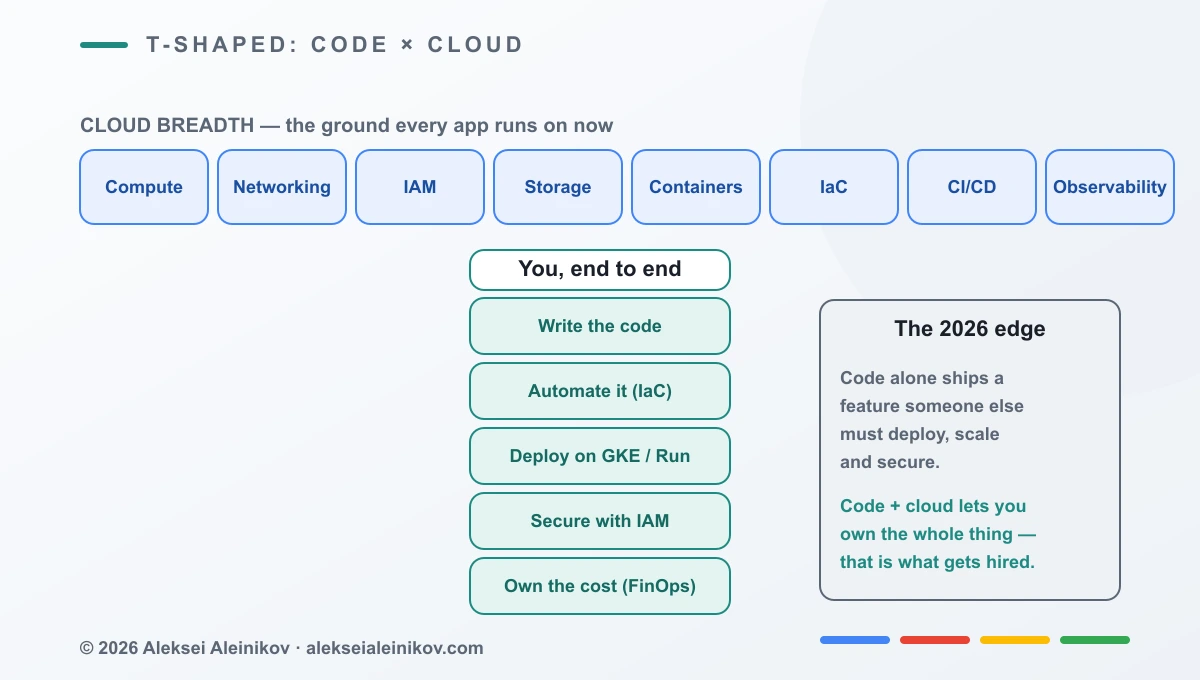
- The cloud breadth — compute, networking, IAM, storage, containers, infrastructure as code, CI/CD, observability. The ground every app runs on now.
- The end-to-end ownership — write the code, automate it, deploy it on GKE or Cloud Run, secure it with IAM, own the cost (FinOps).
Code alone ships a feature someone else must run. Code plus cloud means you own the whole thing. That is the 2026 edge.
Why Google Cloud first
“Which cloud?” is the most common question — and my answer is Google Cloud, for concrete reasons.
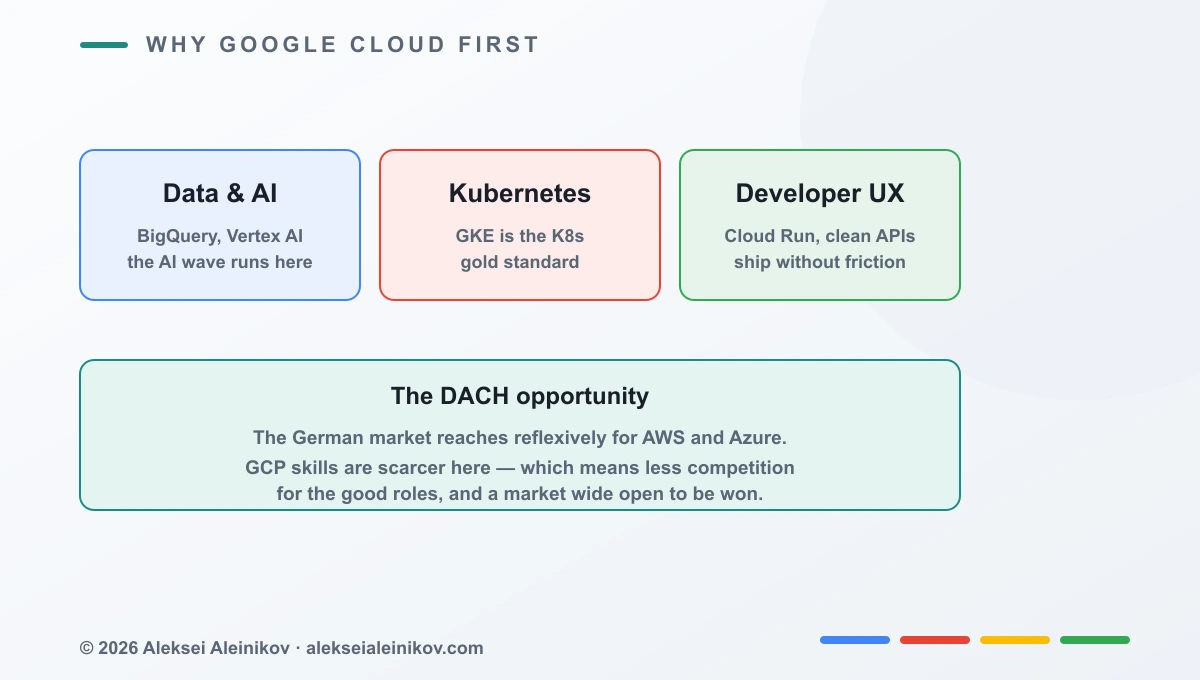
- Data & AI — BigQuery and Vertex AI make GCP the natural home of the AI wave sweeping every industry right now.
- Kubernetes — GKE is considered the gold standard for Kubernetes. Learn here and you learn it at the source.
- Developer experience — Cloud Run and clean APIs let you ship without fighting the platform.
And then the strategic layer that matters in Germany: the DACH market reaches reflexively for AWS and Azure. GCP skills are scarcer here — which shrinks the competition for the good roles and opens a market still to be won. That is exactly my mission: to make Google Cloud visible across the German-speaking world.
Certify — as a signal, not a syllabus
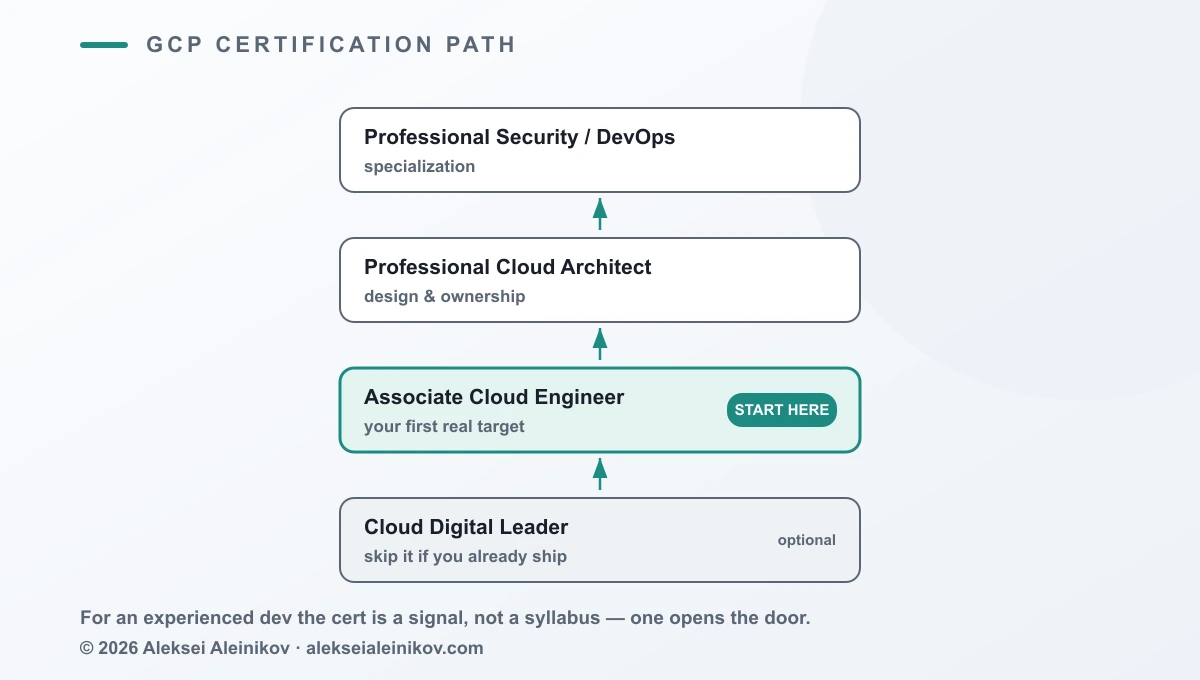
- Cloud Digital Leader (optional) — skip it if you already ship.
- Associate Cloud Engineer — your first real target. Hands-on, affordable (around 125 US dollars), and exactly the signal that tells a recruiter in seconds: this person can work in GCP.
- Professional Cloud Architect — the next step: design and ownership instead of just execution.
- Professional Security / DevOps — specialization, once you know where you are heading.
For an experienced developer, the certification is a door opener, not a study plan. Take one, open the door — and then let a real, public project win the job.
If you want to see how deep this cloud competence goes in practice: in Secure-by-Default GKE: A Reference Architecture for 2026 I show how a production-grade platform is actually built.
The point
Being able to code is valuable — but in 2026 it is the ante, not the win. The skill that makes the difference is the cloud: the ability to run your own code in production, at scale, securely.
Start with one cloud, go deep, and make Google Cloud your first. And once your first cloud-native project is online, reach out — I would be glad to take a look.
From the community
Discussion on the Fediverse
Replies from Mastodon and Bluesky — straight from the open web, no tracking.
Loading replies …
No replies yet. Start the conversation:
Replies could not be loaded right now.