
The first deployment makes Argo CD and Flux look almost interchangeable: commit a Kubernetes manifest, wait, and the application appears. The interesting comparison starts when a chart fails, an operator changes a field, another team needs access, or production must return to yesterday’s image.
Argo CD vs Flux is a choice about how your team controls delivery. Argo CD brings an application-oriented interface; Flux brings controllers that fit directly into the Kubernetes API. Both can support a serious platform. The better fit depends on who operates it, what Helm means in your workflow, and where you want permissions to live.
Argo CD vs Flux: the short answer
Choose Argo CD when developers need an integrated place to see applications, inspect diffs and request synchronization, and your platform team wants ApplicationSets to generate application definitions across a fleet.
Choose Flux when the platform is built around Kubernetes APIs, delegated service accounts, SOPS and composable source pipelines—or when preserving Helm’s release lifecycle is a requirement.
Those are starting points, not restrictions. Flux can have an excellent UI through Flux Operator. Argo CD can be operated declaratively without making every developer use its interface. Flux can manage remote clusters; Argo CD can be installed per cluster.
| Decision | Argo CD | Flux |
|---|---|---|
| Main abstraction | Application; ApplicationSet generates Applications |
Sources plus Kustomization or HelmRelease |
| Human interface | Integrated web UI, API and CLI | Kubernetes API and CLI; UI through additional projects |
| Helm ownership | Chart rendering; Argo CD manages resources | Helm release lifecycle through helm-controller |
| Common fleet pattern | Central instance with access to target clusters | Controllers in each cluster, pulling its configuration |
| Tenant controls | AppProject restrictions, Argo RBAC and cluster permissions | Service account impersonation and Kubernetes RBAC |
| Encrypted Git secrets | Integration or secret operator | Built-in SOPS decryption in kustomize-controller |
| Configuration inputs | Git, Helm, OCI; custom renderers through plugins | Git, Helm, OCI and object-storage buckets |
| Image updates | Separate Argo CD Image Updater project | Optional image controllers in the GitOps Toolkit |
| Progressive delivery | Separate Argo Rollouts project | Separate Flagger project |
| Production promotion | Git/CI workflow or an additional promotion project | Git/CI or OCI workflow; platform-defined policy |
The sections below explain the conditions behind this table, including where “supported” still means work for your platform team.
What GitOps does, in plain language
Imagine that Git declares three replicas of an application. Someone manually changes the cluster to five. A GitOps controller notices that the live state differs from the declared state and acts according to its configuration: report the difference, or restore the intended value.
Five terms make the rest easier:
- Desired state: the versioned description of what should exist.
- Reconciliation: repeatedly comparing that description with reality and acting on the difference.
- Drift: a difference introduced outside the declared configuration.
- CRD: a Kubernetes API extension. It lets you store objects such as an Argo
Applicationor FluxHelmReleasealongside ordinary Deployments. - Health: whether resources meet readiness criteria. Matching Git and serving successful requests are different questions.
CI still builds and tests the application. It publishes an image and updates a configuration reference; the GitOps controller then handles delivery. Terraform or OpenTofu can provision the cluster while either tool manages workloads inside it. Decide explicitly where their responsibilities meet. The Argo CD GitOps introduction walks through that push-to-pull transition.
Deleting a deployment job from CI does not remove authorization from the system. It moves deployment authority to a controller and to whoever can change its inputs. Reviewers, repository rules and controller credentials become part of the deployment boundary.
Architecture: an application platform versus a controller toolkit
Argo CD’s core path has three recognizable roles. The repo-server retrieves and renders configuration. The application-controller compares and synchronizes resources. The API server serves the UI, CLI and integrations. ApplicationSet and notifications add their own controllers; Redis is a cache, and Dex is an optional authentication component. Argo CD architecture
Flux separates the pipeline into source-controller, kustomize-controller, helm-controller and notification-controller, with optional image controllers and source-watcher. Source objects produce artifacts that other controllers consume. You can reason about each stage through Kubernetes resources and conditions. GitOps Toolkit components
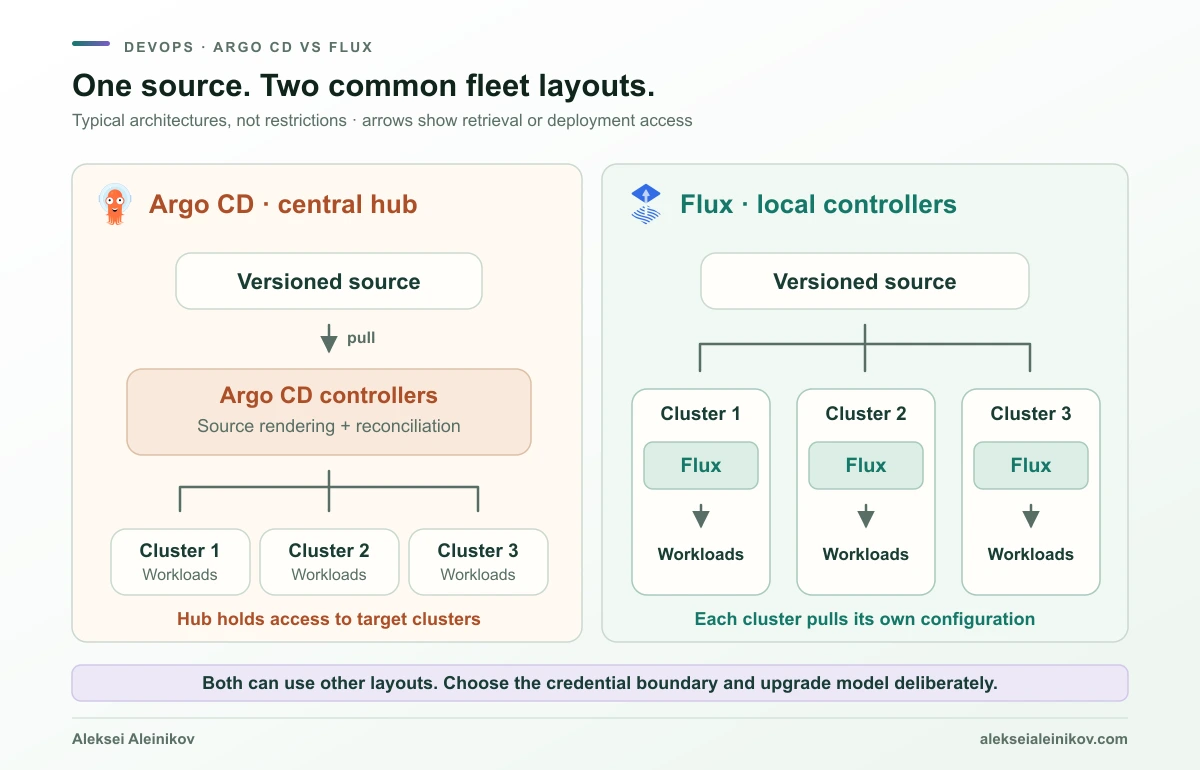
This is why Argo CD often feels like an application delivery product and Flux like platform plumbing. The trade-off appears during an incident: do developers start at an application tree and diff, or at source and reconciliation conditions? A portal can hide either model, but someone must build and maintain that portal.
The diagram shows typical patterns, not mandatory topology. A central installation concentrates credentials and availability requirements. A local installation distributes upgrades and needs fleet-wide reporting. Decide which operational responsibility your team can support.
The same deployment in YAML
Use the same public example for both tools: the kustomize-guestbook directory on the master branch of the upstream Argo example repository, deployed into an existing guestbook namespace. This avoids comparing a toy directory on one side with a private production repository on the other.
Prerequisites: a disposable Kubernetes cluster, the relevant tool and CRDs installed, permission to reconcile this namespace, and the namespace already created. The public source needs no repository token. Use one tool per test cluster, or remove the first tool’s ownership before trying the second.
kubectl create namespace guestbookDownload the Argo Application, Flux source and Flux Kustomization, with setup notes. No credentials are included.
Argo CD: source and destination in one Application
apiVersion: argoproj.io/v1alpha1kind: Applicationmetadata: name: guestbook namespace: argocdspec: project: default source: repoURL: https://github.com/argoproj/argocd-example-apps.git targetRevision: master path: kustomize-guestbook destination: server: https://kubernetes.default.svc namespace: guestbook syncPolicy: automated: prune: true selfHeal: trueThis combines the source, destination and automation policy. The local API endpoint targets the installation’s own cluster. prune permits removal of tracked resources deleted from the source; selfHeal permits correction of live changes. Both are deliberate opt-ins in this example. Application specification
project: default keeps the tutorial short. It is not a tenant isolation policy. Production should use a restricted AppProject and appropriately scoped target-cluster access.
Flux: retrieve the source, then reconcile its contents
apiVersion: source.toolkit.fluxcd.io/v1kind: GitRepositorymetadata: name: guestbook namespace: flux-systemspec: interval: 5m url: https://github.com/argoproj/argocd-example-apps.git ref: branch: masterThe GitRepository fetches an artifact. It does not deploy the application by itself. Multiple consumers can reuse a source. Flux GitRepository API
apiVersion: kustomize.toolkit.fluxcd.io/v1kind: Kustomizationmetadata: name: guestbook namespace: flux-systemspec: interval: 5m path: ./kustomize-guestbook targetNamespace: guestbook prune: true wait: true timeout: 3m sourceRef: kind: GitRepository name: guestbookThis Flux Kustomization is a reconciliation object; the repository’s kustomization.yaml is a Kustomize build file. Similar names, different jobs. wait and timeout add a readiness assessment, and targetNamespace does not create the namespace. Flux Kustomization API
The branch is intentionally readable for a learning exercise, but it moves. Record the source revision for a repeatable evaluation and pin reviewed revisions or immutable artifacts for controlled releases. These snippets illustrate the deployment API; they do not install either platform or harden it.
Helm is the difference that changes operations
“Both support Helm” hides an important distinction. Argo CD uses Helm as a manifest renderer and then controls the resulting Kubernetes objects. It does not create the Helm release you would get from helm install. Consequently, helm list is not an inventory of Argo-managed applications, and Helm’s release rollback is not their recovery mechanism. Argo maps supported Helm hooks into its own lifecycle; that is not complete Helm lifecycle equivalence. Argo CD Helm integration
Flux’s helm-controller manages an actual Helm release. Its API supports tests, values references, retries and install/upgrade remediation. A chart depending on cluster-aware rendering, release hooks or Helm test behavior therefore needs evaluation in that lifecycle, including the controller’s permissions and settings. Flux HelmRelease reference
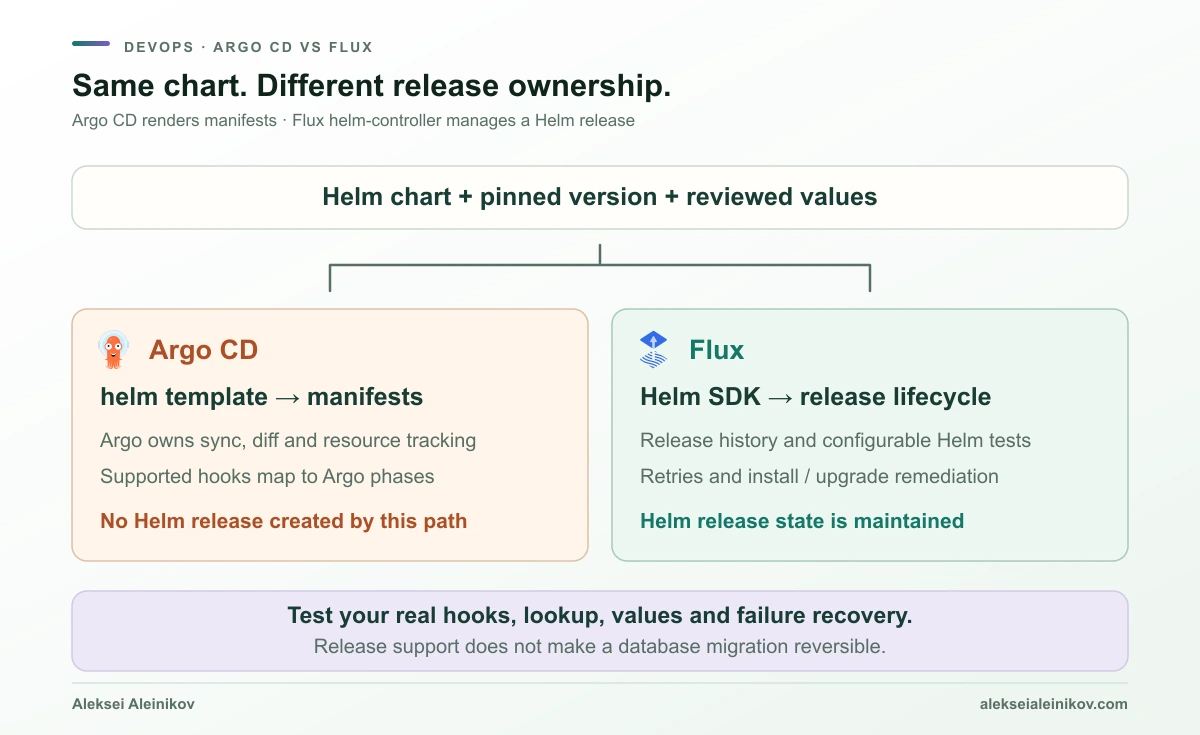
| Operational question | What to verify |
|---|---|
Does the chart use lookup? |
Whether cluster-dependent rendering works in the chosen path; offline templating cannot reproduce a live lookup |
| Are hooks required? | Which hook events are supported, when they run and who removes failed Jobs |
Is helm test part of acceptance? |
How tests are triggered and whether failure blocks promotion |
| Are values stored in ConfigMaps or Secrets? | How changes trigger reconciliation and who can read them |
| Is post-rendering required? | Supported renderer, hook treatment and version-specific defaults |
| What happens after a failed upgrade? | Retry, rollback, uninstall or explicit intervention—and what Git still declares |
Flux 2.8 introduced Helm v4, including new server-side apply and health-checking behavior. Existing releases retain their stored apply method unless opted in; “upgrade Flux” does not mean every release instantly changes apply mode. Flux 2.9 also changed post-render strategy defaults. These are upgrade review items, not free improvements to assume. Flux 2.8 release notes, Flux 2.9 release notes
A team with simple, deterministic internal charts may prefer Argo CD’s unified diff and resource management. A team already operating through Helm release history, tests and remediation should give Flux a close trial. Test your awkward chart, not just the example that renders everywhere.
Sync, health, dependencies and drift
Argo CD separates synchronization policy from health. Automated sync does not automatically imply pruning or self-healing. Its documentation also warns that an application with automated sync enabled cannot use the application’s rollback operation in that state. A reviewed Git revert is usually the more durable correction because it changes desired state. Automated sync policy
Flux continuously reconciles on configured intervals; webhook Receivers can accelerate source updates, and suspension pauses the relevant reconciliation. For Helm-managed resources, configure Helm drift detection explicitly rather than assuming a release check always repairs every manual field edit. Flux Helm management guide
Ordering is not a global transaction
Argo CD provides sync phases, hooks and numbered waves. A wave can order resources within a synchronization, but annotating unrelated Applications does not create a universal dependency graph across the fleet. Sync phases and waves
Flux dependsOn expresses dependencies between Kustomizations or HelmReleases of the relevant type. Readiness rules, including CEL where supported, can make dependencies more precise. Avoid cycles and distinguish “the CRD exists” from “the operator is ready to reconcile its custom resources.” Kustomize API reference
For a database operator followed by a database and an application, define what each boundary means. A Kubernetes Deployment becoming Available does not prove a database migration is reversible or an HTTP checkout succeeds. Neither product turns a distributed release into a transaction.
Let each controller own the right fields
An HPA may own replica count; a webhook may inject fields. Argo CD offers ignoreDifferences; honoring those differences during apply can also require RespectIgnoreDifferences=true. Hiding a diff and changing apply behavior are separate choices. Diff customization, sync options
Flux has field ignore rules for Kustomization drift handling. Use narrowly selected fields and resource selectors, then verify what the controller actually leaves alone. A broad ignore rule can hide a bad change as easily as a legitimate controller update. Selective Flux drift correction
Git, OCI, buckets and rendered manifests
Argo CD accepts Git, Helm and OCI sources. OCI support has packaging constraints, including accepted media types and a single artifact layer. A Helm OCI chart and a generic OCI manifest artifact are related but different source configurations. Do not copy one repository URL format into the other blindly. Argo CD OCI documentation
Flux models Git, OCI, Helm repositories and object-storage buckets as sources. OCIRepository supports artifact signature verification; verification must be configured with the expected identity or trust policy. Merely placing an artifact in a registry does not authenticate its publisher. Flux OCIRepository documentation
Argo CD’s Config Management Plugins accommodate custom rendering tools. Flux deliberately keeps arbitrary renderer execution out of its reconciliation model; render unusual formats in CI and publish the result. Its optional source-watcher and ArtifactGenerator support source composition and splitting. This changes where dependencies, code execution and troubleshooting live. Flux FAQ
Rendered manifests make that boundary explicit: source templates go through a controlled build, and the exact output becomes the reviewed deployment input. Argo CD’s Source Hydrator automates a Git-based version of this pattern and is documented as beta-quality. Crucially, do not inject plaintext secrets during hydration: the generated output is committed to Git. Keep secret resolution on the destination cluster. Source Hydrator
That pattern can improve review clarity, but it creates another artifact to retain, authorize and trace back to its source. A signed manifest bundle still needs a trustworthy build process and immutable references to images.
UI: compare the installations people will actually use
Argo CD’s built-in interface is a substantial advantage when developers need an application tree, live state, diff and synchronization controls in one place. It gives the platform team a shared vocabulary for support. The same convenience creates another identity and authorization surface to operate.
Flux core has no built-in UI, but Flux Operator supplies a separate UI with pipeline graphs, workload and log views, OIDC login and Kubernetes RBAC. That interface belongs to the Operator ecosystem, rather than the core controller installation. Calling Flux “CLI-only” without this distinction is outdated. Flux Operator Web UI
Evaluate the whole path: can a developer find a failed rollout without cluster-admin, see the exact source revision and understand the next permitted action? Count the cost of SSO, upgrade ownership and support documentation alongside the feature list. A screenshot is not a developer experience test.
Multi-cluster scaling: move credentials or distribute controllers?
Argo CD commonly uses a hub-and-spoke design. ApplicationSets generate Applications from cluster registrations, Git directories, pull requests and combinations of inputs. That reduces repetitive configuration while keeping application management in one place. ApplicationSet introduction
The hub still needs capacity. Repository rendering, cluster watches, reconciliation queues, cache behavior and controller sharding matter. A monorepo can amplify work when many applications share inputs; use the documented tuning options and measure your own change fan-out. Argo CD high availability and scaling
Flux is commonly installed in each cluster, with a path such as clusters/eu-prod selecting that cluster’s configuration. This avoids requiring one central deployment identity for every target, but creates a fleet of installations to update. Remote-cluster reconciliation is also possible. Flux Operator’s ResourceSet offers additional generation patterns; it is not the same core API as ApplicationSet.
There is evidence for scale on both sides:
- The 2025 Argo CD user survey reported that 42% of respondents managed over 500 applications per instance and 25% connected more than 20 clusters. That describes respondents, not the whole Kubernetes market. CNCF survey summary
- The Morgan Stanley case study describes over 500 clusters with Flux, service account impersonation, interval and concurrency tuning, centralized observability and a move from self-hosted Git to S3 delivery artifacts. That is an implementation report, not a head-to-head benchmark. Flux case study
Neither proves that one configuration will use less memory on your fleet. A fair performance comparison must hold application count, resource count, source size, intervals, replicas, enabled components and failure conditions constant.
Multi-tenancy and security: trace the actual authority
In Argo CD, an AppProject limits permitted sources, destinations and resource kinds. Argo RBAC then controls user actions; target-cluster credentials determine what the controller can actually do. The default project is permissive and needs deliberate replacement or restriction in a shared platform. Argo CD projects, Argo RBAC
Flux can reconcile on behalf of a tenant service account. Lockdown includes limiting cross-namespace references, selecting a default service account and restricting remote bases. The important property is enforced impersonation, not simply creating one namespace per team. Flux multi-tenancy lockdown
| Boundary | What a production review should establish |
|---|---|
| Repository | Who can change controller definitions, sources and destination permissions? |
| Rendering | Which inputs cause executable tooling to run, and with which credentials? |
| Tenant | Can one team select another team’s source, Secret, service account or destination? |
| Network | Which APIs and webhooks are exposed, and what egress can controllers reach? |
| Artifact | Are release artifacts and source signatures checked against expected identities? |
| Recovery | Can an authorized operator stop a bad reconciliation without broad permanent access? |
Both projects publish security guidance and advisories. Compare your installed version with affected ranges and patched releases. An advisory total is not a probability of compromise: repository boundaries, component scope, disclosure history and research attention differ. Use the totals to find work to investigate, not to award a security trophy. Argo CD security guidance, Flux security documentation
Flux 2.10 adds SPIFFE-based controller mTLS and object identity capabilities. These require the corresponding identity and trust configuration; installing the version alone does not establish a SPIFFE trust domain. Flux 2.10 announcement
The useful security comparison is the path from an allowed Git change to an allowed cluster action. Draw that path before counting features.
Secrets and keyless access on GKE
Flux’s kustomize-controller integrates SOPS decryption, with age and supported key-management backends. That keeps ciphertext in Git, but the decryption identity, resulting Kubernetes Secret and workload access still need controls. Encryption in Git does not protect a secret from an authorized decryption controller. Flux SOPS guide
Argo CD commonly works with External Secrets Operator or Sealed Secrets; rendering-time secret injection through a plugin is another architecture, with different exposure through generated manifests and caches. The project’s documentation favors destination-cluster secret management. Argo CD secret management
On GKE, Flux documents Google Cloud authentication for Artifact Registry, Cloud Storage, Cloud KMS and remote GKE access. Object identity lets different Flux resources use different identities; cloud IAM bindings and controller configuration must match that design. This is a concrete advantage when the platform requirement is tenant-scoped, short-lived Google credentials. Flux Google Cloud integration, object identity setup
Argo CD’s private-repository guide documents Azure Workload Identity and a JSON-key path for Google Cloud Source Repositories. That does not establish that Argo CD cannot use keyless access anywhere on GKE. Repository access, registry access, destination-cluster authentication and a secret operator are different integration paths. Require a documented, maintained path for each service instead of inferring support from one credentials section. Argo CD private repositories
For either design, the workload identity federation guide explains the credential lifetime and trust boundary that matter more than where a JSON file happens to be stored.
Image updates, promotion and canaries are three different jobs
Image automation selects a new image reference. Flux’s optional ImageRepository, ImagePolicy and ImageUpdateAutomation controllers connect registry discovery to a Git change. Argo CD Image Updater is a separate project. In either case, define which repository or branch an automated writer may change. Flux image controllers, Argo CD Image Updater
Promotion decides that an already tested artifact may enter the next environment. That requires evidence and policy: who approves, which tests must pass, which digest moves forward, and how a failed promotion stops. A semver range that discovers a new chart is not an approval workflow. Kargo and GitOps Promoter add promotion machinery around Argo-oriented workflows; Flux platforms often use Git pull requests or controlled OCI references. Kargo, GitOps Promoter
Progressive delivery shifts traffic and evaluates a rollout. Argo Rollouts and Flagger are separate controllers, not features to attribute automatically to a base Argo CD or Flux installation. Their metrics and abort conditions also need operating ownership. Argo Rollouts, Flagger
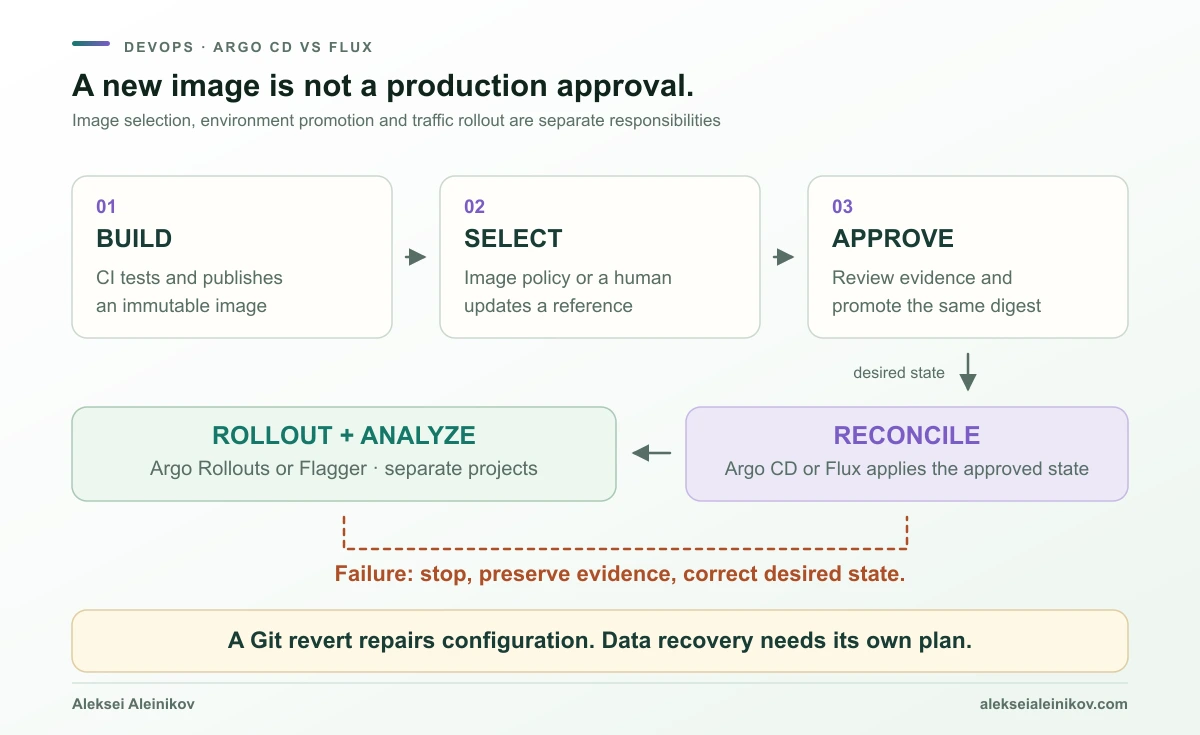
A robust workflow promotes the same immutable image digest from staging to production. Rebuilding the same source for production introduces a different artifact. Keep rollback instructions aligned with both configuration and data: reverting an image cannot undo every schema migration.
Notifications, observability and AI access
Argo CD’s notifications controller and Flux’s Provider/Alert model can send delivery events into existing team workflows. Configure useful failure signals and source revision links rather than flooding chat with every successful reconciliation. Argo CD notifications, Flux notification-controller
Monitor source-fetch errors, reconciliation failures and duration, queue pressure and the time since the last successful desired revision. A green controller pod does not mean the fleet is current. Flux exposes controller metrics for this purpose. Flux monitoring reference
Flux Operator also offers an MCP server. It is not intrinsically read-only: the documented default for --read-only is false, and write tools are disabled only when that mode is selected. Secret masking and a model’s promise do not replace scoped Kubernetes permissions. MCP configuration
If an assistant can inspect logs and request changes, treat it as another deployment client. Separate observation from mutation and apply the AI agent trust-boundary checklist before connecting production credentials.
Releases, project health and upgrade work
Both projects belong to the CNCF graduated ecosystem: Flux graduated in November 2022, and the Argo project in December 2022. Graduation signals project maturity; it does not certify your deployment configuration. Flux graduation, Argo graduation
Flux continued after Weaveworks’ closure, with corporate support and maintainers across its ecosystem. Do not confuse an old vendor’s fate, Flux v1 or a legacy UI with the status of today’s Flux project. Flux ecosystem update
Stars and contributor totals can help locate an ecosystem, but comparing one repository with a toolkit spread across several repositories is not a reliable activity ranking. For procurement, inspect release cadence, supported versions, advisory response and whether your organization can obtain the support it needs.
Argo CD upgrades deserve behavioral review, not only a new image tag. The 3.6 upgrade notes describe server-side diff becoming the default when ServerSideApply=true is set, with an explicit opt-out and additional API-server requests to consider. Earlier major upgrades also changed RBAC and resource tracking defaults. Argo CD 3.5–3.6 upgrade notes, 2.14–3.0 migration
Flux upgrades also have behavioral changes and deprecated APIs. Check controller feature gates, Helm defaults and the Kubernetes support matrix. flux migrate assists API migration; it does not test your charts, permissions or failure recovery. Read the release’s upgrade section before rolling it across a fleet. Flux upgrade procedure
Managed Argo CD and Flux: AWS, Azure, GitLab and Google Cloud
Cloud integration can determine the practical choice before a feature comparison does. Distinguish a fully operated service from an extension that manages components in your cluster.
| Platform | Current documented option | Decision consequence |
|---|---|---|
| Amazon EKS | Managed Argo CD capability, including IAM Identity Center integration | Evaluate capability limits and IAM alongside the reduced control-plane operations |
| Azure AKS | Flux integration and an Argo CD extension; Argo CD extension is GA | Compare identity, supported configuration and extension lifecycle |
| Azure Arc-enabled Kubernetes | Flux integration; Argo CD extension remains preview | Preview status can affect production approval |
| GitLab | GitOps documentation recommends Flux with the Kubernetes agent | Useful alignment with GitLab’s integration path, not a ban on Argo CD |
| OpenShift | Red Hat OpenShift GitOps is based on Argo CD | Distribution support may outweigh a self-managed feature preference |
| Google Cloud | Config Sync is a distinct GitOps option using Git, OCI or Helm sources | Compare it separately; it is not a managed edition of Argo CD or Flux |
Sources: Amazon EKS Argo CD, Azure Flux, Azure Argo CD, GitLab GitOps, OpenShift GitOps, Google Config Sync.
Commercial offerings around the projects include Akuity, Codefresh/Octopus and ControlPlane. Compare the exact offering’s support, tenancy, retention, identity and pricing rather than transferring upstream assumptions to it. Open-source software still costs engineering time, compute and incident response; “free” does not mean the same total cost for both architectures.
How to choose: a practical evaluation plan
Start with your hardest representative application and the actual intended permissions. Include one ordinary workload, one dependency-heavy operator and the Helm chart most likely to expose lifecycle differences.
| Exercise | Evidence to collect |
|---|---|
| Deploy the same reviewed revision | Applied revision, readiness result and instructions a developer followed |
| Make a harmless manual change | Detection, repair policy and behavior for deliberately ignored fields |
| Introduce a failed rollout | Failure reason, alert quality and the next allowed operator action |
| Recover through a reviewed revert | Time to recover, source revision and any remaining data dependency |
| Block source access temporarily | Running-workload behavior and ability to deploy after access returns |
| Attempt a forbidden tenant action | A denial at the enforcing API, not merely a hidden UI button |
| Promote one immutable artifact | Approval evidence and unchanged digest across environments |
| Rebuild a test cluster | Bootstrap order, identity setup and recovery of external state |
Record measured results with your versions and settings. Do not extrapolate an empty installation’s RAM footprint into a production fleet estimate. Compare the entire installation you need, including UI, HA replicas, image controllers, secret integration and monitoring.
Three architectures worth trialing
A developer-facing application platform: Argo CD with ApplicationSets, a restricted AppProject per team, external secret resolution and a promotion workflow. Its advantage is a coherent application interface. Its work is operating the hub, permissions and integrations.
A Kubernetes-native GKE fleet: Flux per cluster, object-scoped Google identity, SOPS with Cloud KMS where appropriate, and signed OCI artifacts if that matches the supply chain. Add Flux Operator for the required human interface. Its work is fleet upgrades, source packaging and a usable support path.
A hybrid infrastructure/application split: Flux owns cluster infrastructure and Argo CD owns team applications. Define ownership down to resources and fields; never let both controllers continually correct the same object. This is justified only when the split solves a real organizational need and the team accepts two operational stacks.
Start small without confusing a tutorial with production
Follow the official Argo CD getting started guide or Flux getting started guide in a disposable cluster, using a selected release rather than a floating install manifest. Flux bootstrap can install controllers and commit their configuration to a Git repository; grant bootstrap credentials only the access needed for that operation.
Then apply the matching guestbook example above and inspect the result:
# Argo CD test clusterkubectl -n argocd get application guestbook
# Flux test clusterflux get sources git -n flux-systemflux get kustomizations -n flux-system
For deeper exercises, use the official Flux multi-tenancy example and Kustomize/Helm example, plus Argo CD’s ApplicationSet and upgrade documentation. Courses and certifications can organize learning; the deployment and denial evidence in your own environment establishes whether the design works.
Choose the control model your team can operate
Argo CD is a strong starting point for an application platform whose developers benefit from an integrated UI and generated fleet definitions. Flux is a strong starting point for a controller-oriented platform that values Helm releases, delegated Kubernetes identities and composable sources.
Choose after a failed deployment, a denied tenant request and a recovery—not only after the first green dashboard. Those are the moments when an attractive feature becomes a dependable operating model.

From the community
Discussion on Mastodon & Bluesky
Replies to this article from the open web, pulled in live. No ads, no tracking scripts.
Reply there — it shows up here automatically.