
Every TypeScript backend discussion eventually circles back to the same three names: Express, Fastify, and Hono. Express 5 finally shipped native async error handling, Fastify 5 refined its schema-compiled pipeline, and Hono 4 turned Web Standards into a serious Node.js contender alongside Bun and Cloudflare Workers.
Older 2024 benchmarks claimed Hono was always slower than Fastify on Node.js because of the IncomingMessage-to-Request adapter. I wanted to see what actually holds up on Node.js 26.13.0 with Express 5.3.0, Fastify 5.12.8, and Hono 4.13.22 (@hono/node-server 2.1.11) — across plain JSON, authenticated parameterized routes, and validated POST payloads.

Hono vs Express vs Fastify: the short answer
| Metric (Node.js 26.13, 100 conns) | Hono 4.13 | Fastify 5.12 | Express 5.3 |
|---|---|---|---|
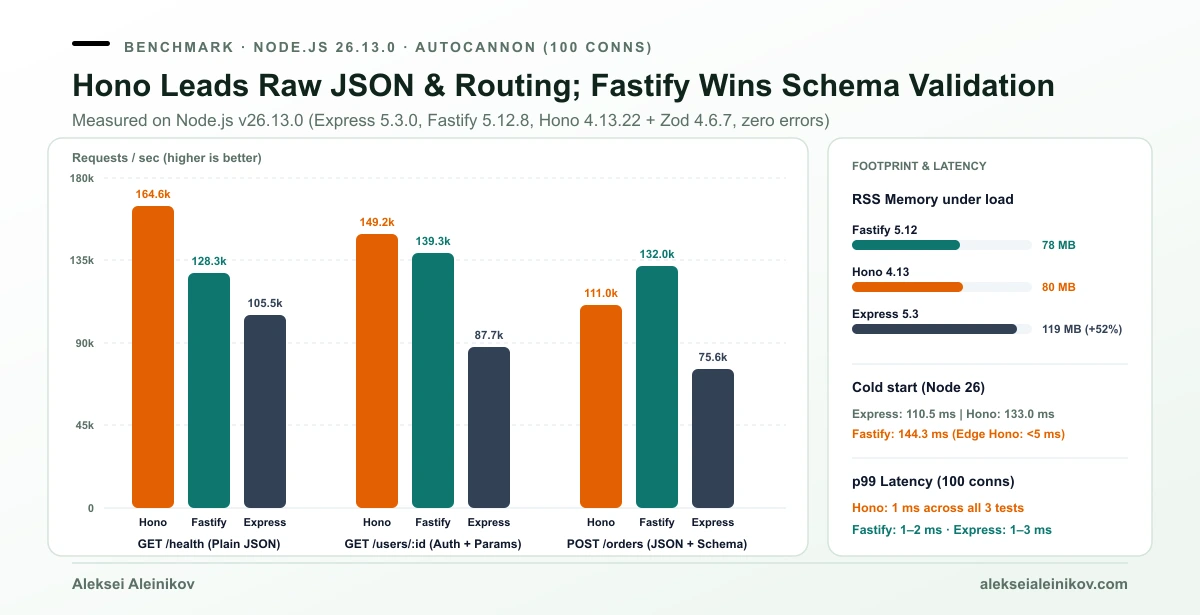
GET /health (plain JSON) |
164,629 req/s (1 ms p99) |
128,293 req/s (2 ms p99) |
105,451 req/s (1 ms p99) |
GET /users/:id + auth header |
149,227 req/s (1 ms p99) |
139,323 req/s (1 ms p99) |
87,744 req/s (2 ms p99) |
POST /orders + schema validation |
110,997 req/s (1 ms p99) |
132,037 req/s (1 ms p99) |
75,605 req/s (3 ms p99) |
| RSS memory under load | 80 MB | 78 MB | 119 MB (+52%) |
| Cold start to ready | 133.0 ms | 144.3 ms | 110.5 ms |
| Runtime portability | Node, Bun, Deno, Workers | Primarily Node.js | Primarily Node.js |
The headline takeaway is nuanced: Hono won raw routing and plain JSON on Node.js 26, whereas Fastify won the realistic POST + validation test by ~19% thanks to precompiled Ajv schemas. Express 5 trailed in throughput and used 50% more RAM, though it remains plenty fast for IO-bound CRUD apps.
Benchmark setup and methodology
Engineering Basis: All tests ran locally against isolated single-process Node.js
v26.13.0servers on127.0.0.1usingautocannon 9.0.0(2s warm-up at 50 connections, then 6s per endpoint at 100 concurrent connections, zero errors across all runs). Validation used Fastify’s built-in compiled JSON Schema (Ajv) vszod 4.6.7on Hono (@hono/zod-validator) and Express.
Using Zod on Hono and Express while using JSON Schema on Fastify reflects how teams actually build apps in each framework rather than forcing an artificial lowest common denominator.
Fastify vs Express vs Hono: why the numbers split
Looking closely at the three scenarios explains why the rankings flip between GET and POST:
- Raw JSON and routing (
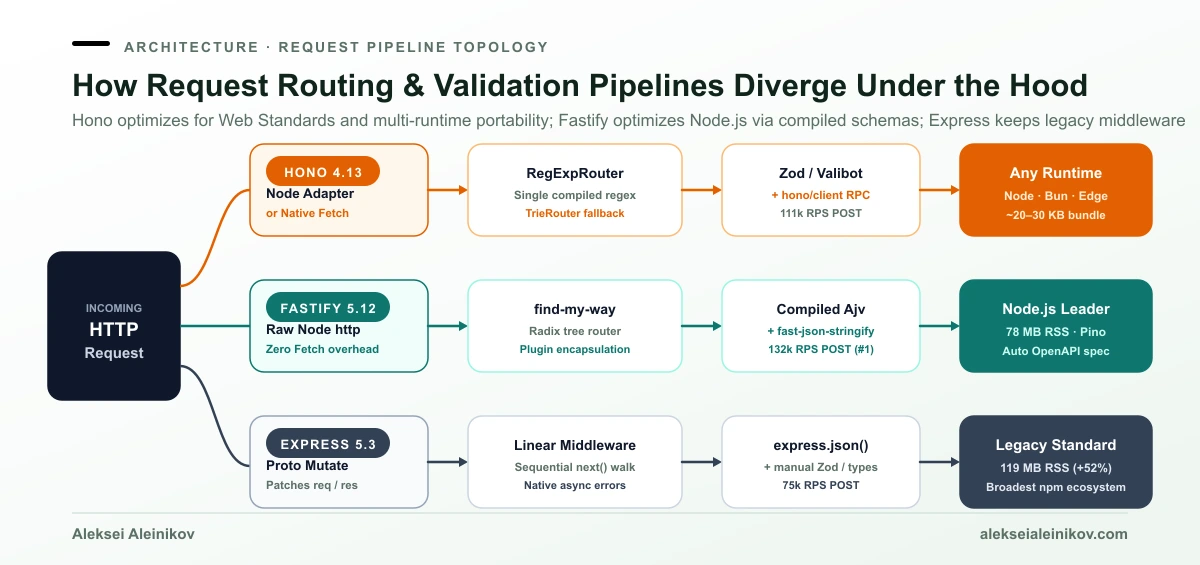
GET /health,GET /users/:id): Hono’sRegExpRoutercompiles routes into a single regex match with near-zero allocation, and Node 26’s improvedfetch/Web Streams internals dramatically shrunk the@hono/node-serveradapter overhead. Meanwhile, Express 5’s linear middleware chain andreq/resprototype augmentation cost noticeable CPU once auth headers and params are involved (dropping from 105k to 87k req/s). - Validated JSON payloads (
POST /orders): Fastify compiles JSON schemas via Ajv at startup and pairs them withfast-json-stringifyfor serialization. That kept Fastify at 132,037 req/s even when parsing, validating, and serializing JSON. Zod’s runtime parsing on Hono (110,997 req/s) and Express (75,605 req/s) adds per-request allocation overhead — still fast, yet ~16% slower than Fastify’s compiled path. - Memory footprint under load: Fastify (78 MB) and Hono (80 MB) stayed lean throughout the benchmark. Express 5 climbed to 119 MB RSS (+52%), which matters when packing dozens of microservice pods onto Kubernetes nodes.
What changes on Bun and Edge runtimes
If your deployment target is Cloudflare Workers, Deno, or Bun, Fastify and Express are effectively off the table (or require Node compatibility layers that negate their advantages). Hono runs natively on Request and Response primitives directly inside V8 isolates or JavaScriptCore without @hono/node-server in between.
Even if you start on Node.js 26 today, picking Hono keeps an exit ramp open: the exact same route handlers and middleware deploy unchanged to Workers or Bun later — just like full-stack TypeScript frameworks such as TanStack Start 1.0 lean on portable Web Standard handlers.
Type safety and RPC (hono/client vs Fastify vs Express)
Raw RPS rarely decides whether a team ships faster; TypeScript ergonomics do. Here is the exact same POST /orders endpoint in Hono and Fastify:
// Hono: route + Zod validation + automatic RPC type exportimport { Hono } from 'hono';import { zValidator } from '@hono/zod-validator';import { z } from 'zod';
const app = new Hono();
const routes = app.post(  '/orders',  zValidator('json', z.object({    userId: z.number().int().positive(),    amount: z.number().positive(),    currency: z.enum(['EUR', 'USD']),  })),  (c) => {    const order = c.req.valid('json');    return c.json({ accepted: true, ...order }, 201);  },);
export type AppType = typeof routes;
In a frontend or monorepo (React, Vite, Next.js, or TanStack Start), hc<AppType>('https://api.example.com') gives you autocomplete and compile-time type checks on every path, body, and response — zero OpenAPI codegen step required.
Fastify achieves strong type safety too via @fastify/type-provider-typebox (or fastify-type-provider-zod) plus automatic OpenAPI generation (@fastify/swagger):
// Fastify 5 + TypeBox: compiles to Ajv JSON Schema + fast-json-stringifyimport Fastify from 'fastify';import { Type, type TypeBoxTypeProvider } from '@fastify/type-provider-typebox';
const app = Fastify().withTypeProvider<TypeBoxTypeProvider>();const OrderBody = Type.Object({  userId: Type.Integer({ minimum: 1 }),  amount: Type.Number({ exclusiveMinimum: 0 }),  currency: Type.Union([Type.Literal('EUR'), Type.Literal('USD')]),});
app.post('/orders', { schema: { body: OrderBody } }, async (req, reply) => {  return reply.code(201).send({ accepted: true, ...req.body });});
That extra schema ceremony is ideal for public or polyglot APIs consumed by Go, Python, or mobile clients, while Express 5 remains manually typed (Request<Params, ResBody, ReqBody>) unless you layer wrappers like tRPC on top.
When to choose Express, Fastify, or Hono
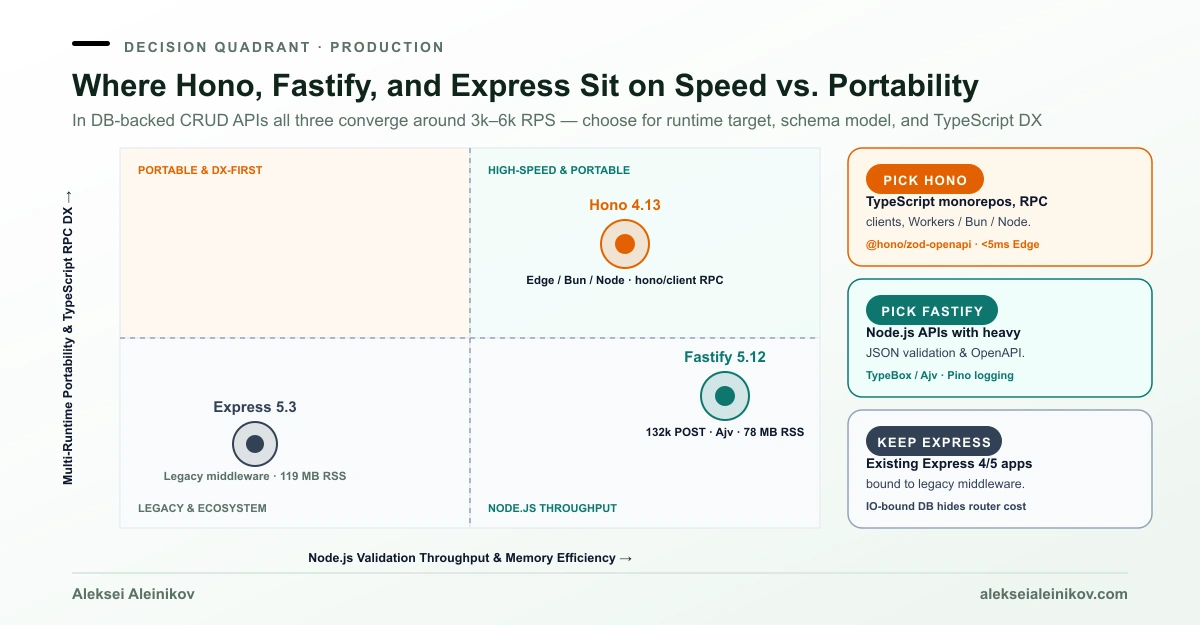
- Choose Hono 4 for greenfield TypeScript APIs, full-stack monorepos using
hono/clientRPC, BFF layers, and anything that might run on Cloudflare Workers, Bun, or Node.js. - Choose Fastify 5 for dedicated Node.js microservices with strict JSON validation throughput, automatic OpenAPI/Swagger specs, Pino structured logging, and plugin encapsulation.
- Keep Express 5 when you already have a working Express codebase with custom middleware (Passport, legacy session stores) and your bottleneck is PostgreSQL or external APIs rather than Node.js routing overhead.
Practical migration checklist & official v5/v4 gotchas
- Measuring before migrating: Profile your production service first — once a real PostgreSQL query (like PostgreSQL index lookups) or external API sits inside the handler, all three frameworks converge to roughly 3,000–6,000 req/s, so switching solely for raw router RPS rarely drops p95 latency by more than 1–2 ms.
- Express 5 breaking changes: The default
query parserswitched fromextendedtosimple(nested queries like?user[name]=...needapp.set('query parser', 'extended')),req.queryis now a read-only getter, andexpress.staticignores dotfiles (such as.well-known) by default. - Fastify 5 breaking changes: Requires Node.js 20+, dropped shorthand schema syntax (explicit
type: 'object'is required), forbids mixing callback and Promise plugin APIs, and splits port out ofrequest.hostnameintorequest.port. For maximum validation speed, pair Fastify with TypeBox (@fastify/type-provider-typebox) rather than Zod. - Hono 4 routing & OpenAPI (
RegExpRoutervsTrieRouter): Hono’s defaultRegExpRoutercompiles all routes into one regular expression for speed (~20–30 KB bundle,<5 msEdge cold starts). On apps with hundreds of complex overlapping wildcards, you can swap explicitly tonew Hono({ router: new TrieRouter() }), and use@hono/zod-openapiwhen you need both Zod types and generated OpenAPI specs.





From the community
Discussion on Mastodon & Bluesky
Replies to this article from the open web, pulled in live. No ads, no tracking scripts.
Reply there — it shows up here automatically.