
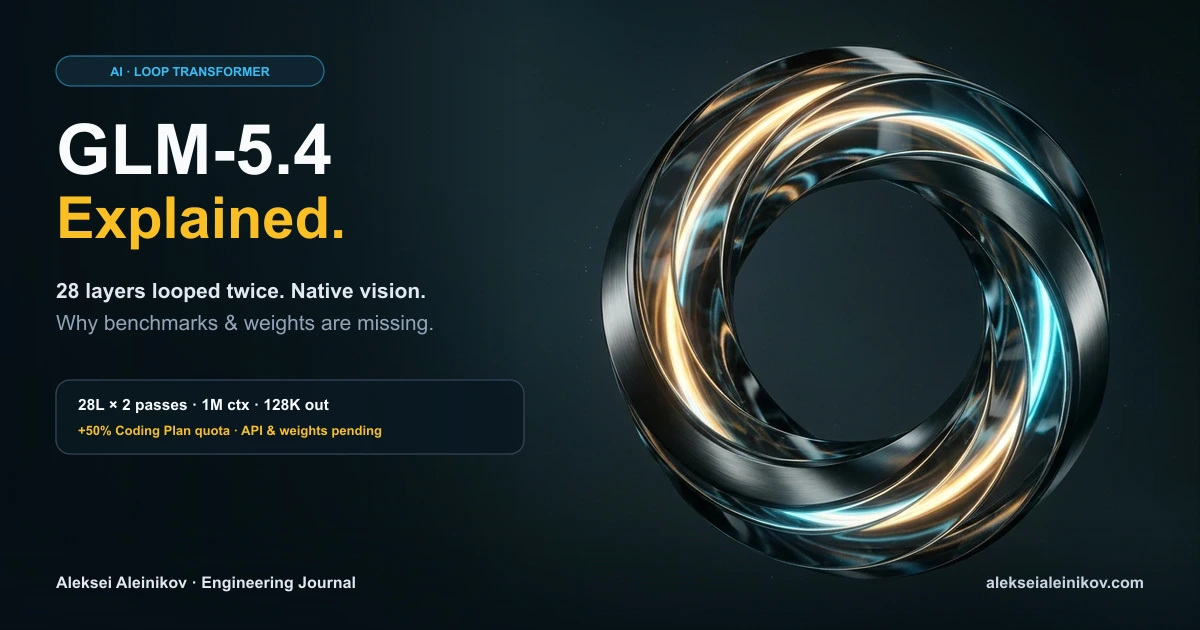
Z.ai (formerly Zhipu AI) dropped GLM-5.4 on November 23, 2026, in an unusual way: straight into the GLM Coding Plan model selector before publishing a formal model card, Hugging Face weights, or a frontier benchmark table.
Yet the architectural bet behind it is one of the most interesting shifts in flagship coding models right now: GLM-5.4 is Z.ai’s first flagship built as a Loop Transformer — trading raw inference speed for deeper multi-step reasoning, native vision, and a 50% quota boost inside coding agents.
The short verdict: Use GLM-5.4 inside the GLM Coding Plan when you need deep debugging, screenshot-to-UI iteration (native vision), or complex script/CAD generation and can tolerate slower responses. Stay on GLM-5.3 (or faster models) if you need pay-as-you-go API billing, self-hosted open weights, or snappy low-latency edits.
What Is GLM-5.4’s Loop Transformer Architecture?
For the past several generations, frontier labs bought reasoning depth by stacking more unique layers and scaling total parameter counts toward multi-trillion weights. That makes models expensive to store in GPU memory and slow to deploy.
GLM-5.4 takes a different route — the same recurrent paradigm we analyzed in Inkling 2 Mini and Looped Transformers, scaled up to Z.ai’s flagship tier:
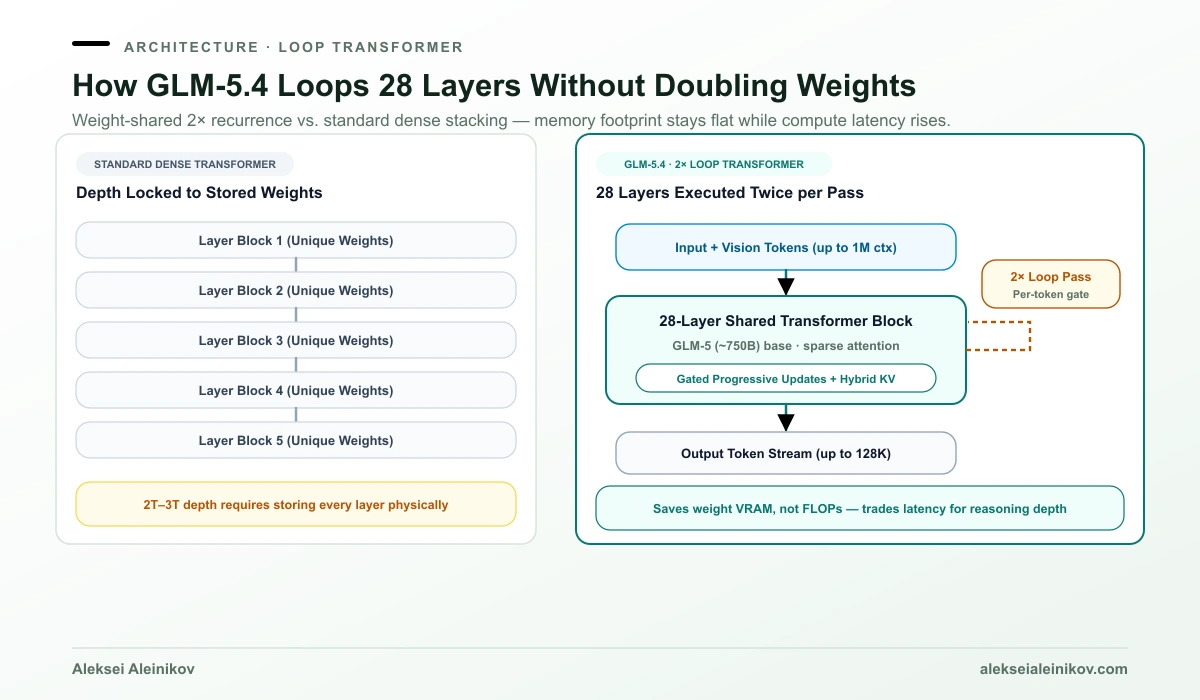
- 28 layers looped twice: Built on the ~750B-scale GLM-5 base architecture, GLM-5.4 routes a 28-layer block through two iterations per forward pass using shared weights.
- Gated progressive updates: Simply feeding hidden states back into the same weights can cause activation values to explode or drift. Z.ai adds per-token gates that regulate how much of each second-pass update is written back into the residual stream.
- Memory & KV optimizations: Hybrid KV caching and reused sparse attention indices keep the 1M-token context window (
glm-5.4[1m]) and 128K output limit practical without blowing up KV-cache memory linearly with loop depth.
The critical engineering distinction: looping saves weight memory, not compute FLOPs. Every token still pays the arithmetic cost of running those 28 layers twice. You get reasoning depth closer to much larger 2T–3T parameter models, at the cost of higher per-token latency.
In Z.ai’s controlled iso-parameter 30B ablation study (with thinking mode enabled and roughly 10% extra training compute), adding the loop mechanism after long-context fine-tuning pushed AIME25 from 19.17 to 30.42 (+11.3 points) — showing that depth via recurrence pays off disproportionately on multi-step mathematical and algorithmic reasoning.
What Actually Changes in the GLM Coding Plan
On launch day, Z.ai positioned GLM-5.4 around “Generalized Coding” — software engineering plus visual, game, video-script, and mechanical 3D/CAD generation (such as FreeCAD Python scripting for multi-axis robotic mechanisms and generative SVG layouts). Three practical changes matter immediately if you use coding harnesses like Claude Code, Codex, OpenCode, or Cline:
- Native vision arrives on the flagship tier: Text-only GLM-5.3 could not inspect UI screenshots, rendered layouts, or architecture diagrams directly. GLM-5.4 accepts image inputs natively inside the coding loop — closing the feedback cycle between code generation and visual inspection.
- +50% weekly token quota (1.5× multiplier): Subscribers on Coding Plan weekly tiers (Lite, Pro, Max) receive 50% more available quota for GLM-5.4 relative to GLM-5.3.
- 1M context window on demand (
glm-5.4[1m]): Long repositories and multi-file refactors can targetglm-5.4[1m]directly without switching models mid-session, while keeping standardglm-5.4for tighter everyday loops.
Effort Playbook in Claude Code: Avoiding “Marathon Thinking” Timeouts
Early developer tests highlight a sharp operational trade-off. Because the Loop Transformer performs two full passes and pairs them with deep reasoning chains, GLM-5.4 frequently enters “marathon thinking loops” on non-trivial tasks — running noticeably slower than fast non-looped coding models like Gemini 4 Neon.
- Use
high/maxeffort for: Root-cause debugging across multiple services, race conditions, legacy query refactoring, FreeCAD/SVG geometry scripts, and screenshot-driven UI audits. - Lower effort (or switch to a fast model) for: Renaming symbols, writing unit-test boilerplate, small CSS tweaks, and quick PR copy edits. In Claude Code, leaving default max effort enabled on trivial prompts burns latency and risks client timeouts without improving output quality.
Two concrete workflows show the difference in practice:
- Vision feedback loop (UI or CAD): Drop a screenshot of a clipped mobile layout or a misaligned FreeCAD bracket directly into
glm-5.4on high effort. Because vision is native, the model inspects the rendered defect itself and patches the exact CSS rule or geometry constraint without you translating coordinates into prose. - 1M context vs. fast inner loop: Switch to
glm-5.4[1m]when you need to ingest a whole multi-service log dump or cross-repo migration plan in one prompt; drop back to standardglm-5.4with reduced effort as soon as you move to file-by-file test fixes.
The Missing Benchmarks, API, and Open Weights
Unlike prior Z.ai launches, GLM-5.4 shipped without three things engineers usually check first:
- No official frontier benchmark table at launch: As both DataCamp and VentureBeat noted, Z.ai did not publish a model card or standard SWE-bench Verified / LiveCodeBench scorecards on day one — relying instead on win-rate charts without full methodology and internal 30B prototype ablations (+3.3 to +11.3 points, including
19.17to30.42on AIME25). Independent trackers like Artificial Analysis have not scored it yet because public APIs and weights are absent; in early community runs such as KingBench 4, GLM-5.4 placed around 7th at max effort while emitting heavy “marathon thinking” token chains. - No pay-as-you-go API yet: If you integrate models via metered API endpoints, GLM-5.3 ($1.40/M input, $4.40/M output) and GLM-5.3-Flash remain the active public pay-as-you-go options while GLM-5.4 undergoes safety hardening.
- No Hugging Face weights for self-hosting yet: Previous GLM-5 releases made open weights a headline feature for teams running local security and coding deployments. For GLM-5.4, Z.ai held weights back pending security and safety evaluations, with no firm public release date announced at launch.
When to Use GLM-5.4 vs. GLM-5.3 or Fast Models
Treat GLM-5.4 as a high-depth specialist inside Coding Plan subscriptions rather than a universal drop-in replacement for every prompt:
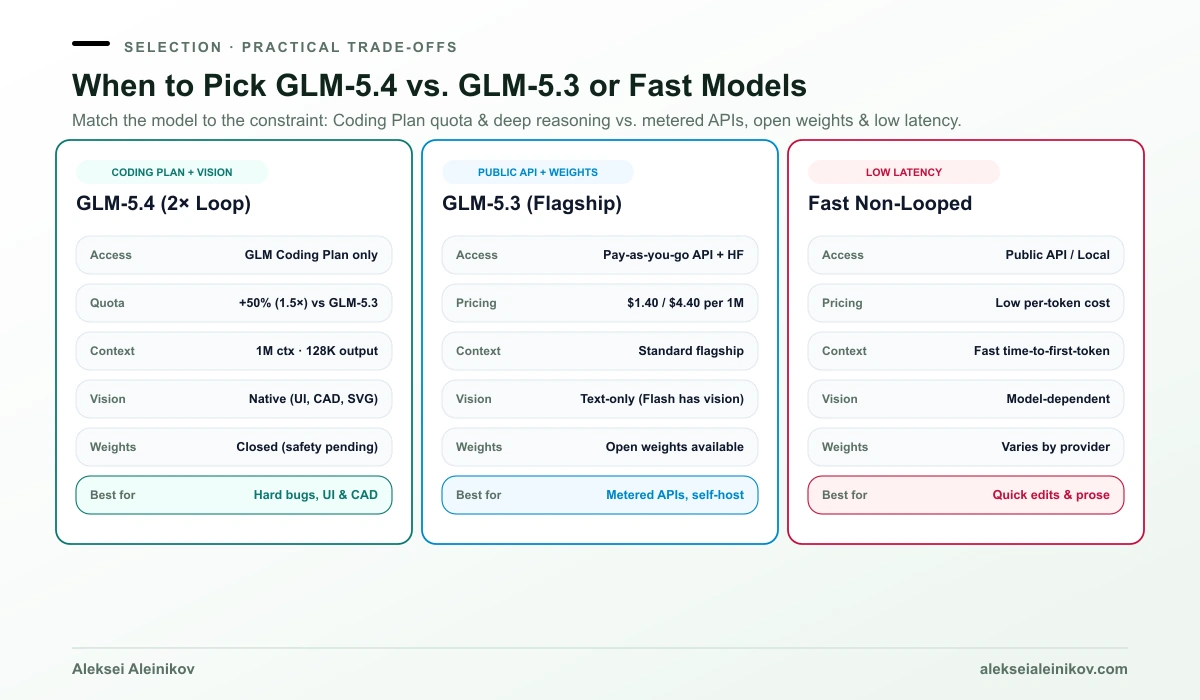
| Criterion | GLM-5.4 | GLM-5.3 | Fast Non-Looped Models |
|---|---|---|---|
| Architecture | 28-layer 2× Loop Transformer | Standard non-looped MoE | Standard / lightweight |
| Access at launch | GLM Coding Plan only | Public API + Open Weights | Public API / Local |
| Quota / Pricing | 1.5× (+50%) Coding Plan quota | $1.40 / $4.40 per 1M tokens | Low cost per token |
| Vision support | Native (screenshots, UI, CAD) | Text-only (Flash has vision) | Varies |
| Context & output | 1M context · 128K output | Standard flagship context | Fast TTFT |
| Best suited for | Hard debugging, UI vision, CAD/3D | Metered APIs, self-hosting | Boilerplate, prose, quick edits |
Community feedback also notes that GLM-5.4 feels heavily “code-maxxed”: its logic and code structure are unusually thorough, while general creative writing and casual prose can come across as rigid compared to general-purpose chat models.
Bottom Line
GLM-5.4 is a bold architectural milestone for Z.ai — proving that Loop Transformers can push flagship coding depth and earn a +50% Coding Plan quota bump without training a 3T-parameter monster. Just go in with eyes open: until Z.ai ships public benchmarks, metered APIs, and open weights, its sweet spot is strictly deep, vision-enabled coding inside Coding Plan subscriptions — with effort tuned down whenever speed matters more than marathon reasoning.


From the community
Discussion on Mastodon & Bluesky
Replies to this article from the open web, pulled in live. No ads, no tracking scripts.
Reply there — it shows up here automatically.