
At Microsoft Ignite (November 17), Microsoft made the move the entire cloud industry saw coming for two years — and still blinked when it landed. Standing on stage in San Francisco, Microsoft AI CEO Mustafa Suleyman unveiled seven in-house commercial AI models, backed by Microsoft’s own 3nm Maia 200 inference silicon, and pointed them straight at the pricing power of both Anthropic and OpenAI.
The headline number lit up Hacker News (500+ points, 330+ comments) within hours: MAI Code 2 reaches 96% of Claude Opus 5.5’s coding pass rate for roughly 5% of the cost, and 98% of GPT-6.1 Sol for 40% of the cost.
That claim is half genuine engineering breakthrough and half clever framing. This review traces how Microsoft got from OpenAI’s exclusive cloud banker to a vertically integrated AI lab, breaks down all seven models, puts Microsoft’s exact MSBench scores under a microscope (including the 14.4-point SWE-Atlas cliff), and separates promotional pricing from the standard list bill.
The short verdict. Microsoft is no longer just reselling OpenAI APIs. With Maia 200 + MAI Code 2 + Decision 1.1, it now owns a complete vertical stack like Google.
MAI Code 2is a legitimate cost weapon for high-volume enterprise coding inside GitHub Copilot ($0.50/$2.50promo →$1/$5list), but it is not a drop-in Opus 5.5 replacement on complex repository-scale tasks (SWE-Atlas:43.1%vs57.5%) or long-horizon autonomous agents.
How Microsoft Got Here: From OpenAI’s Banker to Vertical AI Lab
People keep asking whether this Ignite wave is Microsoft’s “first” neural network release. Strictly speaking, no — Microsoft Research shipped the small open-weight Phi family for years, and Microsoft AI released early first-generation MAI models before and during Microsoft Build. What changed at Ignite is commercial intent and vertical integration.
For five years, Microsoft’s AI margin had an uncomfortable structural flaw: every time GitHub Copilot or Microsoft 365 Copilot usage surged, Microsoft paid a massive external inference tax — either in NVIDIA GPU capex or in revenue share / API payouts to OpenAI and Anthropic. As OpenAI restructured toward full commercial independence, Microsoft executed a quiet four-stage pivot:
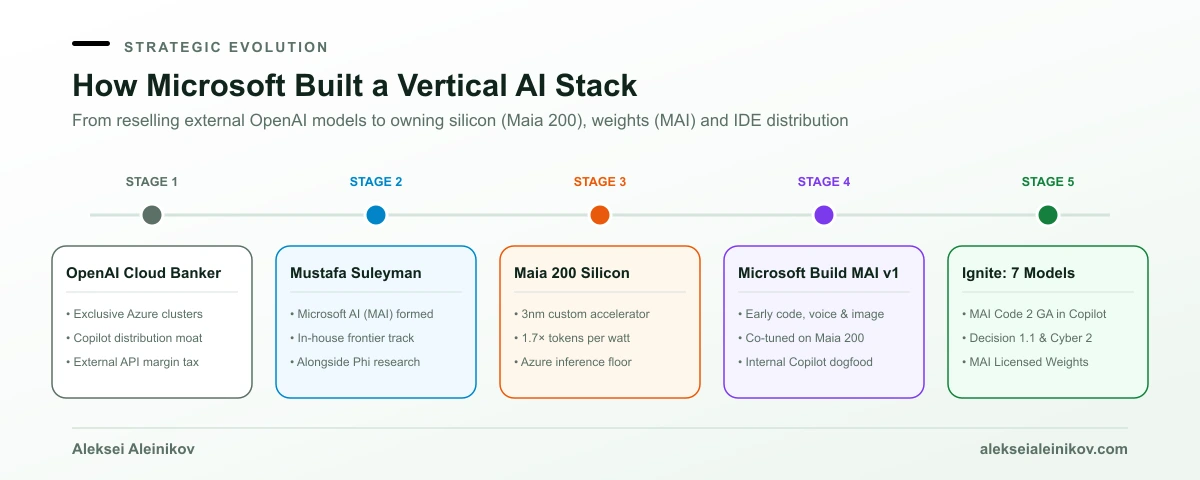
- The Exclusive Cloud Banker (2019–2023): Microsoft invested billions into OpenAI, built Azure’s supercomputing clusters and wired GPT models into GitHub Copilot and Office. Distribution was Microsoft’s moat, not model weights.
- Building Microsoft AI (March 2024): Microsoft hired DeepMind co-founder Mustafa Suleyman to build an internal frontier model organization alongside the research-oriented Phi team.
- Custom Silicon (
Maia 200): Microsoft rolled out Maia 200, a 3nm second-generation AI accelerator built specifically for high-efficiency inference, delivering roughly 1.7× more tokens per watt across Azure. Just as Google’s TPUs let Gemini 4 Neon and Gemini 4 Hydrogen undercut GPU-bound rivals, Maia 200 gave Microsoft its own cost floor. - Ignite Commercial Wave: Seven production-grade MAI models shipped in one wave, co-optimized for Maia 200, plus MAI Licensed Weights — letting large enterprise customers license and run customized MAI weights inside dedicated Azure environments.
The Seven Models Announced at Ignite
Rather than trying to beat every lab on a single giant generalist model, Microsoft aimed each MAI model at a high-volume enterprise cost center:
| Model | Role & Architecture | Headline Claim / Metric | Availability |
|---|---|---|---|
| MAI Code 2 | Flagship coding sparse MoE (1.05M ctx: 922K in / 128K out) |
63.2% MSBench avg (96% of Opus 5.5, 98% of GPT-6.1 Sol) |
GA in GitHub Copilot |
| MAI Code 2 Flash | Fast coding MoE (~12B active params, 1M ctx) |
Matches GPT-6 Luna / Haiku 5.5 at 20%–65% of their cost |
GA in Copilot; private preview in Foundry |
| MAI Cyber 2 Flash | AppSec & SOC vulnerability triage / patching | Beats GPT-6 Astra on CyberGym-E2E; powers Defender ISOC | Security partner preview; Defender rollout mid-Dec |
| Decision 1.1 | Fast routing, classification & verification (Gemma-based MoE) | Up to 50× faster and 79× cheaper than GPT-6.1 Sol | GA in Microsoft Foundry |
| MAI Image 2.7 (+ Flash) | Enterprise image generation & editing | #1 on Artificial Analysis for image editing (1/5 cost of GPT Image 2.6 Sunburst max) |
Preview in Microsoft Foundry |
| MAI Realtime 1 | Native speech-to-speech conversational audio | Outperforms GPT-Realtime 2.1, starting at $0.01 / audio min | Rolling out in Foundry |
| MAI Transcribe 2 | Multilingual speech transcription (Dragon Copilot) | Halves multilingual error rates across 10M monthly patient encounters | Production (Dragon Copilot) |
Notice the one model already validated on an independent leaderboard: MAI Image 2.7 (#1 on Artificial Analysis for image editing). For MAI Code 2, however, all numbers currently come from Microsoft’s own MSBench evaluation — which is why we need to inspect both the rest of the MAI lineup and the raw coding table, not just the press-release average.
Deep Dive: What Microsoft Ships Beyond MAI Code 2
Most headlines stop at MAI Code 2, but Microsoft’s official release makes clear that the other five models are designed to attack specific enterprise margins where general frontier models are wildly overpriced:
- MAI Cyber 2 Flash (Security & Patching —
$0.45vs$34.38per task): Built with a1M-token context window for defensive vulnerability discovery, threat triage and automated patching. On Microsoft’s CyberGym-E2E remediation benchmark, it scores 92.3% task success against GPT-6 Astra’s 91.5% at under 2% of the cost per task ($0.45vs$34.38offline). To curb offensive abuse, Microsoft gates access through verified defender harnesses (including Codename MDASH and Defender ISOC) rather than an open pay-as-you-go token endpoint. - Decision 1.1 (Enterprise Routing —
$0.042 / 1Mtokens): Built on Google DeepMind’s open-weight Gemma architecture (Gemma-based MoE), Decision 1.1 is GA in Microsoft Foundry as a dedicated classifier, verifier and traffic router. Microsoft positions it as up to 50× faster and 79× cheaper than GPT-6.1 Sol — letting platform teams filter and route prompts before paying frontier token rates. - MAI Image 2.7 & Flash (Visual Synthesis —
~$35/~$10per 1,000 images): Available in Foundry public preview, MAI Image 2.7 focuses on identity-preserving, localized image editing (ranked #1 on Artificial Analysis for image editing at roughly1/5the cost of GPT Image 2.6 Sunburst max), while MAI Image 2.7 Flash (~$10 / 1,000images) drives low-latency interactive editing in Microsoft’s Canvas workspace. - MAI Realtime 1 (Native Voice Agents — from
$0.01 / audio min): Microsoft’s first native speech-to-speech model handles live interruptions, background noise and steerable prompting while outperforming GPT-Realtime 2.1. Note the billing nuance Microsoft discloses:$0.01 / audio mincovers the audio layer, while calls to an underlying reasoning engine are billed separately by token. - MAI Transcribe 2 (60-Language ASR in Production): Supports 60 languages with speaker diarization, word-level timestamps and heavy noise robustness. Microsoft already runs it in production inside Dragon Copilot Transcribe, reporting a 50% cut in multilingual error rates across 10 million monthly clinical encounters.
Exact MSBench Benchmarks: The 14.4-Point SWE-Atlas Cliff
Microsoft evaluated MAI Code 2, GPT-6.1 Sol and Claude Opus 5.5 on its MSBench platform via GitHub Copilot CLI with sub-agents disabled and all models set to max reasoning effort:
| Benchmark | MAI Code 2 | GPT-6.1 Sol | Claude Opus 5.5 | MAI vs Opus |
|---|---|---|---|---|
| DeepSWE 1.1 | 73.2% | 74.6% | 69.0% | +4.2 pts |
| Terminal-Bench 2.1 | 84.6% | 85.0% | 78.7% | +5.9 pts |
| SWE-Atlas | 43.1% | 47.4% | 57.5% | −14.4 pts |
| FrontierCode v1.1 | 52.0% | 49.4% | 56.0% | −4.0 pts |
| Average Pass Rate | 63.2% | 64.1% | 65.3% | −2.1 pts |
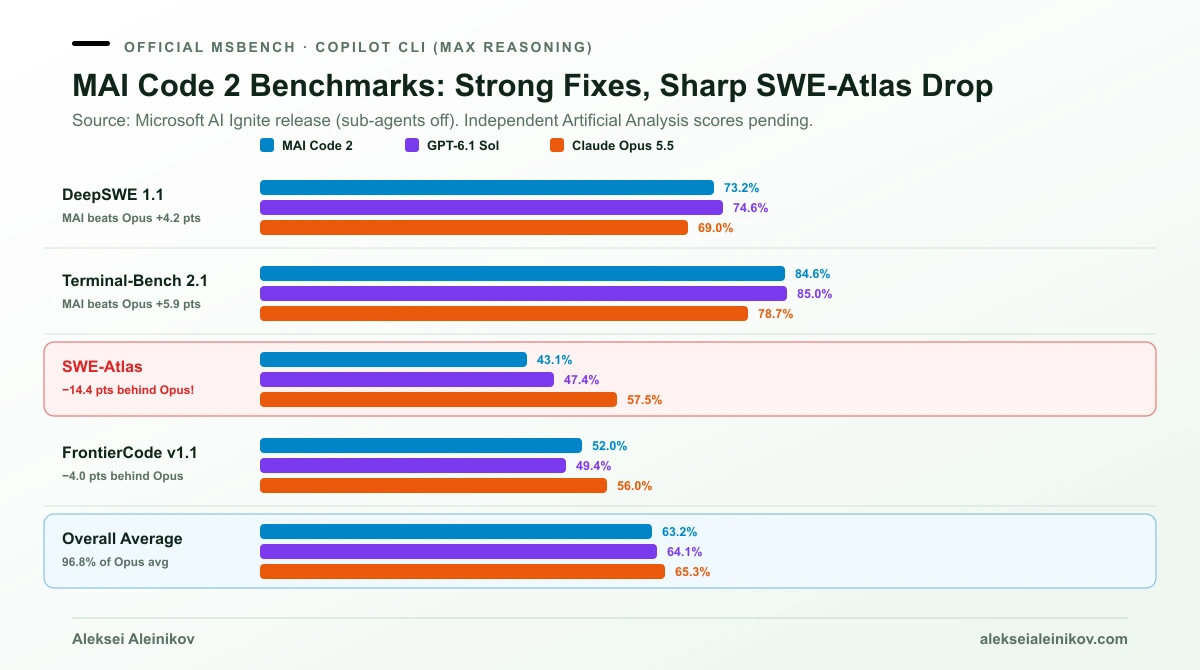
Looking at the four individual bars tells a much sharper engineering story than the “96% of Opus” headline:
- Where MAI Code 2 genuinely shines (
DeepSWE 1.1&Terminal-Bench 2.1): On focused debugging, shell execution and bounded engineering fixes,MAI Code 2beats Claude Opus 5.5 by +4.2 to +5.9 points and sits within 1.4 points of GPT-6.1 Sol. Early developers testing it in GitHub Copilot on Hacker News confirmed that for everyday PRs and fixes, it feels surprisingly close to Sol and Opus. - Where the model cracks (
SWE-Atlas): On SWE-Atlas, MAI Code 2 falls to 43.1% against Opus 5.5’s 57.5% — a 14.4-percentage-point drop. That aligns directly with Microsoft’s own model-card disclaimer: MAI Code 2 is not yet tuned for long-horizon autonomous agents or fundamental scientific reasoning. - Why a “4% average gap” feels bigger in production: As multiple engineers on Reddit and HN pointed out, averaging four benchmarks smooths out tail failures. In real repositories, missing 14% more hard cross-file invariants turns into subtle regressions that eat the time you saved on token cost.
Pricing Reality Check: Promo Rate vs Standard List Rate
Microsoft’s pricing is genuinely aggressive — even after you strip away the promotional discount. Here are the exact published API rates (with the 50% introductory promo active through May 17, 2027) alongside current frontier peers:
| Model | Input / 1M | Output / 1M | Cache Read / 1M | MSBench Avg Cost / Task |
|---|---|---|---|---|
| MAI Code 2 Flash (Promo → List) | $0.05 → $0.10 | $0.25 → $0.50 | $0.005 → $0.01 | Ultra-low |
| MAI Code 2 (Promo until May 2027) | $0.50 | $2.50 | $0.025 | $0.309 |
| MAI Code 2 (List after May 2027) | $1.00 | $5.00 | $0.050 | ~$0.618 |
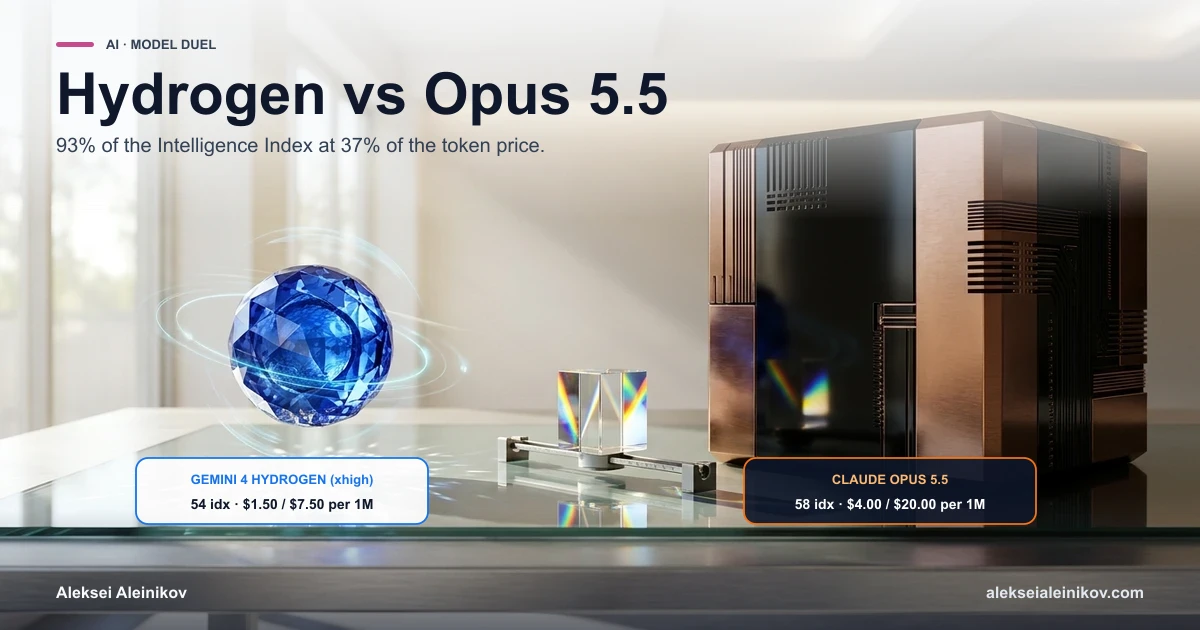
| Gemini 4 Hydrogen | $1.50 | $7.50 | $0.075 | Low workhorse |
| GPT-6.1 Sol | ~$2.00 | ~$10.00 | Cached tier | $0.761 |
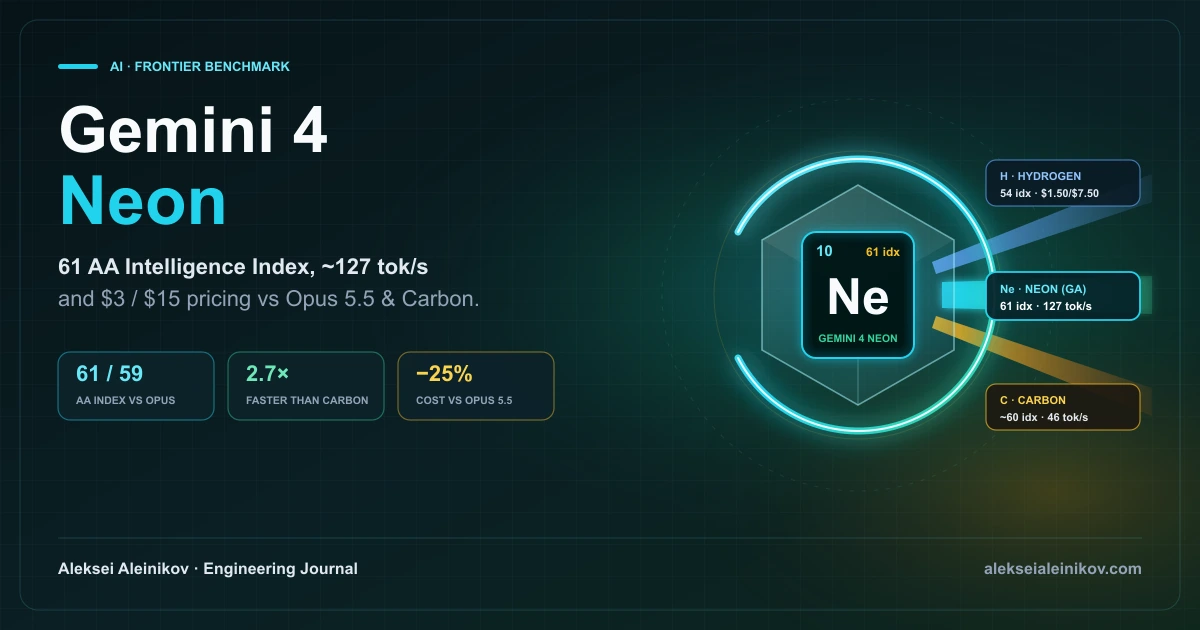
| Gemini 4 Neon | $3.00 ($1.50 Flex) | $15.00 ($7.50 Flex) | $0.15 | Mid frontier (61 AA idx) |
| Claude Opus 5.5 | $4.00 | $20.00 | $0.20 | $6.306 |
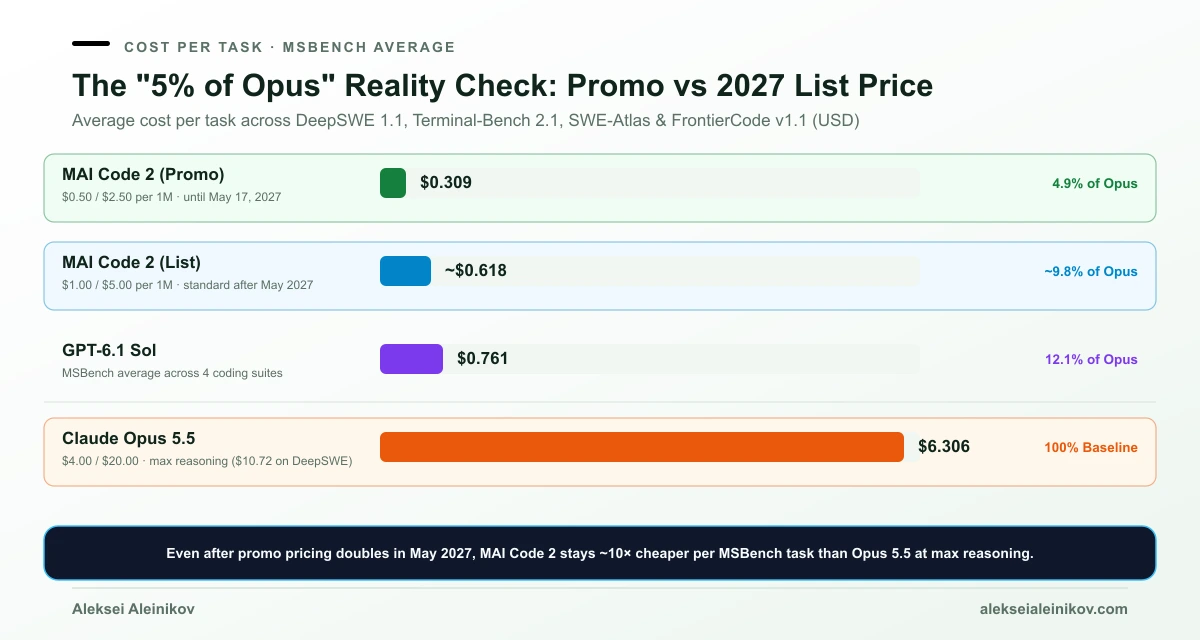
Two pricing facts jump off the chart:
- The “5% of Opus” math is real during the promo — and ~10% after May 2027: On MSBench, Opus 5.5 averaged $6.306 per task (burning
$10.72per DeepSWE 1.1 task!) because max-effort reasoning burns huge output volumes at$20/1M. MAI Code 2 averaged $0.309 at promo rates (4.9%of Opus) — and even when prices double to$1.00 / $5.00in May 2027,~$0.618per task is still 10× cheaper than Opus 5.5 and slightly cheaper than GPT-6.1 Sol ($0.761). - The ecosystem catch: Unlike Gemini 4 Neon (live on OpenRouter and Google AI Studio on day one) or open-weight models you can self-host, MAI models live tightly inside GitHub Copilot and Microsoft Foundry / Azure. On Hacker News, developers outside the Microsoft stack asked the obvious question: if you are not already on Azure or Copilot, why adopt a closed proprietary model that has no independent Artificial Analysis score yet?
What This Means for Engineering Teams
Microsoft’s Ignite launch changes the economics of enterprise AI in three concrete ways:
- If your team already uses GitHub Copilot: Switch routine coding, test generation and terminal debugging to MAI Code 2 (and MAI Code 2 Flash for boilerplate) immediately — the cost-per-PR drop is massive, and you keep Opus 5.5 or Gemini 4 Neon for hard architectural refactors.
- If you run an AI Gateway on Azure / Foundry: Decision 1.1 (
GA, up to 50× faster and 79× cheaper than GPT-6.1 Sol) is arguably the quietest sleeper hit of Ignite — using a dedicated Gemma-MoE router to classify and triage prompts before they ever hit a$15–$20/1Mmodel pays for itself on day one. - Wait for third-party verification before replacing your hardest agent tier: Until
MAI Code 2appears on independent leaderboards (Artificial Analysis, Vals.ai, SWE-bench Verified outside Copilot CLI) and closes itsSWE-Atlasgap, treat it as a high-efficiency daily workhorse, not an autonomous long-horizon architect.

From the community
Discussion on Mastodon & Bluesky
Replies to this article from the open web, pulled in live. No ads, no tracking scripts.
Reply there — it shows up here automatically.