Google released gemini-4-hydrogen on November 12, 2026 as the successor to Gemini 3.8 Flash in the Gemini model family. On paper, pitting a fast workhorse model against Anthropic’s flagship Claude Opus 5.5 looks lopsided. In practice, developers testing both side by side in IDEs and agent harnesses keep reaching the same conclusion: Hydrogen feels fast enough to change daily engineering habits while holding surprisingly close on code quality.
This guide puts official vendor specs, independent Artificial Analysis benchmarks, 10-turn agent session math and real-world developer feedback next to each other. Every benchmark and price below is attributed to the party that published or measured it — no unverified claims, and no hiding where xhigh burns quota faster than expected.
The short verdict. Gemini 4 Hydrogen (
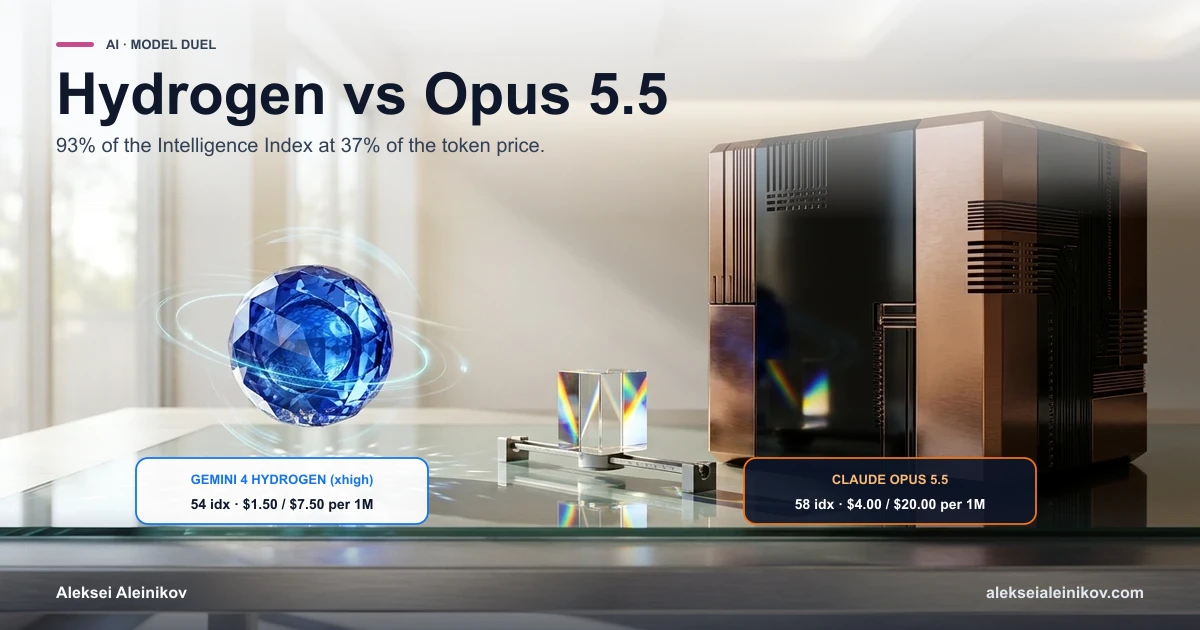
high/xhigh) closes over 90% of Claude Opus 5.5’s benchmark gap at 37% of the list token price ($1.50/$7.50 vs $4/$20) and noticeably lower latency. Use Hydrogen as your default daily coding driver; keep Opus 5.5 for ambiguous architectural decisions and hardest computer-use loops.
Specs and Pricing at a Glance
The specs below come from Google AI Studio model documentation, Gemini API pricing, Anthropic’s model overview and OpenRouter:
| Metric | Gemini 4 Hydrogen | Claude Opus 5.5 |
|---|---|---|
| API model ID | gemini-4-hydrogen |
claude-opus-5-5 |
| Input / output per 1M tokens | $1.50 / $7.50 | $4.00 / $20.00 |
| Cache read per 1M tokens | $0.075 | $0.20 |
| Context window | 1M tokens (flat pricing) | 1M tokens |
| Max output | Up to 1M (via continuation) | 128K tokens |
| Thinking control | 4 tiers: low, medium, high, xhigh |
Adaptive, always on (medium default) |
| Native modalities | Text, image, audio, video, PDF/files | Text, image |
| Role in lineup | High-efficiency workhorse | Heavyweight flagship |
Three architectural details explain why Hydrogen feels disruptive in day-to-day IDE and agent work:
- Flat 1M context at $1.50 / $7.50. Feeding an entire repository, CI logs, or architecture specs costs less than half of Opus 5.5’s input rate, with no long-context surcharge cliff.
- Cache reads at $0.075 vs $0.20. Agentic coding loops re-read the same system prompt, tool schemas and repository prefix on every turn — cutting cache read cost by 2.67× dominates the real bill.
- Native multimodal + 1M continuation. Hydrogen processes audio, video transcripts and large PDFs directly without an external extraction pipeline.
Real Cost Math: A 10-Turn Coding Agent Session
List prices per million tokens only tell half the story. Consider a realistic 10-turn coding-agent session (for example, refactoring a module and fixing failing tests):
- Cached prefix per turn:
80,000tokens (repo map, tool definitions, system prompt) →800,000cache-read tokens total - Fresh input per turn:
4,000tokens (diff output, test errors, file snippets) →40,000fresh input tokens total - Output + thinking tokens per turn:
6,000tokens →60,000output tokens total
| Cost component | Gemini 4 Hydrogen | Claude Opus 5.5 |
|---|---|---|
Cache reads (0.80M tokens) |
$0.060 ($0.075/1M) |
$0.160 ($0.20/1M) |
Fresh input (0.04M tokens) |
$0.060 ($1.50/1M) |
$0.160 ($4.00/1M) |
Output + thinking (0.06M tokens) |
$0.450 ($7.50/1M) |
$1.200 ($20.00/1M) |
| Total 10-turn session | $0.570 |
$1.520 |
At equal token counts, Hydrogen is 2.67× cheaper ($0.57 vs $1.52). However, if you crank Hydrogen to xhigh and it emits 40–60% more thinking tokens per turn, that real-world task gap narrows — which matches Artificial Analysis task-cost measurements where Hydrogen jumps from $1.87/task on high to $3.16/task on xhigh (+69%).
Benchmarks and Who Measured What
Separating independent leaderboards from vendor-reported suites keeps the comparison honest:
| Benchmark | Source | Hydrogen (high) |
Hydrogen (xhigh) |
Claude Opus 5.5 | Sonnet 5.5 | Gemini 4 Carbon |
|---|---|---|---|---|---|---|
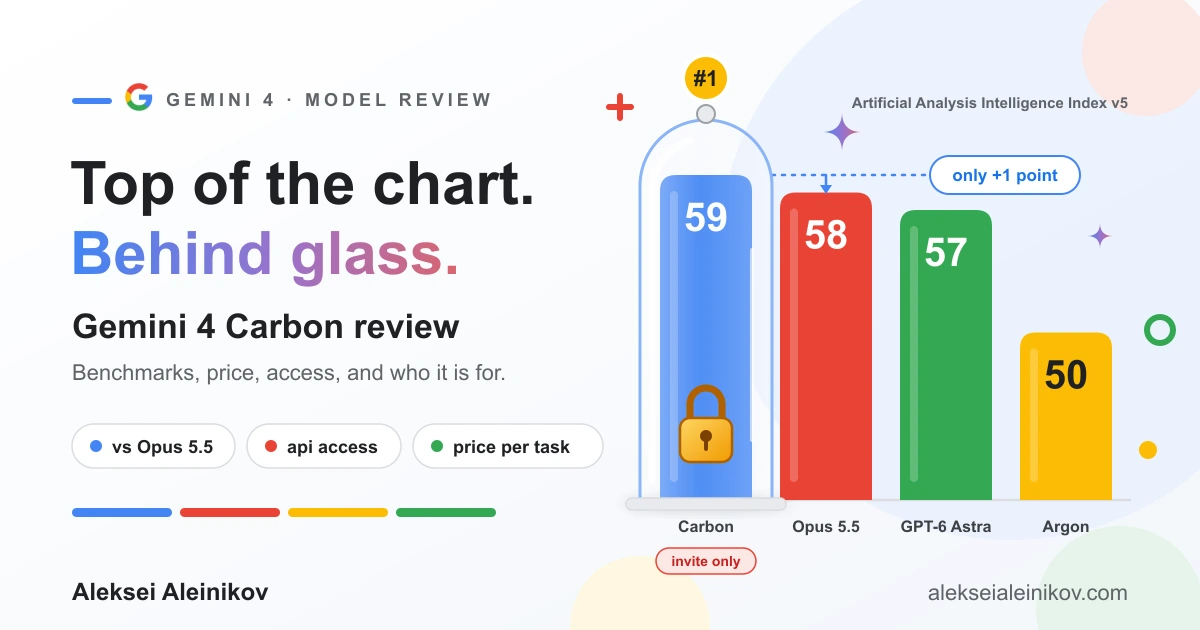
| AA Intelligence Index v5 | Artificial Analysis | 51 | 54 | 58 | ~55 | 59 |
| Avg. cost per AA task | Artificial Analysis | $1.87 | $3.16 | — (premium tier) | — | $7.76 (std) |
| Terminal-Bench 4.1 | Google / AA | 57.0% | — | 66.4% (TB 4.0) | 63.9% | — |
| OSWorld-2.1 (offline) | Vendor cards | 77.6% | — | 87.2% | — | 81.5% |
| AutomationBench-AA | Artificial Analysis | 76.1% | — | — | — | — |
| HLE-Diamond | Vendor / evals | 58.8% | — | 67.7% (HLE w/ tools) | 64.5% | — |
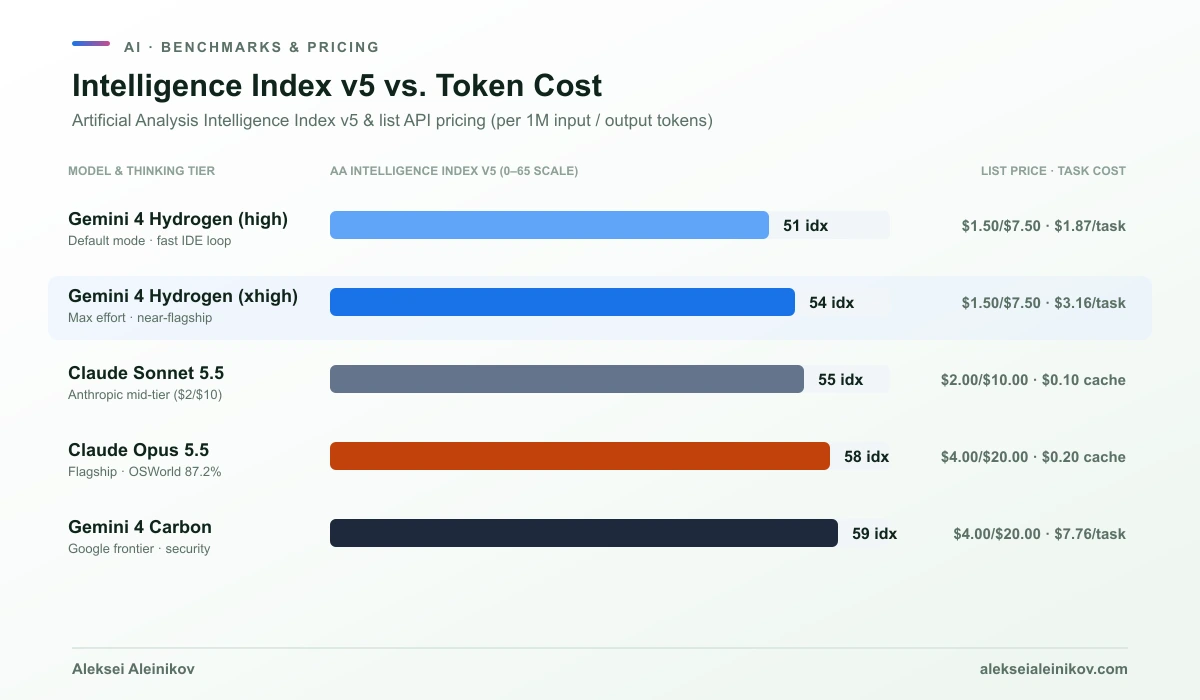
Notice three clear takeaways from those numbers:
- Inside Google’s own lineup, Hydrogen at default
high(51) matches or slightly edges out Gemini 4 Argon (50at launch) while costing a fraction per turn. Gemini 4 Carbon (59) remains Google’s heavy hitter for cybersecurity and long-horizon reasoning. - Against Claude Opus 5.5, a 4-point gap on the Intelligence Index (
54vs58) is small enough that in everyday coding, 2× faster iteration cycles often beat single-prompt depth. - Where Opus 5.5 still wins cleanly: UI/computer-use suites (
87.2%vs77.6%on OSWorld offline) and ambiguous, open-ended architecture where subtle product intent matters on the first pass.
What Engineers Are Reporting in Daily Use
Across early production rollouts and side-by-side coding tests, engineering feedback converges on a clear pattern — without the usual hype:
- Speed transforms the edit-test loop. Developers consistently single out how snappy
gemini-4-hydrogenfeels compared to heavyweight reasoning models. Faster turnaround lets you run two or three tight iterations in the time a single frontier-tier call takes. - Strong surgical debugging and vision-to-code. Teams report clean repository-level bug fixes, noticeably fewer fabricated assumptions when a prompt is missing constraints (a big step up from Gemini 3.8 Flash), and reliable UI generation straight from rough wireframes or screenshots.
- Where friction still shows up. At
xhigh, outputs can turn verbose and burn through fixed monthly quotas quickly inside retry loops. Some teams are also frustrated that Google gates Orchestrator pairing and top usage caps behind $100+ AI subscription tiers. - How Opus 5.5 compares in practice. Engineers still praise Opus 5.5 for “senior-dev” greenfield architecture and SOLID structure, though some note that its high confidence can occasionally mask subtle edge-case bugs or runaway retry logic if prompts lack tight guardrails.
API Configuration and the Thinking-Level Trap
Both APIs expose reasoning depth, with different defaults and failure modes:
// Gemini API — gemini-4-hydrogen (default thinking_level: "high"){  "model": "gemini-4-hydrogen",  "generationConfig": {    "thinkingConfig": { "thinkingLevel": "high" }  }}
// Claude API — claude-opus-5-5 (default effort: "medium"){  "model": "claude-opus-5-5",  "output_config": { "effort": "medium" }}
Real-world testing consistently highlights the same three configuration traps:
highis the daily sweet spot. It scores 51 on the Intelligence Index (~$1.87/task) and keeps interactive IDE latency low enough for rapid edit-test loops.lowandmediumdrop too much accuracy. Reviewers report sharp regressions in multi-file refactoring and edge-case debugging belowhigh— keeplow/mediumstrictly for classification, extraction, or boilerplate.xhighburns time and Pro quota fast. Pushing Hydrogen toxhighreaches 54, right behind Sonnet 5.5, but increases average task cost by ~69% ($1.87 → $3.16) and triggers the most common community complaint: fixed-window Pro subscriptions exhaust much earlier than expected when automated retry loops stay pinned onxhigh.
Two-Tier Routing in Production
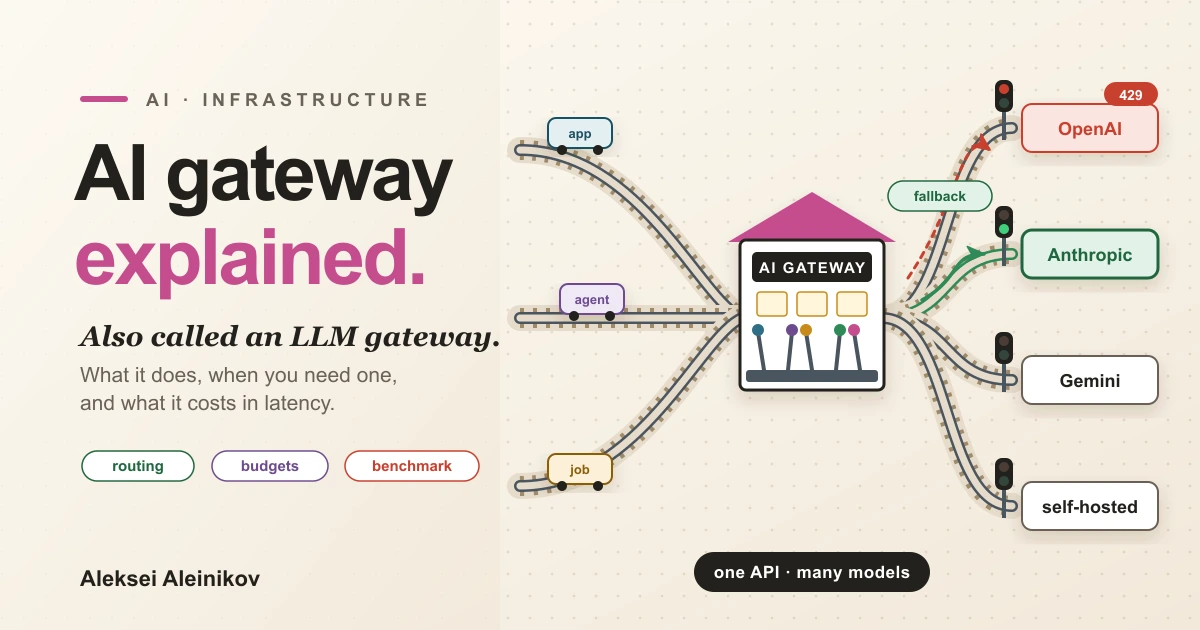
Instead of forcing one model onto every prompt, the cleanest engineering setup pairs them — the same Orchestrator pattern Google ships in Antigravity and teams run in Cursor:
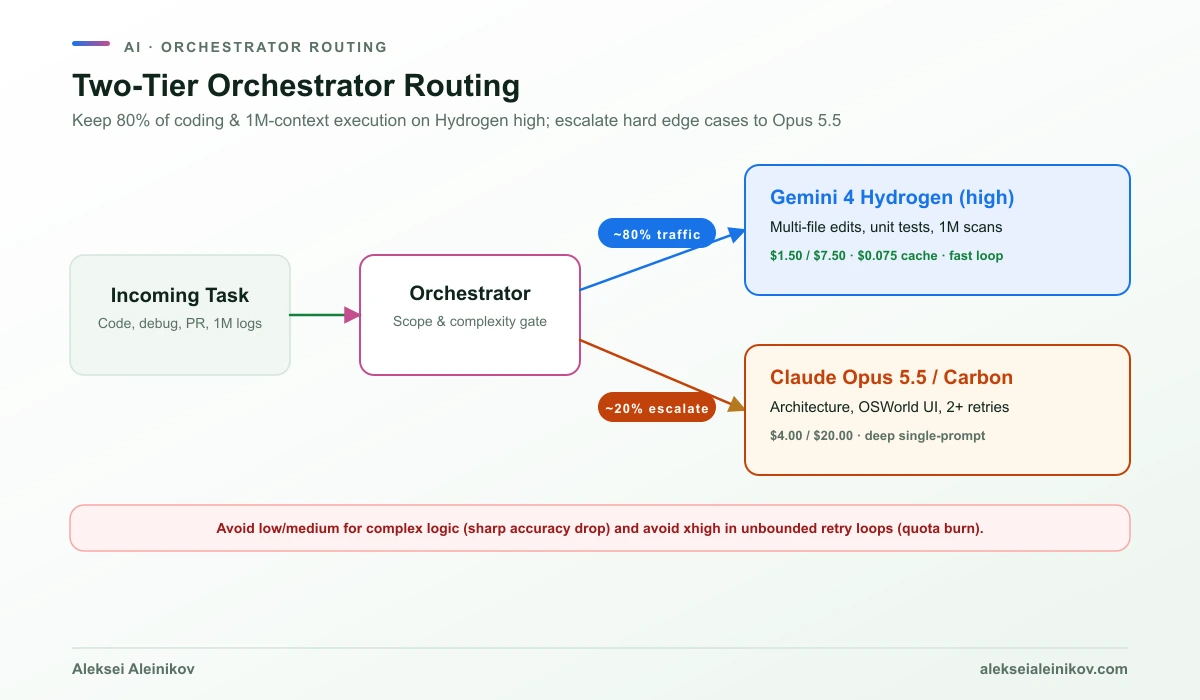
- Route to Gemini 4 Hydrogen (
high): multi-file code edits, unit and integration tests, 1M-context log and trace analysis, PR reviews and parallel subagent execution. - Escalate to Claude Opus 5.5 (or Gemini 4 Carbon): initial system architecture, ambiguous product specs, cross-service debugging after two failed Hydrogen attempts, and high-stakes computer-use automation.
(If your router also switches between Claude models, keep the one-way thinking transfer rule between Sonnet 5.5 and Opus 5.5 in mind so reasoning blocks are not silently dropped mid-thread.)
The Bottom Line
Google didn’t beat Claude Opus 5.5 on raw heavyweight reasoning — Opus 5.5 still holds the edge on hard agentic judgment and computer use. Where Google did decisively win is value per second: Gemini 4 Hydrogen delivers 90%+ of flagship coding utility at $1.50 / $7.50 with a flat 1M context window. Making Hydrogen (high) your daily default and keeping Opus 5.5 as your escalation tier gives you the best balance of speed, quality and cost available right now.