
Google released gemini-4-neon on November 18, 2026, just six days after Gemini 4 Hydrogen and right in the middle of a crowded frontier week alongside GPT-6.2 Astra and Sol. On paper, Google’s periodic-table naming (Hydrogen, Neon, Carbon, Argon) tells you nothing about model size or tier. In practice, Neon is the release that forces teams to rethink their default coding and agent model.
At $3.00 / $15.00 per million tokens (25% cheaper than Claude Opus 5.5 and Gemini 4 Carbon), Neon scores 61 on the Artificial Analysis Intelligence Index at xhigh thinking, lands at 58.6–59 on the Coding Agent Index, and serves at roughly ~127 tokens/sec on OpenRouter — nearly 2.7× faster than Carbon’s ~46 tokens/sec.
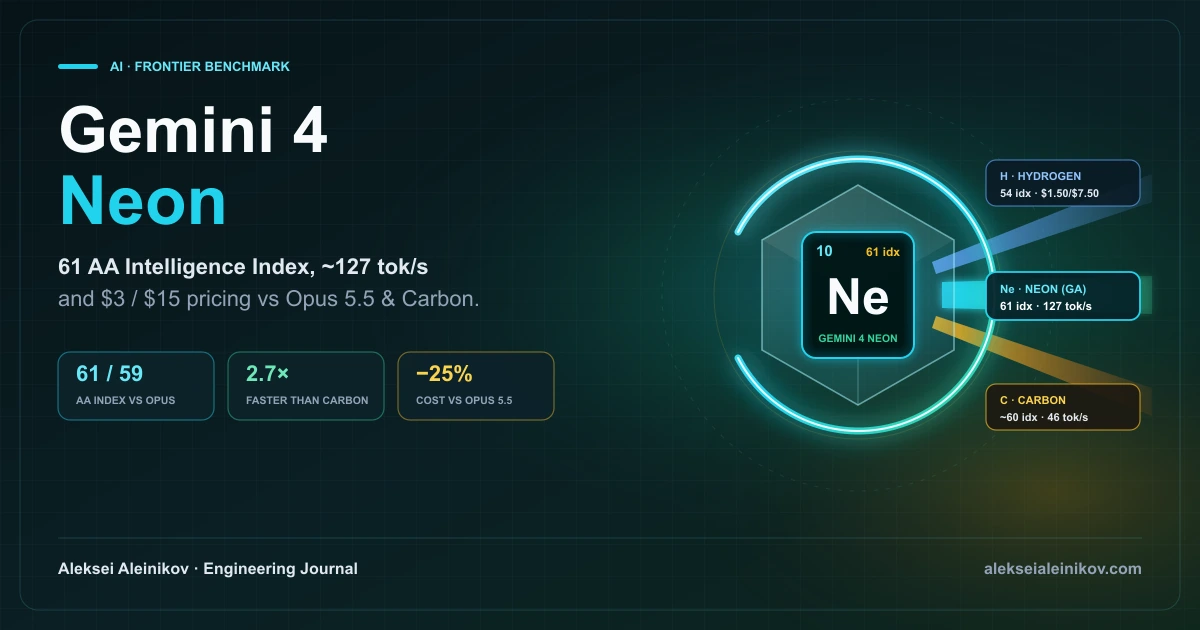
The short verdict. Gemini 4 Neon breaks the old trade-off between Hydrogen’s speed and Opus 5.5 / Carbon’s intelligence. For daily agentic coding, PR reviews and multi-step tool use, Neon is the strongest default choice in Google’s lineup and a genuine 25%-cheaper rival to Opus 5.5. Keep Hydrogen for high-volume subagents, and keep Opus 5.5 or Carbon only for open-ended architecture and deepest long-horizon research.
Specs, Pricing and the Periodic-Table Lineup
Developers on Hacker News immediately pointed out the biggest UX problem with Gemini 4: you cannot tell from the name Neon whether it sits above or below Carbon. Here is the actual hierarchy as of November 19, 2026, compiled from Google AI Studio pricing, Anthropic’s model overview and OpenRouter:
| Metric | Gemini 4 Hydrogen | Gemini 4 Neon | Gemini 4 Carbon | Claude Opus 5.5 | GPT-6.2 Sol |
|---|---|---|---|---|---|
| API model ID | gemini-4-hydrogen |
gemini-4-neon |
gemini-4-carbon |
claude-opus-5-5 |
gpt-6.2-sol |
| Input / output (1M) | $1.50 / $7.50 | $3.00 / $15.00 | $4.00 / $20.00 | $4.00 / $20.00 | ~$2.00 / $10.00 |
| Flex / batch tier | Available | $1.50 / $7.50 | Available | Batch discount | Batch discount |
| Cache read (1M) | $0.075 | $0.15 (~95% off) | $0.20 | $0.20 | Cached tier |
| Context window | 1,048,576 | 1,048,576 | 1,048,576 | 1,000,000 | 400K–1M |
| Max output | 65K (1M cont.) | 65,536 (1M cont.) | 65K (1M cont.) | 128K | 128K |
| Thinking control | low → xhigh |
low → xhigh (high default) |
low → xhigh |
Adaptive | Reasoning effort |
| Observed speed (OpenRouter) | Very fast | ~127 tok/s | ~46 tok/s | Medium | Fast |
| Native modalities | Text, img, audio, video, PDF | Text, img, audio, video, PDF, Office | Multimodal | Text, image | Text, image |
| Free API tier | Limited | None (paid only) | None | None | None |
Three architectural details stand out in Neon’s spec sheet:
- Unified 1,048,576-token multimodal window: Input, thinking blocks and output share one flat 1M window, with native ingestion of PDFs and Office/OpenDocument files — making it practical to drop entire RFCs, compliance spreadsheets and repository snapshots into a single prompt.
- 95% context-cache discount ($0.15/1M): For coding agents that replay an 80K–200K repository prefix on every tool call, cache-read pricing matters far more than headline input pricing. At
$0.15/1M, Neon undercuts Opus 5.5 ($0.20/1M) by 25% on every cached turn. - Flex tier cuts rates in half ($1.50 / $7.50): Non-interactive pipelines — nightly test generation, security triage, doc indexing, PR batch audits — get Neon’s intelligence at Hydrogen’s standard price.
Independent Benchmarks: Where Neon Wins (and Where It Doesn’t)
Unlike announcements that rely purely on internal vendor charts, Gemini 4 Neon landed on independent trackers within 24 hours:
| Benchmark / Tracker | Gemini 4 Neon | Claude Opus 5.5 | Gemini 4 Carbon | GPT-6.2 Sol | Gemini 4 Hydrogen |
|---|---|---|---|---|---|
AA Intelligence Index (xhigh / max) |
61 | 59 | ~60 | 57 | 54 (xhigh) / 51 (high) |
| AA Coding Agent Index (Antigravity / top harness) | 58.6–59 | 58 | — | — | — |
| Vals Index v2.2 | 70.9% | Slightly behind | Behind Neon | Behind Neon | Lower |
| Terminal-Bench v4.1 (cheating-adjusted) | 65.2% | Top tier | Top tier | Competitive | Strong flash-class |
| Agent Arena | #2 overall | Top tier | Top tier | — | — |
| Throughput (OpenRouter) | ~127 tok/s | Lower | ~46 tok/s | Fast | Very fast |
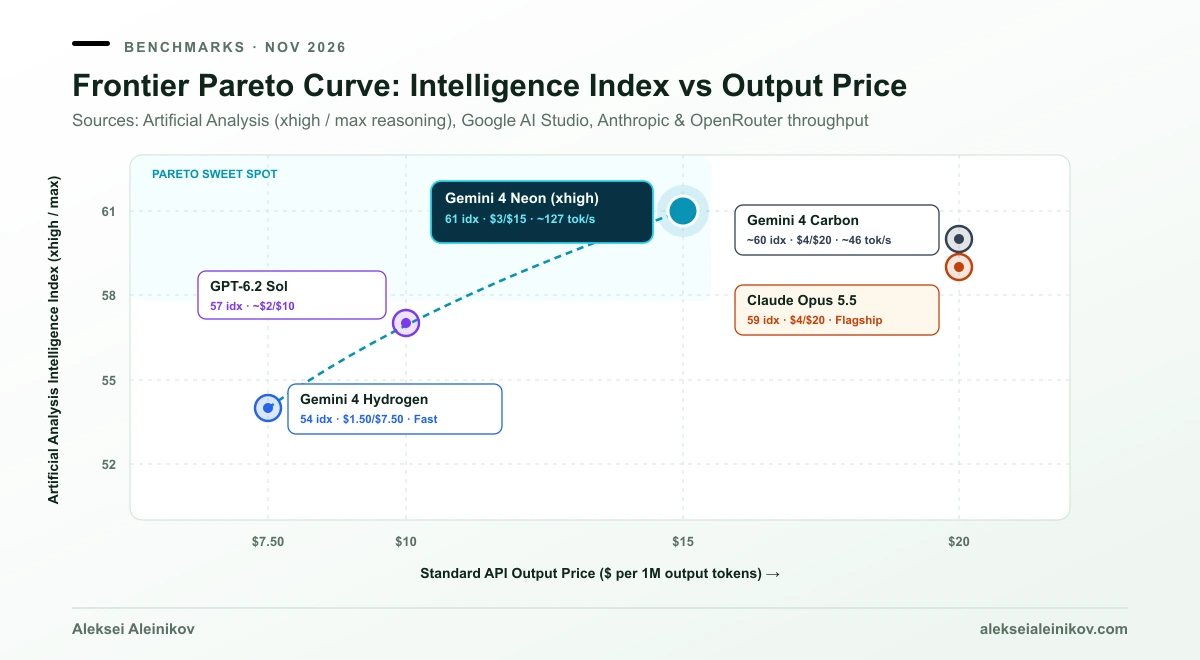
Two important nuances keep the benchmark numbers honest:
- The Carbon paradox (aggregate score vs long-horizon depth): Even though Neon edges out Gemini 4 Carbon on the aggregate Artificial Analysis Intelligence Index (
61vs~60) while costing ~32% less per task, Carbon still leads on long-horizon research evaluations such asCritPt. Neon is tuned to climb the Pareto frontier fast; Carbon is tuned to keep grinding through deep, multi-hour research chains. - The harness effect is massive: In bare, text-only minimal SWE harnesses, Neon scores dramatically lower (~12.8%) than inside a full agentic harness like Google Antigravity (~39%+ on the same style of software engineering suite and 58.6–59 on the Coding Agent Index). That is not a flaw unique to Neon — it confirms that in late 2026, tool definitions, terminal feedback loops and context management matter almost as much as the base weights.
Real 10-Turn Agent Session Math
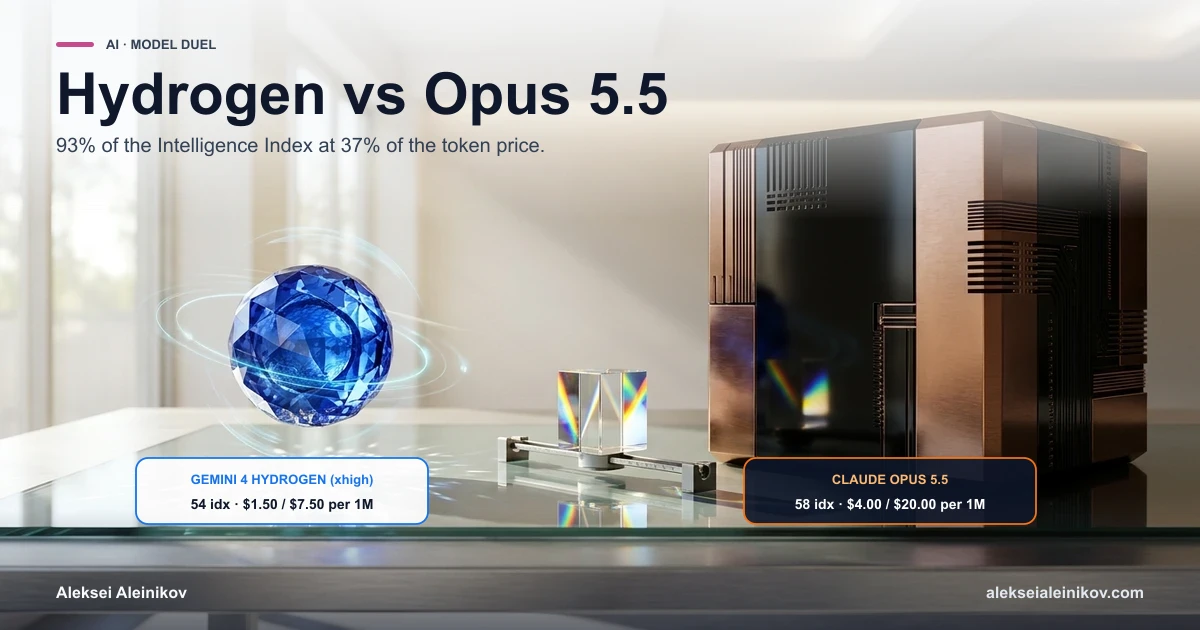
Headline per-million rates hide how coding agents actually spend tokens. Let’s apply the exact same transparent formula we used in our Hydrogen vs Opus 5.5 breakdown:
- Session shape: 10 agent turns
- Per turn:
80,000cached prefix tokens +4,000fresh input tokens +6,000output tokens (including thinking tokens) - Session totals:
800Kcache read (0.8M) +40Kfresh input (0.04M) +60Koutput (0.06M)
| Model | Cache Read (0.8M) |
Fresh Input (0.04M) |
Output (0.06M) |
Total 10-Turn Cost | vs Opus 5.5 |
|---|---|---|---|---|---|
| Gemini 4 Hydrogen | $0.06 | $0.06 | $0.45 | $0.57 | −62.5% |
| Gemini 4 Neon (Flex) | ~$0.06 | $0.06 | $0.45 | ~$0.57 | −62.5% (async) |
| Gemini 4 Neon (Standard) | $0.12 | $0.12 | $0.90 | $1.14 | −25.0% |
| Claude Opus 5.5 | $0.16 | $0.16 | $1.20 | $1.52 | Baseline |
| Gemini 4 Carbon | $0.16 | $0.16 | $1.20 | $1.52 | Baseline |
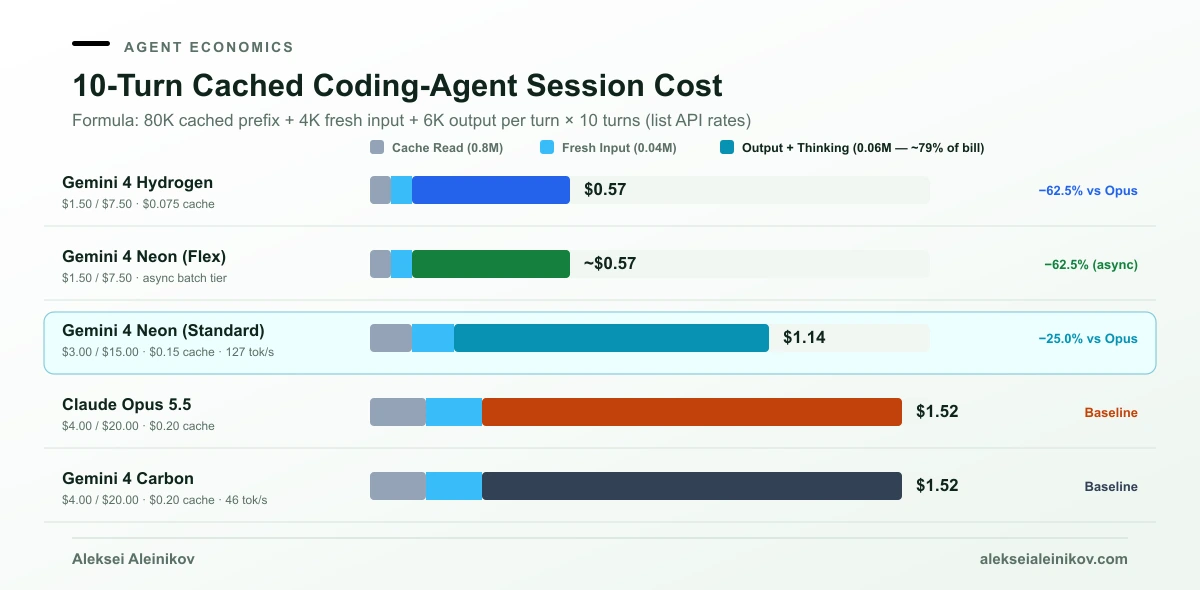
Notice where the money actually goes: 79% of the bill on every model is output tokens (including reasoning/thinking tokens). That is why Neon’s efficiency advantage over Carbon (~32% lower real task cost) is even bigger than the 25% gap in list prices — Neon reaches its answer in fewer output tokens and delivers them at ~127 tok/s instead of ~46 tok/s.
Where You Can Use Gemini 4 Neon Today
Unlike preview-only launches, Google shipped gemini-4-neon as Generally Available (GA) across six surfaces on day one:
- Gemini Web App (
gemini.google.com): Available for Google AI Pro and Google AI Ultra subscribers (replacing older Pro slots). - Google Antigravity IDE & Android Studio: Built-in for AI Pro and Ultra plans with direct controls for
low,medium,highandxhighreasoning depth. - GitHub Copilot: Available for Copilot Pro+, Business and Enterprise across VS Code, JetBrains, Xcode and compatible extensions (including open-source agents that support GitHub Copilot providers).
- Gemini API / Google AI Studio (
gemini-4-neon): Available on paid billing tiers only — there is no free API tier. - OpenRouter (
google/gemini-4-neon): Live at$3 / $15list pricing with observed ~127 tok/s streaming throughput.
What Developers Are Actually Saying
Early reactions across Hacker News and engineering teams split cleanly along practical lines:
- Speed changes the workflow: Going from Carbon’s ~46 tok/s to Neon’s ~127 tok/s makes multi-file agent loops feel interactive again. Waiting 10 seconds instead of 28 seconds per edit step keeps developers in flow.
- The “Opus feel” debate is still alive: Several engineers testing both side by side note that while Neon wins on Intelligence Index (61 vs 59) and Vals.ai, Claude Opus 5.5 still feels subtly more calibrated on fuzzy, under-specified design questions where the prompt itself has hidden contradictions.
- Naming fatigue is real: Without a lookup table, nobody knows whether
Hydrogen,Argon,NeonorCarbonis the flagship. Teams wiring models through an AI Gateway should alias them by role (fast-worker,daily-coder,deep-architect) instead of hardcoding element names across microservices.
Production Routing: Hydrogen → Neon → Carbon / Opus 5.5
The real takeaway from November 2026 is that you no longer have to pick one model for everything. A three-tier router captures both Hydrogen’s cost floor and Neon’s new Pareto peak:
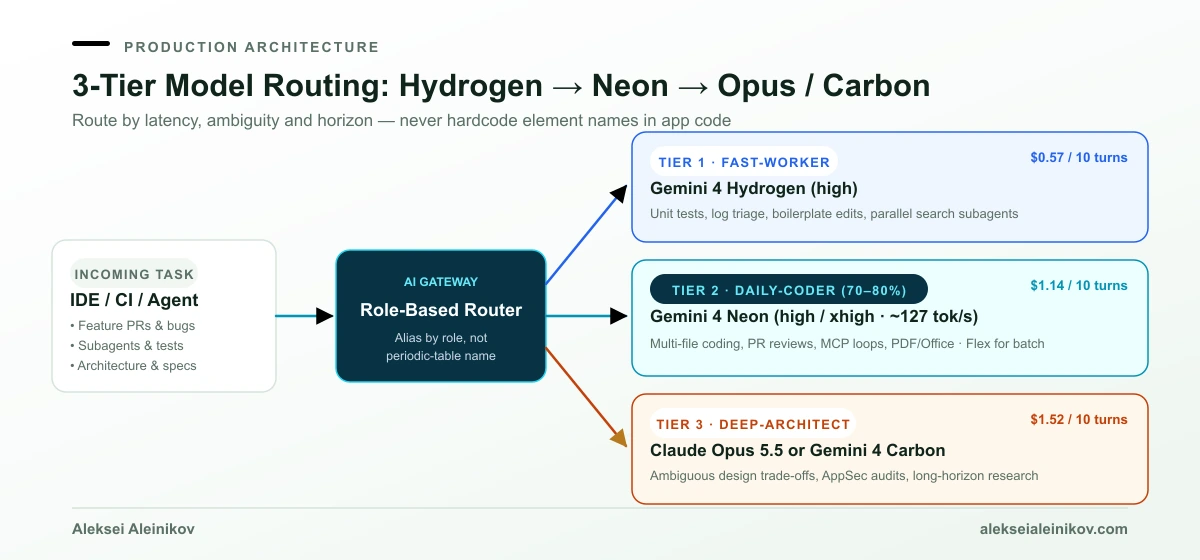
- Tier 1 — High-volume execution (
gemini-4-hydrogen,high): Unit test sweeps, log classification, boilerplate refactors, parallel search subagents ($0.57per 10-turn session). - Tier 2 — Default daily engineering (
gemini-4-neon,highdefault /xhighfor tough bugs): Multi-file feature work, PR reviews, terminal debugging, MCP tool loops, PDF/spec ingestion ($1.14per 10-turn session, ~127 tok/s). Route overnight batch jobs to Neon Flex ($1.50/$7.50). - Tier 3 — Deep escalation (
claude-opus-5-5orgemini-4-carbon): Ambiguous system design, high-stakes security reviews and long-horizon research where extra latency is worth the last few percent of judgment ($1.52per 10-turn session).
If you were previously paying $4 / $20 for Opus 5.5 or Carbon on every coding prompt, moving 70–80% of daily engineering traffic to Gemini 4 Neon cuts your bill by a quarter immediately while making your agent loops more than twice as fast.


From the community
Discussion on Mastodon & Bluesky
Replies to this article from the open web, pulled in live. No ads, no tracking scripts.
Reply there — it shows up here automatically.