
Every few years an open-weights release breaks the assumption that better reasoning requires a heavier model file on disk. Inkling 2 Mini, released under Apache 2.0 by Thinking Machines Lab on November 20, 2026, does it by reviving an architectural idea most labs left in research papers: Looped Transformers.
With 26.4B total MoE parameters (~20 GB in native NVFP4/MXFP8) and just 3.4B active weights per pass, Inkling 2 Mini loops its middle 12 layers three times to match dense 27B models on intelligence benchmarks — while hitting 79.2% on SWE-bench Verified and running locally on a 32 GB Mac.
The short verdict: Use Inkling 2 Mini as your default local coding-agent and tool-use model on 32 GB+ Macs, single 32 GB GPUs, or NVIDIA DGX Spark. It trades a bit of multi-turn chat polish for 4× faster agentic coding than dense 27B alternatives — and ships a built-in DSpark speculative drafter right inside the checkpoint.
What Is a Looped Transformer? (And Why 3.4B ≠ 5.4B)
In a standard transformer, depth is locked to parameter count: if you want 48 layers of sequential reasoning, you must store 48 distinct layers in VRAM or unified memory.
Inkling 2 Mini breaks that 1:1 coupling:
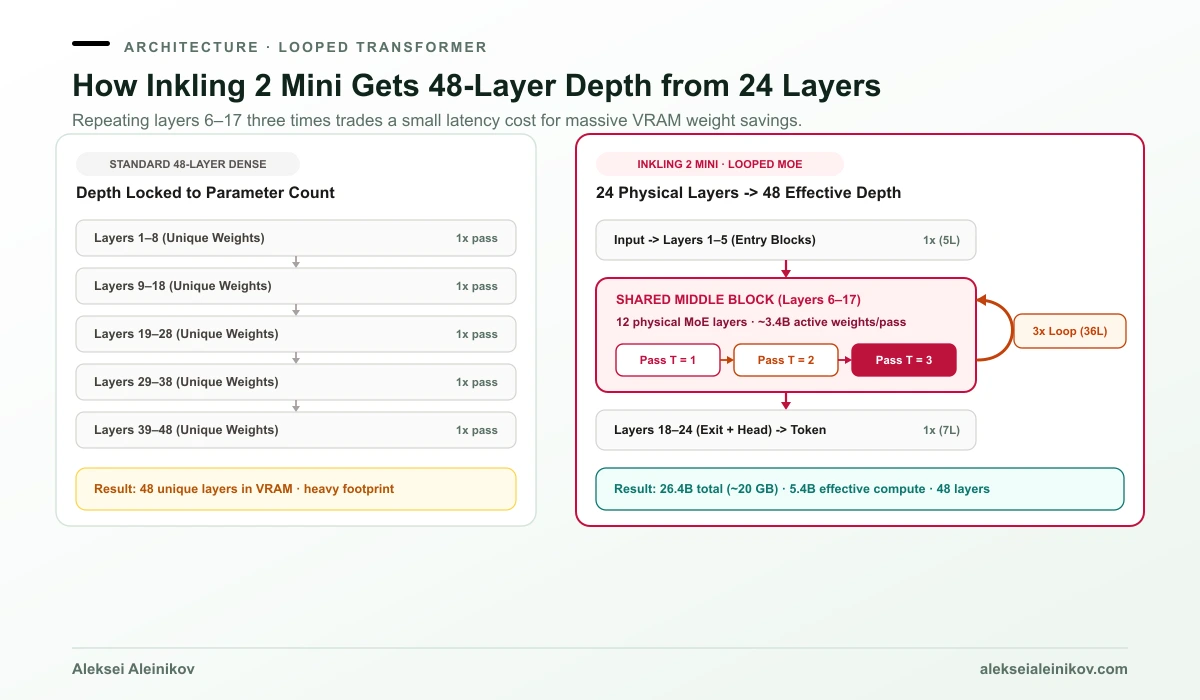
- 24 physical decoder layers: Only 24 layers exist in the model weights (
26.4Btotal parameters across sparse Mixture-of-Experts blocks, with~3.4Bactive parameters per layer pass). - 3× recurrent loop (
layers 6–17): Instead of marching straight to the output head, the hidden state from layer 17 loops back into layer 6 twice — running the middle 12-layer block three times with shared weights. - Why two active-parameter numbers circulate online: Each pass touches ~3.4B unique weights, but because the middle block executes three times, the effective arithmetic compute per token equals ~5.4B active parameters across 48 effective layer applications.
Think of that loop as latent Chain-of-Thought: the model refines its internal representation in vector space before emitting a single visible token. Standard reasoning models often burn 1,000–3,000 visible output tokens inside <think> blocks before writing a single line of code; Inkling 2 Mini pays a compact 3-pass compute cost internally, keeping coding-agent tool loops tight and avoiding wasted context-window bloat.
Inkling 2 Mini Benchmarks vs. Qwen3.8-27B
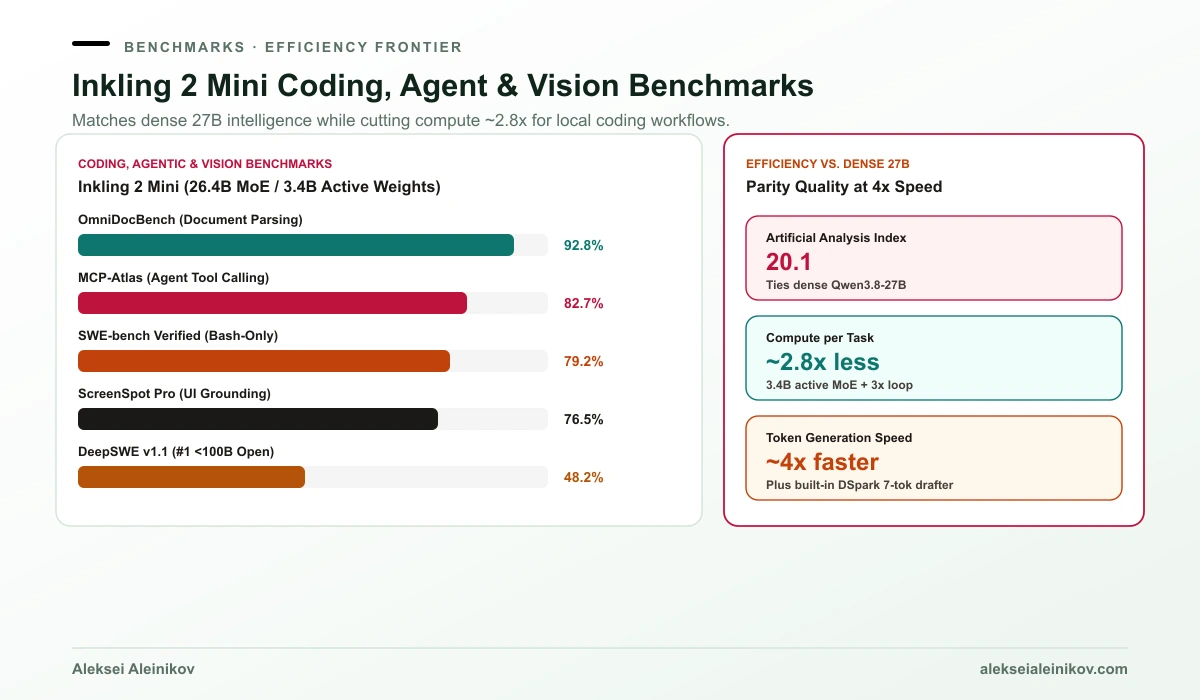
Thinking Machines tuned the 3-pass loop specifically for software engineering, bash execution, UI grounding, and tool calling rather than trivia:
| Benchmark / Metric | Inkling 2 Mini | What It Measures |
|---|---|---|
| SWE-bench Verified (bash-only) | 79.2% | Autonomous multi-step bug fixing in real repos |
| DeepSWE v1.1 | 48.2% | #1 open-weights model under 100B total parameters |
| MCP-Atlas | 82.7% | Agentic tool calling & Model Context Protocol workflows |
| ScreenSpot Pro | 76.5% | Visual UI element grounding for computer use |
| OmniDocBench | 92.8% | Multimodal document & layout parsing |
| Artificial Analysis Index | 20.1 | Ties dense Qwen3.8-27B at ~2.8× less compute & ~4× speed |
| Context & License | 1M tokens · Apache 2.0 | Text + image inputs, commercial-friendly weights |
How It Stacks Up Against Dense & Frontier Alternatives
| Model | Total / Active Params | Architecture | Hardware Tier | Best Fit |
|---|---|---|---|---|
| Inkling 2 Mini | 26.4B / 3.4B (~5.4B eff.) | Looped MoE (3× mid-block) | 32 GB Mac / 24–32 GB GPU | Fast local coding agents, bash & MCP tool loops |
| Qwen3.8-27B | 27B / 27B | Standard Dense | 32–48 GB RAM/VRAM (4-bit/8-bit) | Generalist reasoning & consistent multi-turn chat |
| Gemma 4 31B | 31B / 31B | Standard Dense | 32–48 GB RAM/VRAM | Long-form writing, instruction adherence, Q&A |
| Inkling 2 Small | ~594B (MoE) | Large-scale MoE | Multi-GPU Cloud / H200 cluster | Heavy cloud inference, not laptop/workstation class |
How to Run Inkling 2 Mini Locally: Ollama, MLX, GGUF & vLLM
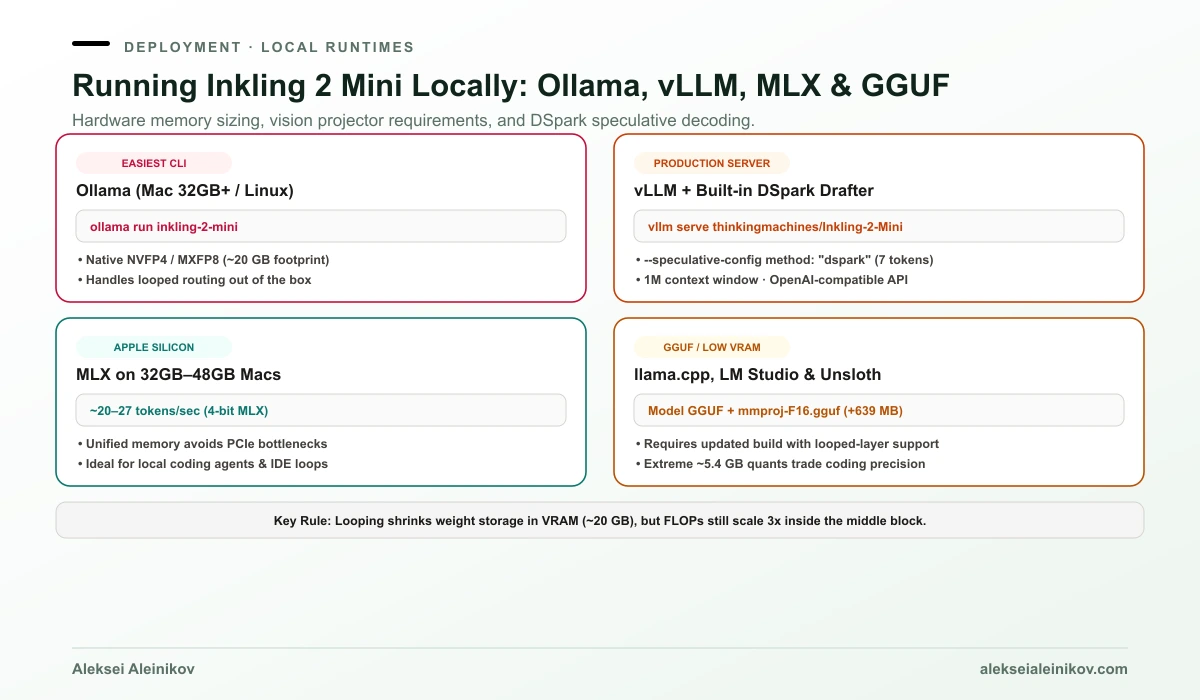
Because the checkpoint was trained natively in NVFP4 and MXFP8 (~20 GB on disk), you avoid most post-training quantization collapse — as long as your runtime supports looped layers and per-expert scaling:
Hardware & Memory Sizing (Watch the 1M Context Trap)
| Format / Runtime | Weights Size | Recommended RAM / VRAM | Notes & Trade-Offs |
|---|---|---|---|
Native NVFP4 / MXFP8 (vLLM / Ollama) |
~20 GB | 32 GB+ unified or VRAM | Full native quality + DSpark drafter support |
4-bit MLX / Q4 GGUF |
~15–18 GB | 24–32 GB | ~20–27 tok/s on 32–48 GB Apple Silicon Macs |
Vision Add-On (mmproj-F16.gguf) |
+639 MB | Same tier | Required alongside GGUF if passing UI screenshots |
| Extreme Low-Bit Quants (community) | ~5.4 GB | 8–16 GB laptops | Proof-of-concept fit; degrades multi-step code accuracy |
Option A: Ollama (Fastest Local Start)
Ideal on a 32 GB+ Mac or Linux workstation with 24–32 GB VRAM:
ollama run inkling-2-miniOption B: vLLM with Built-In DSpark Speculative Decoding
Unlike most open-weights releases, Inkling 2 Mini ships a native dspark speculative drafter inside its checkpoint, predicting up to 7 draft tokens per verification step:
vllm serve thinkingmachines/Inkling-2-Mini \ --tensor-parallel-size 1 \ --reasoning-parser inkling \ --speculative-config '{"method":"dspark","num_speculative_tokens":7,"draft_sample_method":"probabilistic"}'Option C: llama.cpp / Unsloth GGUF / Apple Silicon MLX
- Apple Silicon (
MLX): Expect roughly 20–27 tokens/sec on 32 GB–48 GB M-series Macs using native 4-bit MLX builds. - GGUF (
llama.cpp/ LM Studio): Use a recent build that explicitly supports looped-transformer routing (such asggml-org/Inkling-2-Mini-GGUFor Unsloth GGUF builds). If you pass screenshots or UI images, remember to load the separatemmproj-F16.gguf(~639 MB) vision projector. - Extreme 5.4 GB quantizations: Community ultra-low-bit builds squeeze the model into ~5.4 GB of RAM/VRAM, which is impressive for proof-of-concept runs on 8 GB laptops, though heavy compression degrades multi-step code precision as explained in our quantization VRAM & quality guide.
Limitations of Looped Transformers
Looped Transformers are a major efficiency win, not magic:
- Memory shrinks; FLOPs do not: Repeating 12 layers three times keeps weights small in VRAM, but arithmetic compute and KV/activation work still scale linearly with the loop count ($T = 3$).
- Reasoning beats recall: Extra recurrent passes sharply improve code tracing, math, and tool orchestration, but add very little for memorizing obscure static facts compared to a larger dense model.
- Multi-turn quirks: Independent evaluations note that looped architectures can occasionally drift on strict multi-turn formatting constraints or over-loop on ambiguous prompts compared to non-looped 30B+ dense models.
The Bottom Line
- Pick Inkling 2 Mini if you want a fast, Apache 2.0 local coding & MCP agent (with vision + 1M context) that fits comfortably inside 32 GB unified memory or VRAM.
- Stick with dense 27B–32B models (or larger cloud frontier models) if your workload is pure factual Q&A or long multi-turn creative chat rather than tool-driven engineering.
Related reading on local AI hardware and quantization:

From the community
Discussion on Mastodon & Bluesky
Replies to this article from the open web, pulled in live. No ads, no tracking scripts.
Reply there — it shows up here automatically.