
For years, picking a full-stack React framework meant either accepting Next.js App Router conventions or stitching together Vite, a router, and a custom server by hand. On October 13, 2026, TanStack Start 1.0 shipped its stable release — turning TanStack Router, Vite, and Nitro into a cohesive full-stack alternative.
Meanwhile, Next.js 16 matured on the other side with Turbopack enabled by default and no-store dynamic fetching defaults that corrected earlier caching pain. Comparing them is no longer about “mature vs experimental” — it is a sharp architectural choice between explicit client-driven control and framework-managed automation.
The short verdict: Choose TanStack Start 1.0 for data-dense SaaS apps, strict URL/search-param type safety, TanStack Query caching, and effortless deployment to Cloudflare Workers, Node.js, or Docker via Nitro. Choose Next.js 16 when your core product is content/SEO-driven (SSG/ISR), relies on RSC-first streaming, or needs the largest React hiring ecosystem.
Who Owns the Component Tree?
The deepest difference between TanStack Start and Next.js is not syntax — it is who controls execution boundaries:
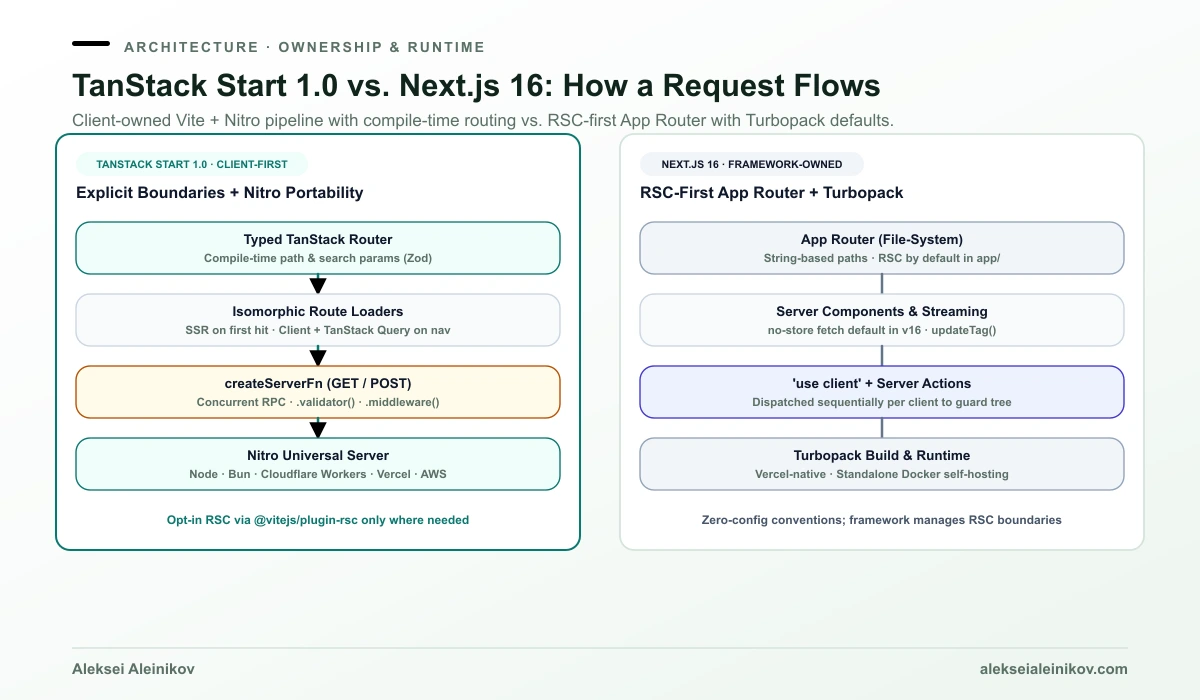
- Next.js 16 (Framework-owned): Every file under
app/defaults to a React Server Component (RSC). Interactive components must opt into the browser with'use client'. Data flows top-down through server components, with Next.js orchestrating streaming, request deduplication, and cache tags behind framework conventions. - TanStack Start 1.0 (Client-owned): Your React tree behaves like a classic Vite SPA/SSR application by default. Route
loaderfunctions run isomorphically (on the server during initial SSR, in the browser on client navigation), callingcreateServerFnRPCs when server-only access is required. If you want RSCs for heavy Markdown parsers or server-only UI subtrees, you enable them selectively via@vitejs/plugin-rsc.
TanStack Start 1.0 vs Next.js 16 at a Glance
| Dimension | TanStack Start 1.0 | Next.js 16 |
|---|---|---|
| Core philosophy | Explicit, client-first + opt-in RSC | Convention-first, RSC by default |
| Bundler | Vite (fast plugin ecosystem) | Turbopack (Rust default in v16) |
| Server runtime | Nitro (Node, Workers, Bun, Vercel, AWS) | Node / Edge (Vercel-optimized, Docker standalone) |
| Routing type safety | Compile-time (paths, params, search params) | File-system / string-based |
| Server RPC / Mutations | createServerFn (GET / POST, concurrent) |
'use server' Server Actions (sequential queue) |
| Caching model | TanStack Query + HTTP headers | Uncached by default in v16 + tag revalidation |
| Ecosystem & hiring | Growing rapidly (huge Query/Router base) | Largest React meta-framework ecosystem |
Just as moving to TypeScript 7’s native compiler or Vitest reshaped JS tooling around speed and strict types, TanStack Start bets that TypeScript teams want compile-time guarantees on URLs and server boundaries rather than implicit string conventions.
Routing, Search Params, and createServerFn vs Server Actions
In complex web apps — filters, paginated tables, multi-pane dashboards — the URL is state. Next.js gives you string-based useSearchParams() where parsing, defaults, and refactoring across <Link> components stay manual.
TanStack Start inherits TanStack Router: every route declares typed validateSearch schemas (using Zod, Valibot, or ArkType), and renaming a route param or search key fails TypeScript compilation immediately across every <Link> in the codebase.
On the server boundary, createServerFn behaves like a clean, typed RPC layer rather than hidden form magic:
import { createServerFn } from '@tanstack/react-start'import { z } from 'zod'
const filterSchema = z.object({  teamId: z.string().min(1),  status: z.enum(['open', 'closed']).default('open'),})
export const getTeamIssues = createServerFn({ method: 'GET' })  .validator((input: unknown) => filterSchema.parse(input))  .middleware([authMiddleware])  .handler(async ({ data, context }) => {    // Runs strictly on the server; client receives typed JSON    return db.issues.findMany({      where: { teamId: data.teamId, status: data.status, orgId: context.orgId },    })  })
Compare that to Next.js Server Actions ('use server'):
- Server Actions shine when submitting HTML
<form>mutations withuseActionState, returning both updated state and re-rendered RSC UI in a single network round-trip. However, Next.js dispatches Server Actions sequentially per client to keep the RSC tree consistent — firing several actions concurrently queues them behind each other. createServerFnsupports explicitGET(cacheable reads) andPOST(mutations), composable.middleware(), and built-in CSRF protection (createCsrfMiddleware), executing concurrently like normal API endpoints and integrating directly with TanStack Query (ensureQueryData).
Opt-In RSC vs Mandatory RSC
One of the biggest misconceptions about TanStack Start 1.0 is that it cannot do React Server Components. In reality, v1.x supports RSCs modularly via @vitejs/plugin-rsc without forcing every page into server-component rules:
import { defineConfig } from 'vite'import { tanstackStart } from '@tanstack/react-start/plugin/vite'import rsc from '@vitejs/plugin-rsc'
export default defineConfig({  plugins: [    tanstackStart({      rsc: { enabled: true },    }),    rsc(),  ],})
That gives you a clean escape hatch: keep 90% of your interactive dashboard in standard client/SSR React with TanStack Query, and isolate heavy syntax highlighters, MDX renderers, or server-only templates inside opt-in RSC boundaries (createCompositeComponent).
Caching, Tooling Speed, and Deployment Lock-In
Next.js 16 fixed the biggest developer complaint of the App Router era: dynamic fetch() requests now default to no-store (uncached) instead of aggressively caching by accident, and Turbopack is now the default bundler with persistent file-system caching for fast cold starts and low memory usage.
To replace the old implicit cache, Next.js 16 introduces Cache Components (cacheComponents: true in next.config.ts) and the 'use cache' directive alongside cacheLife() and cacheTag() — allowing you to cache individual async functions or React Server Components inside a Partial Prerendering (PPR) shell while streaming dynamic <Suspense> holes:
import { cacheLife, cacheTag } from 'next/cache'
export async function BillingSummary({ orgId }: { orgId: string }) {  'use cache'  cacheLife('hours')  cacheTag(`billing-${orgId}`)  const summary = await db.billing.findSummary(orgId)  return <span>{summary.plan}</span>}
TanStack Start takes a simpler environment-primitive approach instead of directive-based component caching: you rely on TanStack Query (queryKey invalidation) and HTTP headers for caching, and use explicit runtime guards like createServerOnlyFn(() => process.env.API_SECRET) or createIsomorphicFn().server(...).client(...) to separate Node-only utilities from browser code without typeof window checks.
Still, two operational differences remain decisive in production:
- Deployment portability: TanStack Start delegates server output to Nitro. Changing from a Node.js container to Cloudflare Workers, Netlify, or AWS Lambda is a Nitro preset switch rather than rewriting middleware or debugging standalone Next.js output edge cases.
- Cache transparency: Debugging Next.js revalidation tags (
updateTag(), route-level revalidation) can still feel opaque across nested layouts, whereas TanStack Start lets you keep server HTTP caching simple and rely on TanStack Query’s explicitqueryKeyinvalidation on the client.
Pairing TanStack Start’s Vite pipeline with modern Rust linters like Biome and UI primitives like shadcn/ui keeps both local DX and CI times noticeably lean.
Production Gotchas: Where Both Frameworks Bite
Every architectural trade-off shows up as real operational friction once an app hits production or grows beyond a starter template:
TanStack Start 1.0 Gotchas
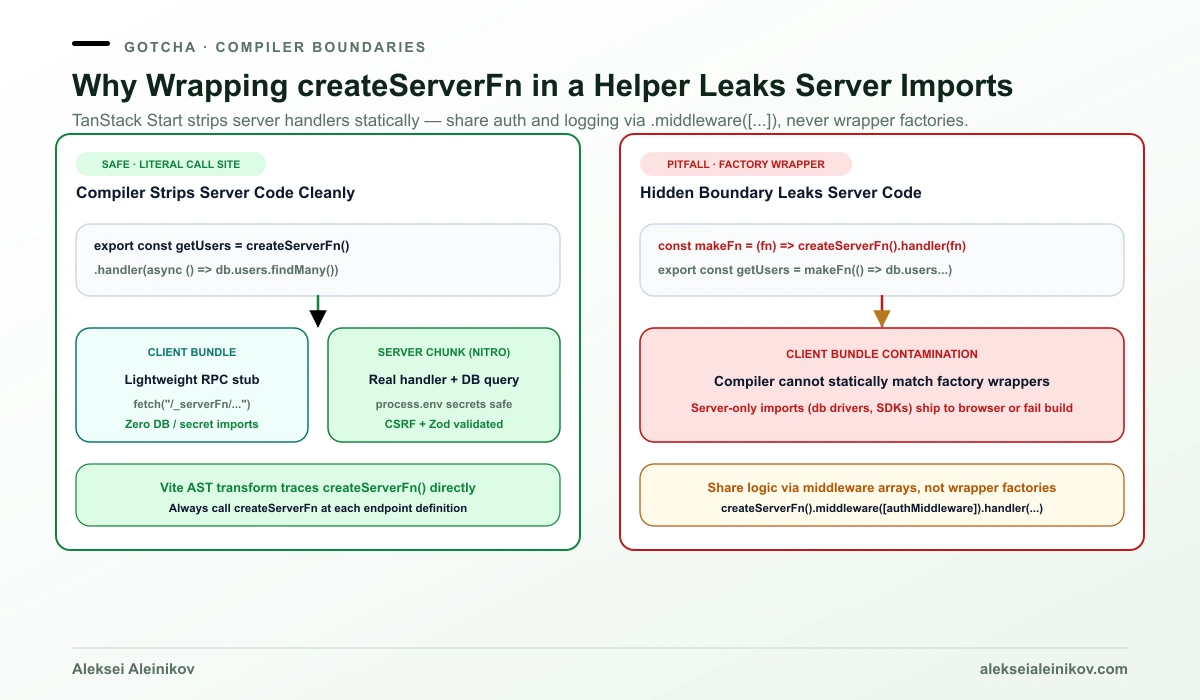
- Wrapping
createServerFnin helper factories leaks server code: The Vite compiler statically detects literalcreateServerFn(...)call sites to strip database drivers and server-only logic from the client chunk. If you wrap it in a custom helper (makeAuthServerFn(...)), static extraction fails and server imports can leak into the browser bundle or break builds. Share cross-cutting logic with.middleware([...])instead. - Strict ESM-only build graph:
@tanstack/react-start/plugin/viteis ESM-only. Projects without"type": "module"or with legacy CommonJSrequire()insidevite.config.tsfail immediately at startup. - No built-in
next/imageornext/font: Migrating from Next.js means wiring up image optimization (such as@unpic/reactor CDN transforms) and font loading (@fontsourceor CSS preloads) explicitly.
Next.js 16 Gotchas
- Sequential Server Action queue & hidden
POSTendpoints: Rapidly triggering multiple Server Actions queues them sequentially per client, and debugging hidden frameworkPOSTpayloads in network tabs is harder than inspecting explicitGET/POSTRPC endpoints. - Docker / self-hosted memory pressure: Large App Router component trees can still drive high local dev memory usage and require careful container memory sizing (
output: "standalone") outside Vercel. - The “RSC Security Tax”: Treating UI component serialization as an implicit server-client security boundary requires strict discipline around
'use client'boundaries and prompt security patching when RSC CVEs land.
When to Choose TanStack Start 1.0 vs Next.js 16
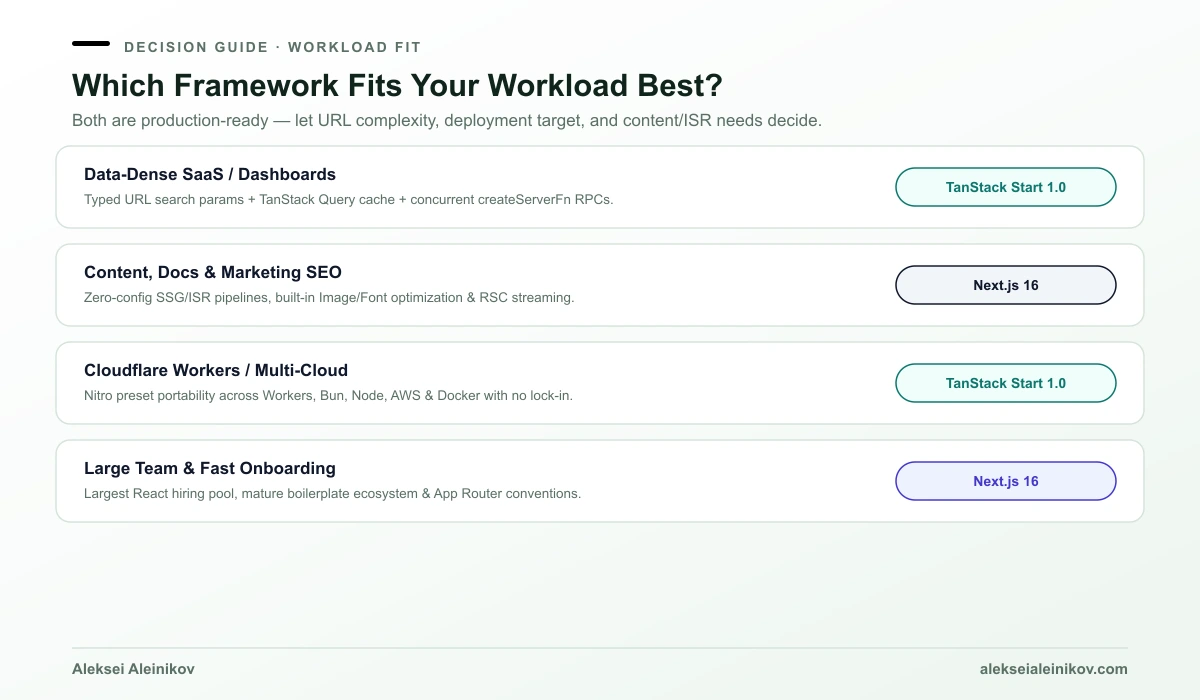
- Choose TanStack Start 1.0 if:
- Your app is dashboard-, table-, or SaaS-heavy with complex URL filters and client state.
- You already rely on TanStack Query and TanStack Router and want compile-time safety across every link and search param.
- You deploy to Cloudflare Workers, Bun, or self-hosted containers via Nitro and want zero vendor lock-in.
- Choose Next.js 16 if:
- Your site is content- and SEO-driven, leaning heavily on SSG, ISR, and automatic
<Image>/ font optimization. - You want an all-in-one convention where routing, RSC streaming, and form actions work out of the box with minimal wiring.
- Hiring speed matters most and you need engineers who already know Next.js App Router on day one.
- Your site is content- and SEO-driven, leaning heavily on SSG, ISR, and automatic
Bottom Line
TanStack Start 1.0 finally gives React teams a production-ready alternative to Next.js without sacrificing Vite speed, Nitro deployment portability, or compile-time type safety. Next.js 16 remains the safer default for content-heavy sites and large teams standardized on Vercel and RSC conventions — while TanStack Start 1.0 is the cleaner, sharper tool for engineers building stateful web applications who want full control over every boundary.

From the community
Discussion on Mastodon & Bluesky
Replies to this article from the open web, pulled in live. No ads, no tracking scripts.
Reply there — it shows up here automatically.