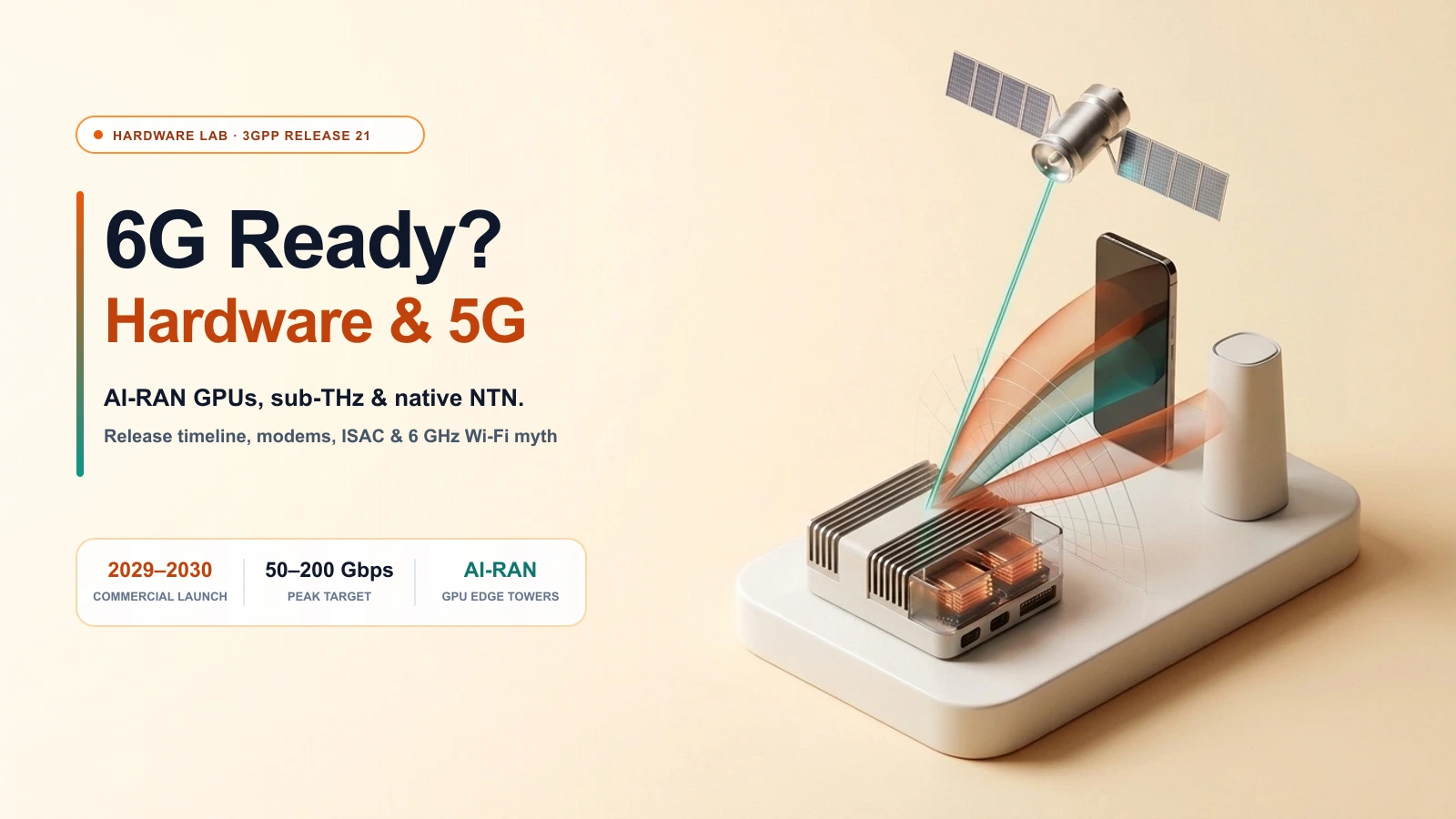
Every few years, wireless marketing blurs everything together—and right now thousands of users searching for 6G internet, 6G Wi-Fi, or a 6G release date hit conflicting rumors. Behind the hype, however, the real engineering roadmap for 6G (IMT-2030 / 3GPP Release 21) is already locked in—and it brings the biggest hardware shift in telecom history.
Instead of just chasing higher gigabit numbers on a phone screen, 6G redesigns cell towers, smartphone modems, radio spectrum, building facades, and satellite handoffs around three pillars: AI-native radio, sensing (ISAC), and GPU-accelerated AI-RAN.
6G vs. 5G: What Actually Changes in the Hardware
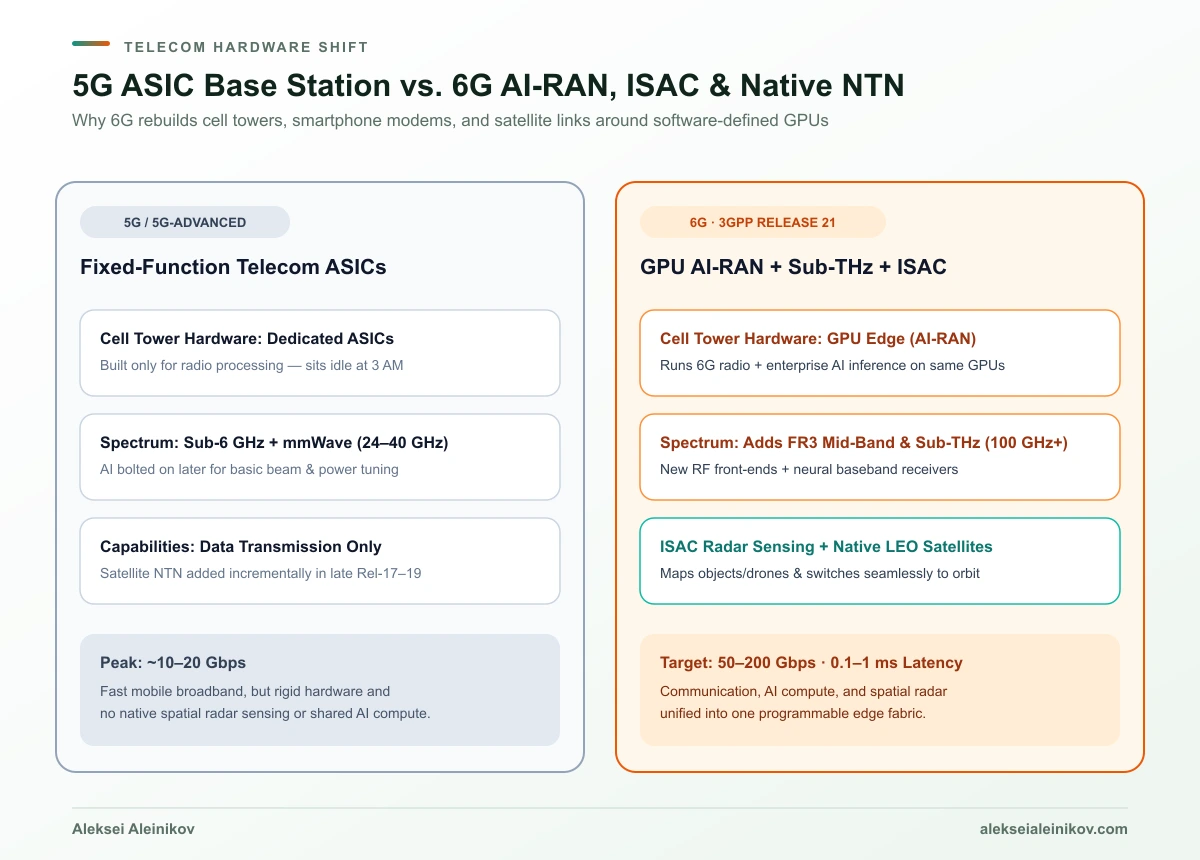
Think of 5G as a faster highway built mostly on specialized, single-purpose telecom chips (ASICs), with AI bolted on later to tune antennas. 6G rebuilds both the road and the vehicles so that communication, AI compute, and radar-like sensing run on one shared hardware fabric.
| Dimension | 5G / 5G-Advanced | 6G (3GPP Release 21 / IMT-2030) |
Hardware Impact |
|---|---|---|---|
| Core Design | Faster mobile broadband (eMBB) + URLLC | AI-native air interface + sensing + comms | Neural accelerators inside baseband modems |
| Tower Compute | Fixed-function telecom ASICs | Software-defined AI-RAN on GPUs | Cell sites act as edge AI data centers |
| Antenna Topology | Sectorized Massive MIMO per tower | Cell-Free Giga-MIMO + RIS meta-panels | Coordinated multi-tower beams; zero cell-edge drop |
| Spectrum Bands | Sub-6 GHz + mmWave (24–40 GHz) | Adds upper mid-band (FR3) & sub-THz (100 GHz+) | Completely new RF front-end & antenna arrays |
| Channel Width | Up to 100 MHz (mid) / 400 MHz (mmWave) | 400+ MHz (FR3) to 5–20 GHz (sub-THz) |
Higher ADC/DAC sampling & power efficiency needs |
| Sensing | Comm-only (early ISAC in late 5G-Adv) | ISAC (Integrated Sensing & Communications) | Radio waves map motion, objects & digital twins |
| Satellites (NTN) | Incremental add-on in Rel-17–19 | Native multi-layer terrestrial + LEO fabric | Seamless phone/FWA fallback built into core |
| Speed & Latency | ~10–20 Gbps peak (~1 ms latency) | 50–200 Gbps peak (up to 1 Tbps sub-THz; 0.1–1 ms) | Multi-gigabit backhaul & 1–10 Gbps real phone speed |
How 6G Actually Works Under the Hood
Most articles explain what 6G promises, not how the physics and hardware actually pull it off without dropping your signal the moment you step behind a concrete wall.
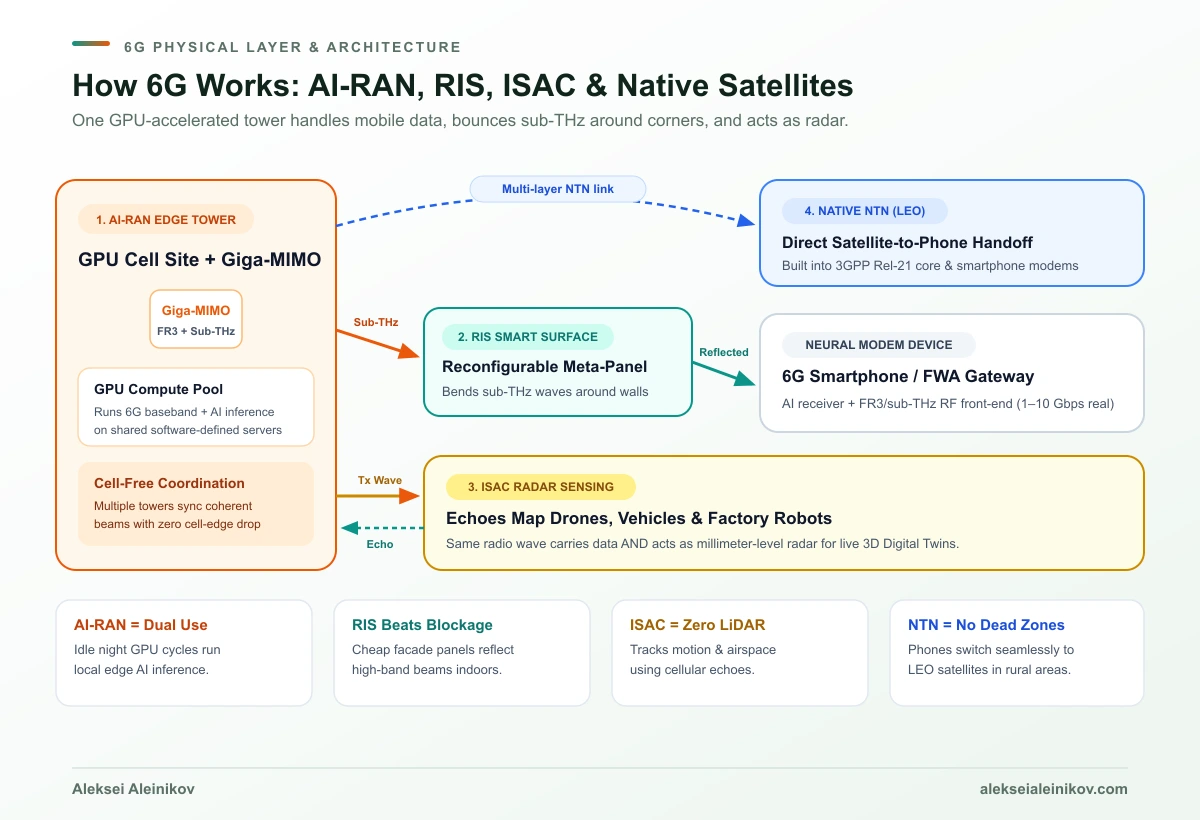
Here is the end-to-end signal loop inside a 6G hardware cell:
- AI-RAN GPU Edge Tower: Instead of fixed telecom ASICs sitting idle at 3 a.m., software-defined 6G radio runs on GPU-accelerated servers at the cell site. During off-peak hours, those same GPUs process enterprise AI inference or local edge workloads.
- Cell-Free Giga-MIMO: In 5G, one tower owns your phone until you hit a weak cell edge. In 6G, multiple nearby antenna arrays coordinate coherently—acting like one giant virtual antenna (Cell-Free MIMO) so dead zones between towers disappear.
- RIS (Reconfigurable Intelligent Surfaces): High-frequency
sub-THzandFR3beams struggle to pass through walls. 6G mounts thin, low-power RIS metamaterial panels on building facades and glass to electronically bounce and steer beams around corners into indoor spaces. - ISAC Radar Echoes: While transmitting your video or data, the tower listens to radio reflections bouncing off drones, vehicles, walls, and factory robots—turning the cellular network into a real-time 3D digital twin with zero extra LiDAR hardware.
- Native LEO Satellite Handoff (NTN): If you drive out of terrestrial tower range, the
3GPP Release 21modem hands off natively to Low Earth Orbit (LEO) satellites without third-party apps or proprietary emergency modes.
6G Spectrum Physics: Why FR3 Matters More Than 1 Tbps Hype
Search headlines love throwing around “1 Tbps 6G speeds”, but real-world wireless engineering comes down to a brutal physics trade-off: higher frequencies carry wider data lanes, but travel shorter distances.
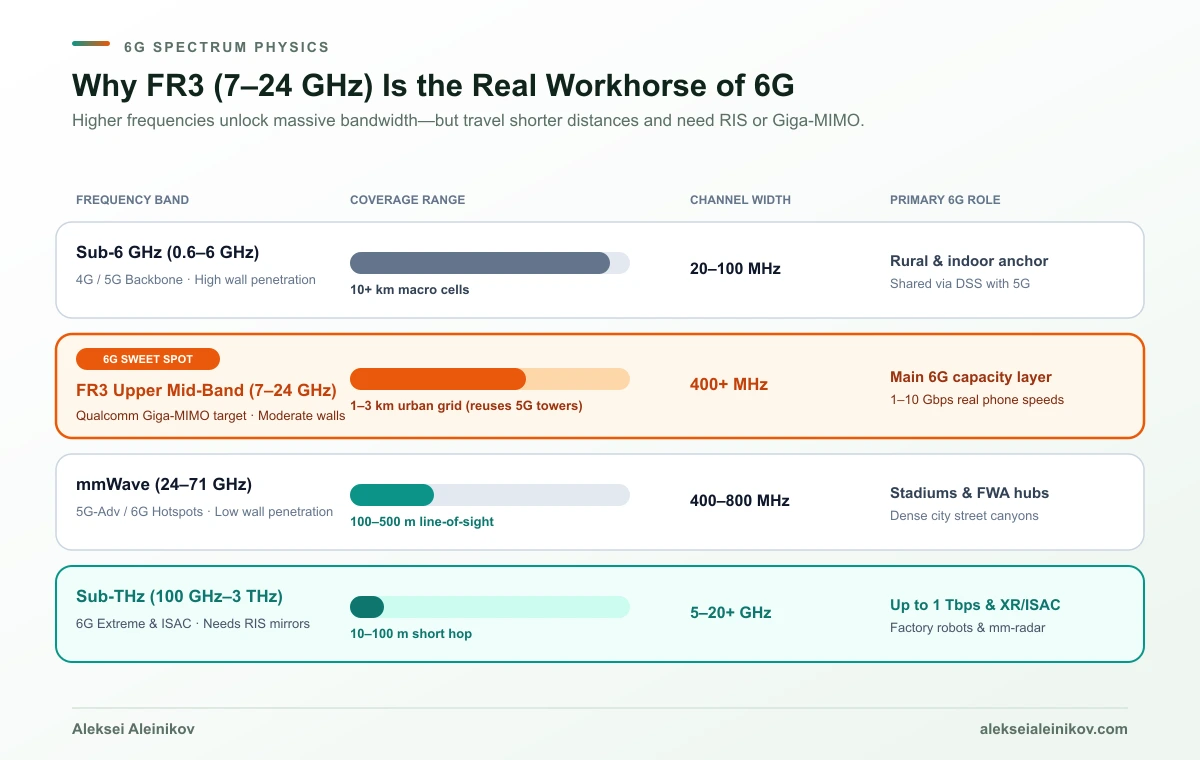
- Sub-6 GHz (
0.6–6 GHz): Remains the rural and deep-indoor anchor (10+ kmreach), shared smoothly between 5G and 6G via Dynamic Spectrum Sharing (DSS). - FR3 Upper Mid-Band (
7–24 GHz): The true workhorse of commercial 6G. With400+ MHzcontiguous channels and1–3 kmurban range, FR3 lets carriers reuse existing 5G tower grids (upgraded with Giga-MIMO) to deliver 1–10 Gbps real-world smartphone speeds. - mmWave (
24–71 GHz) & Sub-THz (100 GHz–3 THz): Reserved for stadiums, factory robotics, holographic XR, and millimeter-precision ISAC sensing—where5–20+ GHzultra-wide channels hit50–200 Gbps(and up to1 Tbpsin short-range line-of-sight hops aided by RIS mirrors).
6G Release Date: The Official 2026–2030 Roadmap
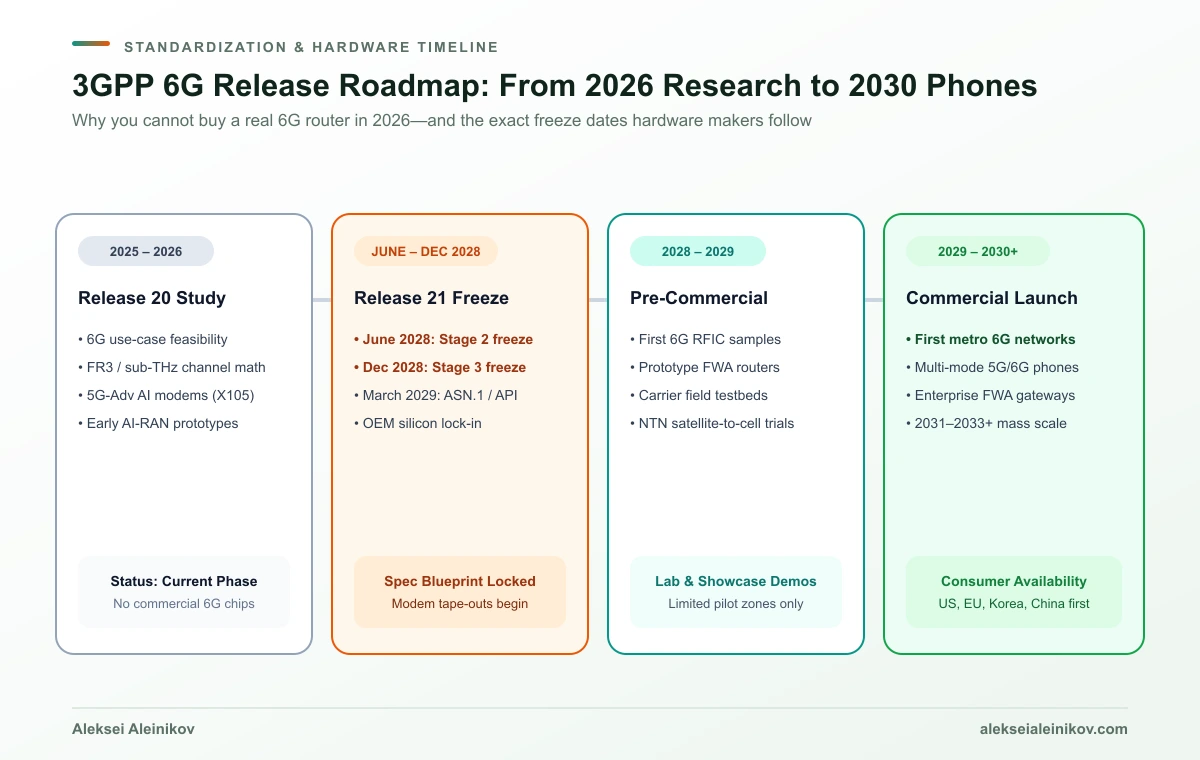
Unlike Wi-Fi generations—where vendors ship early draft routers years ahead of final certification—cellular networks move on strict global 3GPP freezes before carriers can deploy spectrum nationwide.
| Phase | Timeline | Key Technical & Hardware Milestone | What Consumers See |
|---|---|---|---|
Study Phase (Rel-20) |
2025–2026 | 3GPP evaluates 6G scenarios, FR3/sub-THz channels, AI-RAN trials | 5G-Advanced modems (e.g., Qualcomm X105) test early AI features |
Requirements (Rel-21) |
March 2027 | Stage 1 service & hardware requirements freeze | Carrier RF spectrum auctions & FR3 lab testbeds expand |
Normative Spec (Rel-21) |
June–Dec 2028 | Stage 2 architecture freeze (June 2028); Stage 3 protocol freeze (Dec 2028) | First OEM baseband & RFIC test samples |
| Pre-Commercial Pilots | 2028–2029 | ASN.1 freeze (March 2029); FWA router & prototype handset trials | Carrier showcase demos in US, EU, South Korea, Japan, China |
| Commercial Launch | 2029–2030 | Initial metro 6G networks & multi-mode 5G/6G smartphones | First flagship 6G phones & enterprise FWA gateways |
| Mass Adoption | 2031–2033+ | Dynamic Spectrum Sharing (DSS) alongside 5G anchor networks | Broader regional rollout as hardware costs drop |
Who Is Building 6G Hardware (and Which Countries Lead)?
Every major silicon and telecom vendor is betting on a distinct piece of the 6G hardware stack:
| Company / Region | Core 6G Hardware Focus | Why It Matters |
|---|---|---|
| NVIDIA (AI-RAN Alliance) | GPU-accelerated RAN + edge AI compute servers | Turns telecom base stations from idle ASIC racks into dual-use AI edge clouds |
| Qualcomm | Upper mid-band FR3 (7–15+ GHz) Giga-MIMO & neural modems |
Unlocks multi-gigabit urban 6G without rebuilding every cell tower from scratch |
| Nokia (Bell Labs) | ISAC sensing fabrics, sub-THz prototypes & cloud-native RAN | Turns city infrastructure into real-time digital twins for drones and robotics |
| Ericsson | Ultra-lean energy-efficient RAN & Sub-Band Full Duplex (SBFD) | Keeps power draw flat despite massive antenna counts and wider FR3 bands |
| First Launch Regions | US, South Korea, Japan, China, EU | Early metro trials in 2028–2029; initial commercial service in 2029–2030 |
If you already follow how portable satellite links integrate into modern networks—see our breakdown of Starlink Mini 2 battery and WAN architecture—6G brings that seamless terrestrial-to-LEO switching directly into standard smartphones.
Stop Confusing “6G Wi-Fi” with 6G Cellular
One of the biggest sources of confusion online is the phrase “6G Wi-Fi” or “6G router”.
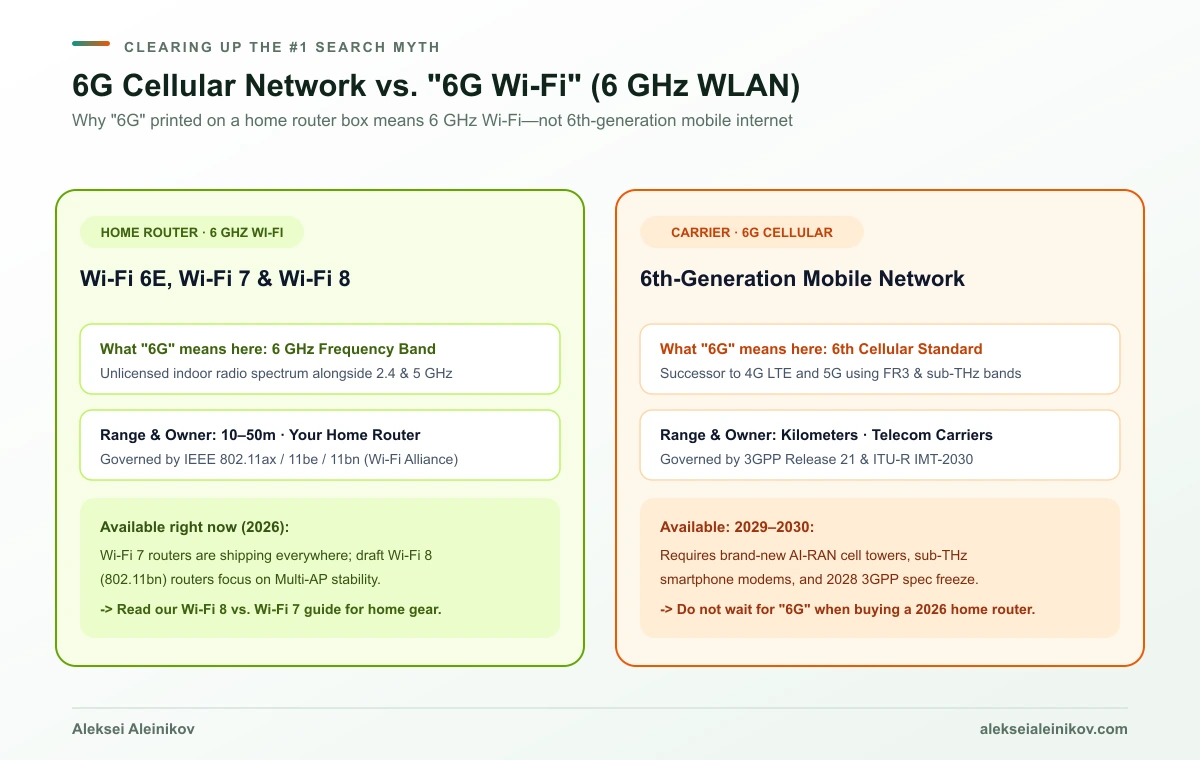
- When a home router box says “6G” or “6 GHz”, it means the 6 GHz unlicensed radio band inside Wi-Fi 6E, Wi-Fi 7, or Wi-Fi 8 (
802.11bn)—covering your apartment or office over tens of meters. - Cellular 6G (
3GPP Release 21) is your telecom carrier’s outdoor mobile network arriving around 2030.
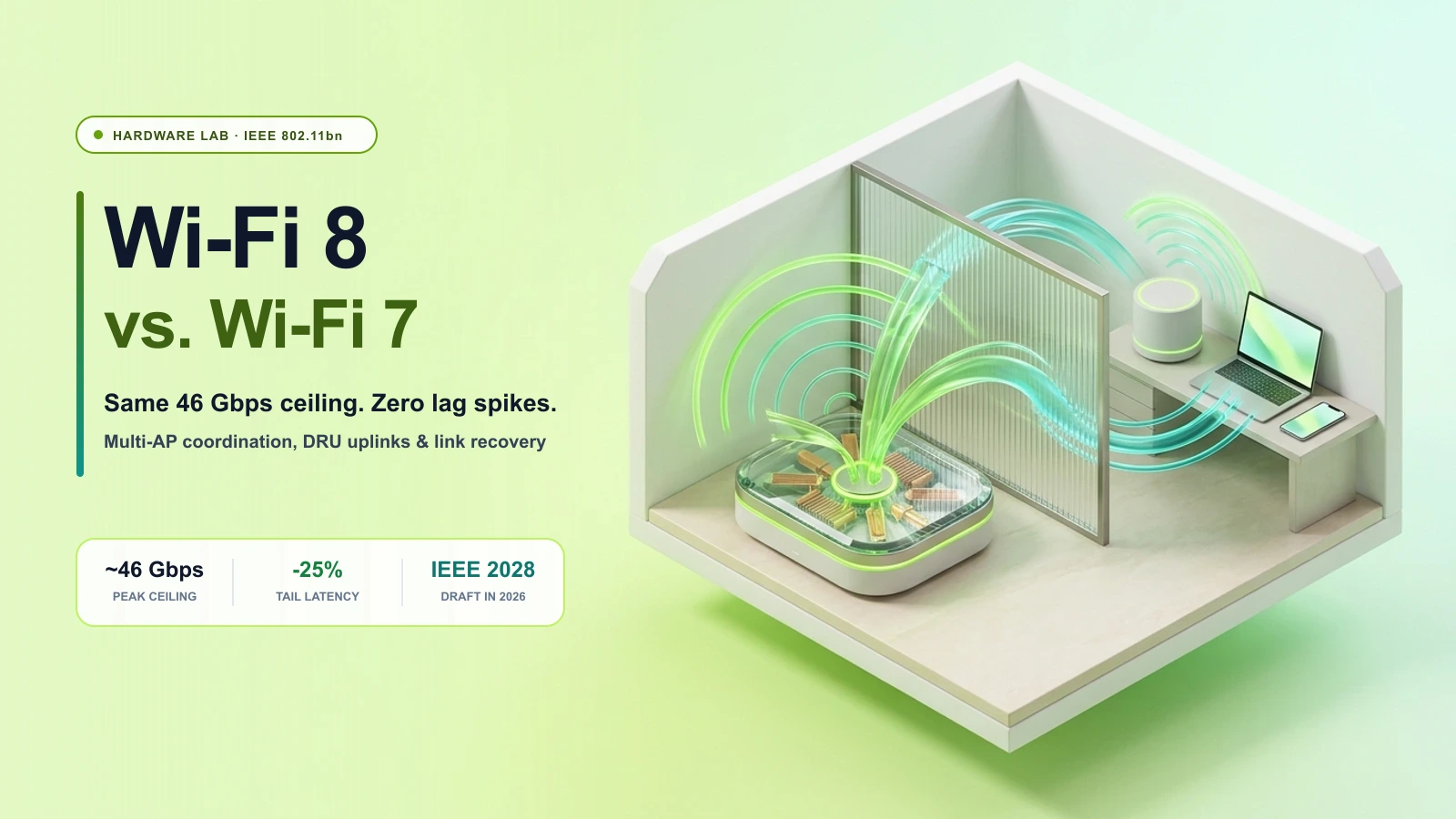
If you want better wireless reliability at home right now, what you actually want is our comparison of Wi-Fi 8 (802.11bn) vs. Wi-Fi 7 routers—not a nonexistent 2026 cellular 6G router.
Should You Wait for 6G Hardware?
No. If you are upgrading a phone, Fixed Wireless Access gateway, or home lab in 2026–2028:
- For mobile & WAN: Buy proven 5G / 5G-Advanced hardware (or LEO satellite backup where needed); mainstream 6G coverage is 4+ years away, and 5G phones will keep working alongside 6G well into the 2030s.
- For home & office wireless: Focus on Wi-Fi 7 today and
2.5G / 10Gwired switching that will outlast both Wi-Fi 8 and future 6G FWA gateways.
Summary
6G (IMT-2030 / 3GPP Release 21) is not just a theoretical 1 Tbps speed badge. Its real revolution is in the hardware: GPU-driven AI-RAN cell towers, Cell-Free Giga-MIMO over FR3 (7–24 GHz), RIS smart facade panels that bend sub-THz waves around obstacles, ISAC radar sensing, and native LEO satellite integration—all converging toward initial commercial networks in 2029–2030.