
For months, the biggest gap between a consumer AI mini PC and NVIDIA’s DGX Spark wasn’t raw memory capacity—it was clustering. A single 128 GB Strix Halo box hit a wall the moment a 235B or 405B model exceeded its VRAM budget, while two DGX Spark units could snap together over 200 Gb/s ConnectX-7 RDMA to pool 256 GB.
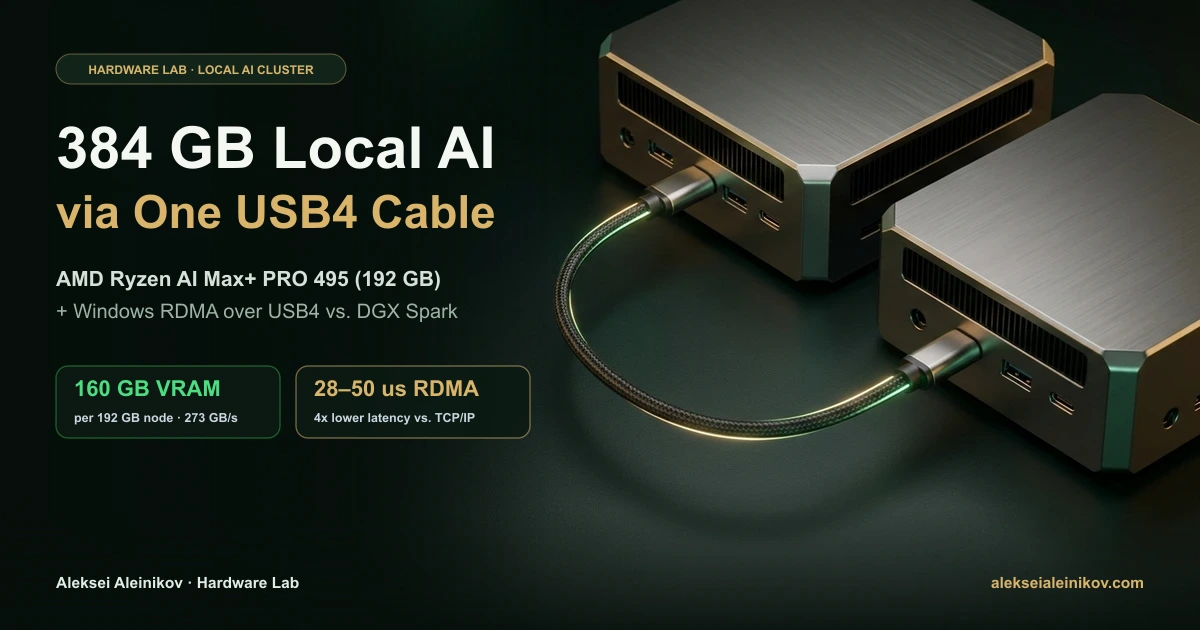
Two November 2026 releases change that equation on paper: AMD’s Ryzen AI Max+ PRO 495 raises unified memory on compact x86_64 workstations to 192 GB (with up to 160 GB assignable as VRAM), and Microsoft’s RDMA over USB4 developer preview turns a plain USB4 cable into a low-latency RDMA fabric on Windows 11.
What changed with Ryzen AI Max+ PRO 495
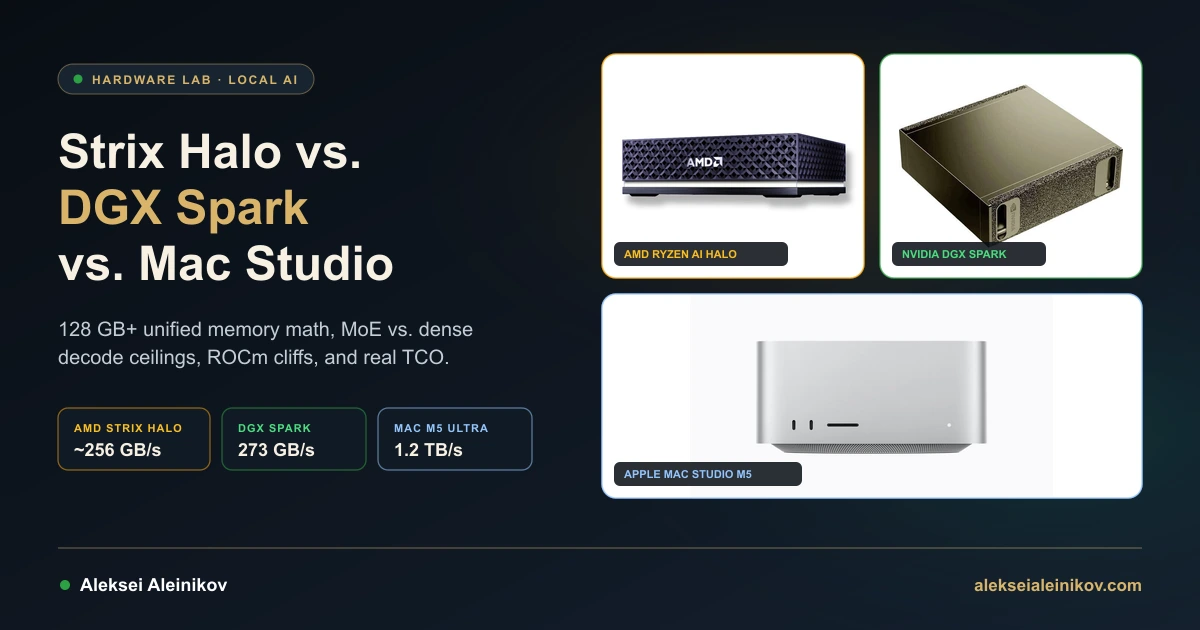
Earlier 128 GB Strix Halo systems—like the ones we compared in our 128 GB Strix Halo vs. DGX Spark vs. Mac Studio breakdown—capped BIOS Variable Graphics Memory around 96–112 GB. Ryzen AI Max+ PRO 495 (“Gorgon Halo”) pushes both memory density and bus clock higher while adding AMD PRO manageability.
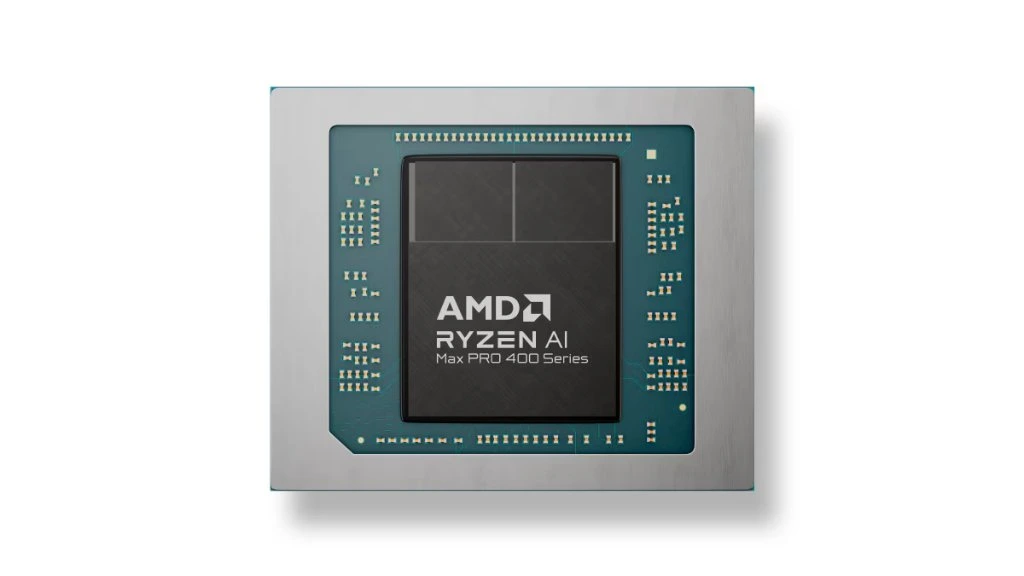
| Specification | Ryzen AI Max+ 395 (128 GB) | Ryzen AI Max+ PRO 495 (192 GB) |
|---|---|---|
| CPU | 16-core / 32-thread Zen 5 | 16-core / 32-thread Zen 5 (up to 5.2 GHz, 64 MB L3) |
| Integrated GPU | Radeon 8060S (40 RDNA 3.5 CUs) | Radeon 8065S (40 RDNA 3.5 CUs) |
| NPU / Total AI | XDNA 2 (50+ TOPS) | XDNA 2 (up to 55 TOPS NPU · ~131 TOPS total · 61 TFLOPS FP16) |
| Unified Memory | 128 GB LPDDR5x-8000 | 192 GB LPDDR5x-8533 (256-bit bus) |
| Max Assignable VRAM | ~96 GB typical | Up to 160 GB (leaving 32 GB for host OS) |
| Memory Bandwidth | ~256 GB/s | ~273 GB/s (matches DGX Spark’s 256-bit bus) |
| TDP Envelope | 45–120 W | 45–120 W (140–160 W sustained OEM designs) |
The 192 GB mini-workstations shipping with PRO 495
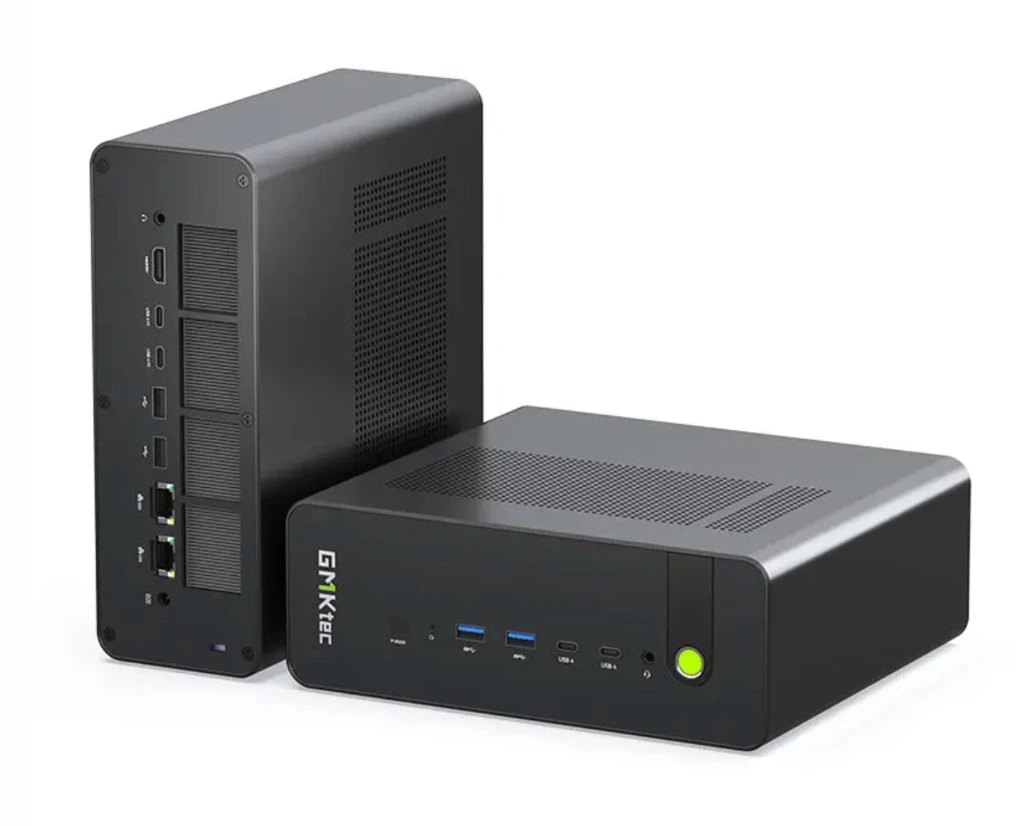
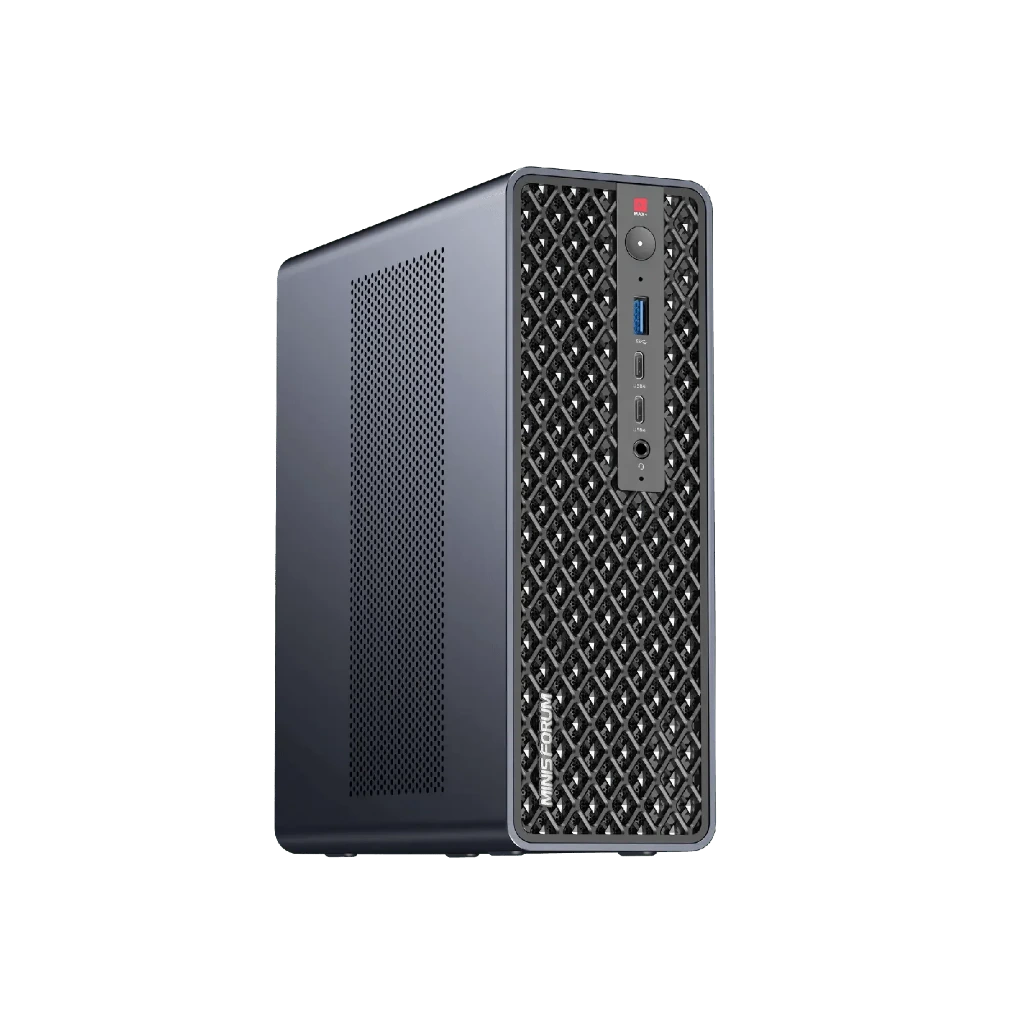
Two compact x86_64 platforms pair the PRO 495 with 192 GB LPDDR5x-8533 and dual USB4 v2 (80 Gbps) ports out of the box:
- GMKtec EVO-X5 Pro (~$6,799 retail with 192 GB RAM): 221 × 80 × 195 mm chassis (~2.5 kg), 2× USB4 v2 (80 Gbps), 2× USB4 (40 Gbps), dual 10GbE LAN with AMD DASH out-of-band management, dTPM 2.0, 3× M.2 PCIe 4.0 slots, and a 330 W PSU.
- Minisforum MS-S1 MAX-P495 (~$6,599–$8,249+ depending on region/bundle): ~2.8 kg workstation chassis with dual USB4 v2 (80 Gbps), dual 10GbE LAN, Wi-Fi 7, and a PCIe x16 expansion slot aimed at desktop or 2U rack clustering.
How Windows RDMA over USB4 actually works
Historically, linking two Windows PCs over a USB4 cable meant USB4Net—emulating Ethernet over the USB4 tunnel and pushing every tensor packet through the OS TCP/IP or UDP stack. That costs CPU interrupts, kernel buffer copies, and 116–194 microseconds of round-trip latency.
In its November 2026 Windows 11 Developer Preview, Microsoft introduced a software RDMA over USB4 provider built on the NetworkDirect API. Instead of crossing the OS network stack, it maps send/receive queue pairs directly onto the USB4 host router’s DMA rings, transferring registered memory regions peer-to-peer across the cable.
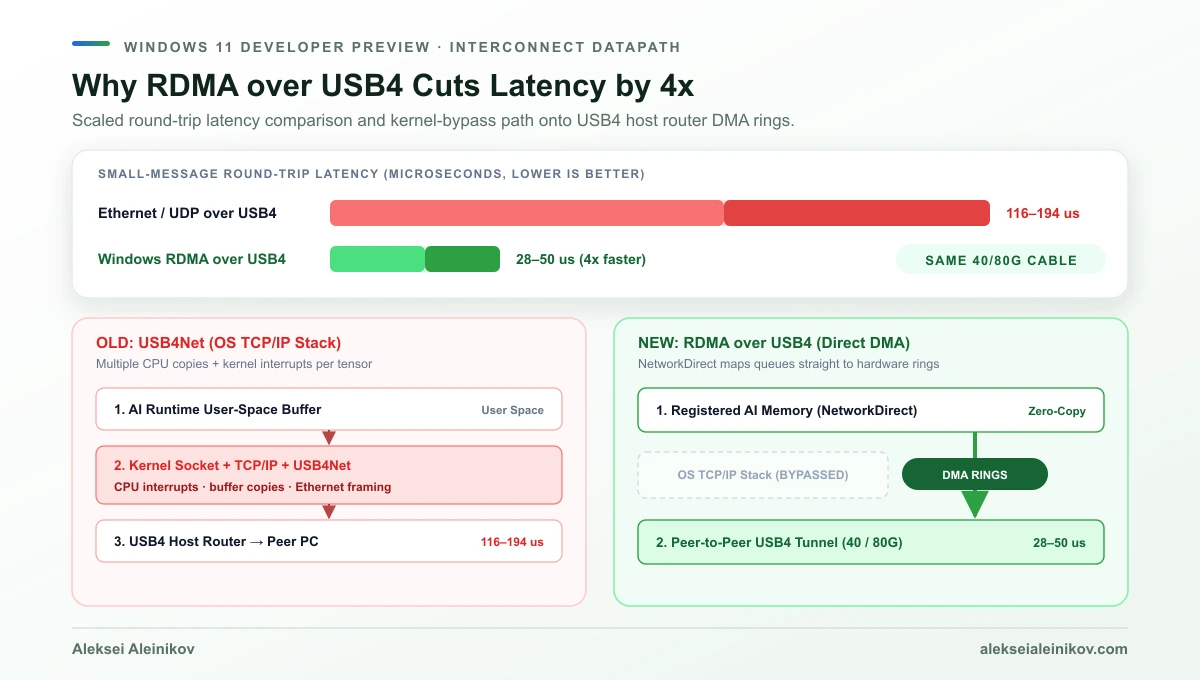
According to Microsoft’s published developer preview numbers:
- Latency drops ~4×: small-message round-trip time falls from 116–194 us (UDP/Ethernet over USB4) to 28–50 us on both 40 Gbps and 80 Gbps links.
- No SmartNICs or switches: Microsoft demonstrated a 235B-parameter model running across three Ryzen AI Max mini PCs connected over standard 40 Gbps USB4 cables, while 80 Gbps USB4 v2 doubles link bandwidth at the same 28–50 us baseline latency.
Architecture: Pipeline vs. Tensor Parallelism
A 384 GB memory pool (320 GB combined VRAM across two 192 GB boxes) sounds like a datacenter node—until you check how distributed LLM inference uses the wire.
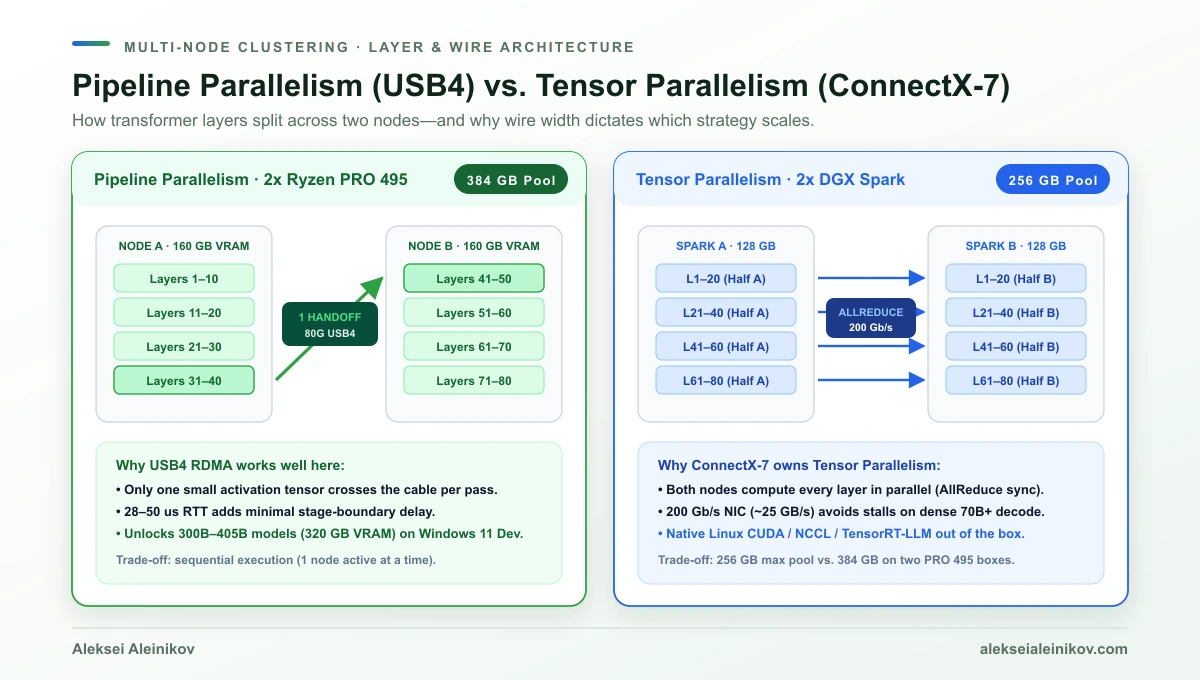
RDMA over USB4 eliminates OS networking overhead, not the physical 40–80 Gbps cable ceiling. That makes Pipeline Parallelism the natural fit for USB4 clusters, while Tensor Parallelism still favors 200 Gb/s ConnectX-7.
- Pipeline Parallelism (layers 1–N/2 on Node A, N/2–N on Node B): Each forward pass sends only a compact activation tensor across the USB4 link once per stage boundary. At 28–50 us RTT, the handoff penalty is tiny—this is where two 192 GB nodes shine for 300B–405B models.
- Tensor Parallelism (splitting every layer across both nodes): Requires an
AllReducesynchronization across the cable on every single transformer layer, for every generated token. At 40–80 Gbps (5–10 GB/s raw), USB4 is 2.5× to 5× narrower than a 200 Gb/s ConnectX-7 link (25 GB/sraw), so dense tensor-parallel decode stalls earlier on the wire.
Capacity vs. bandwidth: what actually fits
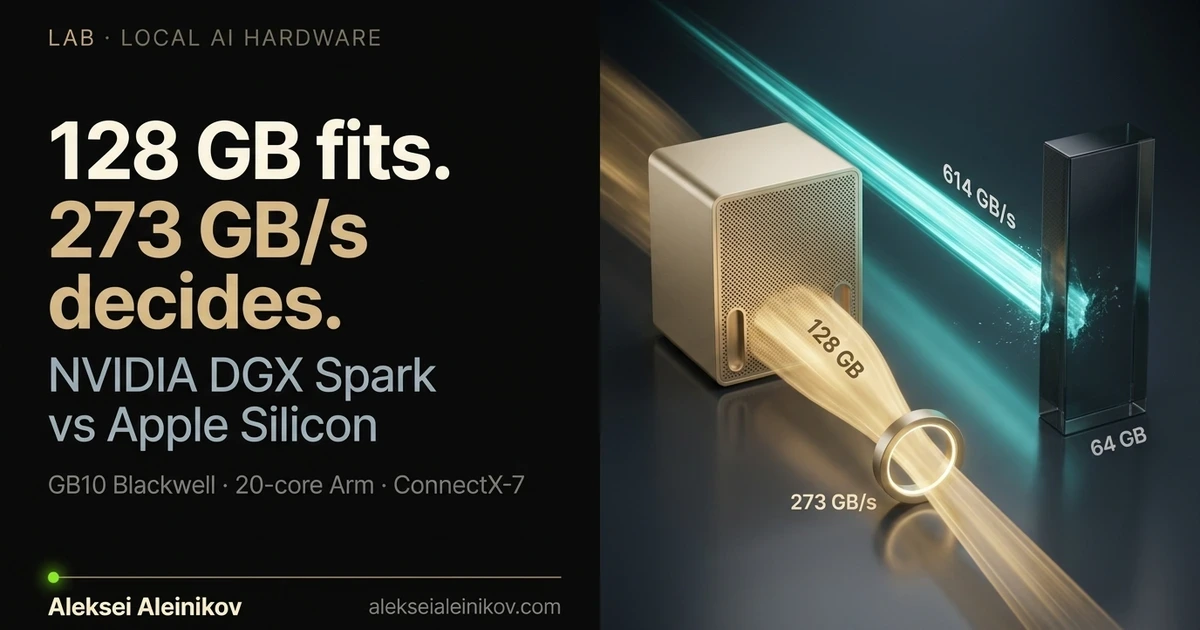
The 256-bit LPDDR5x-8533 bus delivers ~273 GB/s—the exact same theoretical memory bandwidth as NVIDIA’s DGX Spark (GB10). That means more VRAM lets you load bigger models, not magically stream dense weights faster.
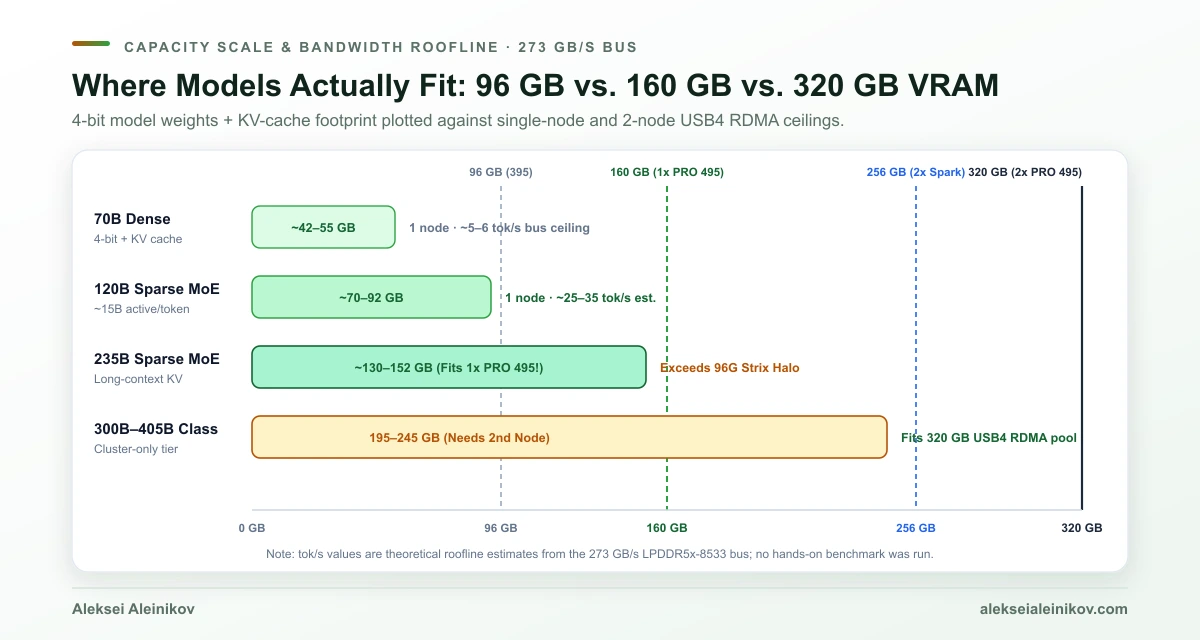
Using simple roofline math (bandwidth / active weights per token):
- 70B dense (4-bit, ~40 GB weights): Fits on one 192 GB node with plenty of KV-cache room, hitting the ~5–6 tok/s single-node bus ceiling. Clustering two nodes adds latency here for no reason.
- 120B–235B sparse MoE (4-bit, ~15–22B active): Fits cleanly inside 160 GB VRAM on a single PRO 495 node, where sparse activation keeps decode brisk (~20–35 tok/s theoretical ceiling). Adding a second node expands KV-cache headroom for long-context multi-agent loops.
- 300B–405B flagship / large MoE (~190–245 GB): Exceeds a single node’s 160 GB VRAM cap, but fits comfortably inside a 2-node 320 GB VRAM USB4 RDMA cluster.
The honest trade-offs and caveats
Before buying two $6,600+ mini-workstations expecting a turnkey Linux cluster, check four constraints:
- Windows 11 Developer Preview dependency: RDMA over USB4 currently ships in a Windows 11 Developer Preview using Microsoft’s NetworkDirect API. If your inference stack depends on Linux
vLLMorROCmcontainers, you cannot use this Windows USB4 RDMA provider yet. - OEM pricing vs. 128 GB Strix Halo: At $6,599–$8,249 per 192 GB unit, two PRO 495 boxes cost $13,200+, which actually exceeds two 128 GB DGX Sparks (~$9,400+ MSRP pair)—though it buys you 384 GB vs. 256 GB total memory and full x86_64 flexibility.
- 273 GB/s is still not HBM or M5 Ultra: If your primary workload is fast single-user chat on 70B dense models, an Apple Mac Studio M5 Max (614 GB/s) or M5 Ultra (1.2 TB/s) remains 2×–4× faster per token.
Quick decision matrix
| Setup | Usable VRAM / Pool | Interconnect | Software Stack | Approx. Hardware Cost | Best Fit |
|---|---|---|---|---|---|
| 1× Ryzen AI Max+ PRO 495 | 160 GB VRAM (192 GB) | Single node | Windows / Linux (ROCm, Vulkan) |
~$6,600–$8,250 | 120B–235B MoE models on x86_64 |
| 2× Ryzen AI Max+ PRO 495 | 320 GB VRAM (384 GB) | 40/80 Gbps USB4 RDMA | Windows 11 Dev Preview | ~$13,200–$16,500 | 300B–405B models via pipeline parallelism |
| 2× NVIDIA DGX Spark | 256 GB Coherent | 200 Gb/s ConnectX-7 | DGX OS (Arm Linux, CUDA) | ~$9,400+ MSRP | Tensor parallelism, CUDA/vLLM parity |
| 1× Mac Studio M5 Ultra | Up to 512 GB Unified | Single node (1.2 TB/s) | macOS (MLX, llama.cpp) |
~$5,499–$9,500+ | Fastest dense 70B+ single-user decode |
Read next: For the dedicated CUDA architecture and 200 Gb/s ConnectX-7 clustering baseline, see our NVIDIA DGX Spark unified memory analysis.
The Bottom Line
AMD Ryzen AI Max+ PRO 495 solves the single-box VRAM ceiling at 160 GB usable GPU memory, and Windows RDMA over USB4 removes the biggest pain point of multi-node mini-PC clustering—dropping interconnect latency 4× to 28–50 us over ordinary USB4 cables.
Choose a single 192 GB node if you want to run 120B–235B MoE models locally on x86_64 without cluster complexity. Add a second node over 80 Gbps USB4 RDMA only if you specifically need 320 GB+ combined VRAM for 300B–405B models via pipeline parallelism and are willing to run on Windows 11 Developer Preview.
Sources & References
- AMD — Ryzen AI Max+ PRO 495 processor, Radeon 8065S, XDNA 2 NPU, and LPDDR5x-8533 specifications.
- Microsoft Windows Developer Preview — RDMA over USB4 architecture, NetworkDirect DMA rings, 28–50 us vs. 116–194 us benchmarks, and 3-node 235B demo.
- GMKtec EVO-X5 Pro — 192 GB LPDDR5x, dual 80 Gbps USB4 v2, dual 10GbE, and chassis specs.
- Minisforum MS-S1 MAX — 192 GB unified memory, dual USB4 v2, and PCIe x16 workstation specifications.

From the community
Discussion on Mastodon & Bluesky
Replies to this article from the open web, pulled in live. No ads, no tracking scripts.
Reply there — it shows up here automatically.