Every modern Large Language Model—whether it has 8 billion or 800 billion parameters—relies on the exact same highway design invented nearly a decade ago: residual connections (y = x + F(x)). Whenever you hear about massive AI breakthroughs, people talk about bigger GPUs, longer context windows, or Mixture-of-Experts. Almost nobody touches the humble + sign sitting between transformer layers.
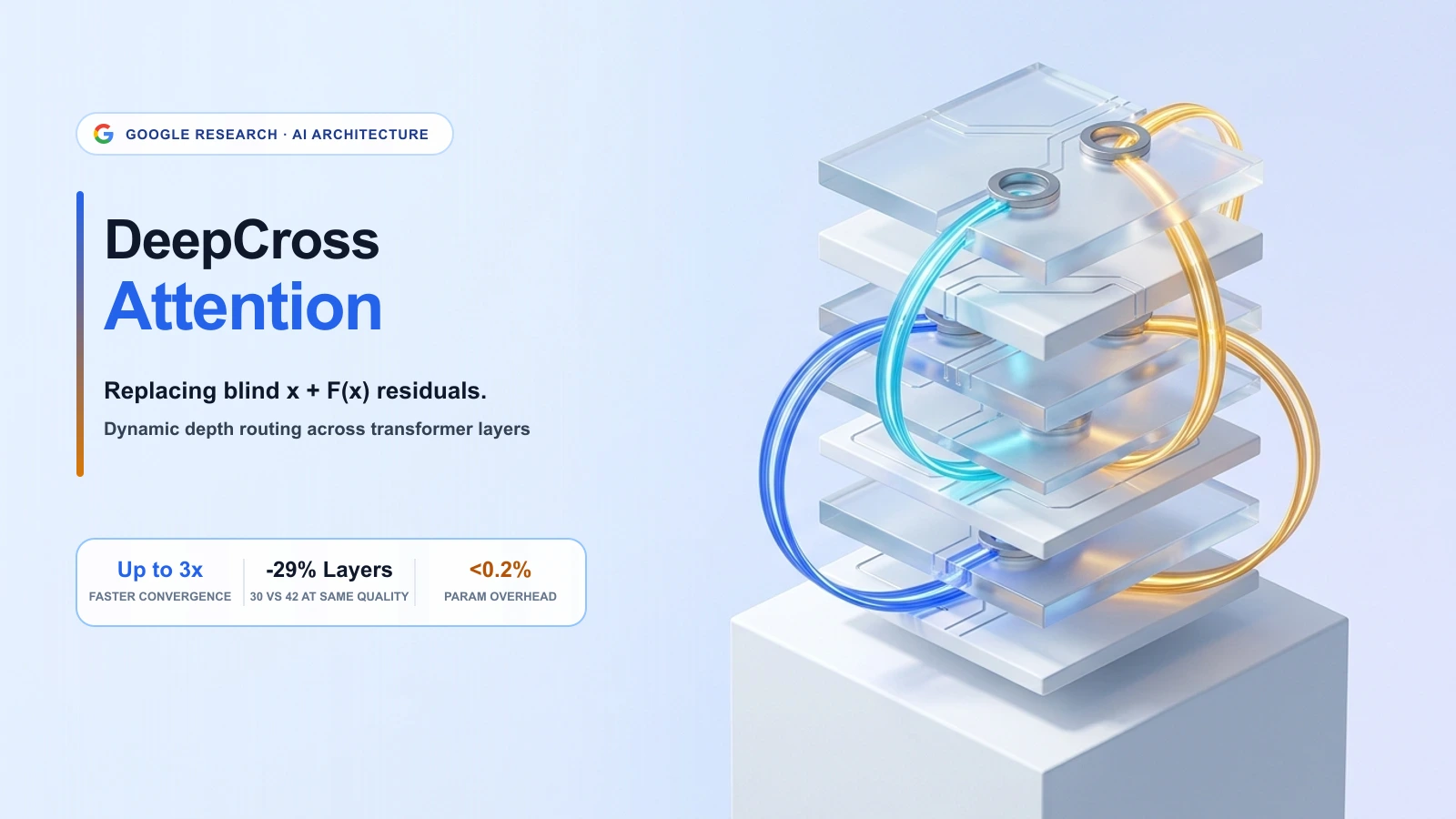
In Supercharging Transformer Residual Connections, Google Research showed that leaving that + sign untouched has quietly been wasting huge amounts of compute. Their solution—DeepCrossAttention (DCA)—replaces blind addition across layers with dynamic, token-aware attention across depth, achieving comparable model quality up to 3x faster (and up to 5x fewer training steps) with less than 0.2% extra parameters.
Here is a crystal-clear breakdown of why standard residuals leak information, how DeepCrossAttention fixes it, and how it stacks up against alternatives like DenseFormer, Hyper-Connections, and Looped Transformers.
The Hidden Bottleneck: Why x + F(x) Dilutes Information
Imagine passing a crisp architectural blueprint down a 50-person assembly line, where each person is only allowed to scribble notes directly on top of the exact same sheet of paper. By person #40, the original fine lines from person #2 are buried under forty layers of overlapping ink.
That is literally what happens inside a deep transformer using standard residual connections (y = x + F(x)):
- Layer 1–5 extract sharp syntactic and lexical cues (exact word boundaries, local phrasing, punctuation).
- Layer 20–40 keep adding abstract semantic updates onto the exact same residual stream vector.
- Because every update is summed blindly with equal weight
1, early high-resolution signals suffer from information dilution. Deep layers either lose them or burn precious MLP/attention capacity recomputing features that earlier layers already found.
Plain-English intuition: Standard transformers give tokens an attention mechanism to look across words in a sentence, yet force them to use dumb addition to look across layers of the network. DeepCrossAttention gives tokens attention across depth too.
Standard Residual vs. DenseFormer vs. DeepCrossAttention
Researchers had noticed residual bottlenecks before, leading to approaches like DenseFormer and Hyper-Connections. DeepCrossAttention takes the idea significantly further by making cross-layer routing dynamic per token.
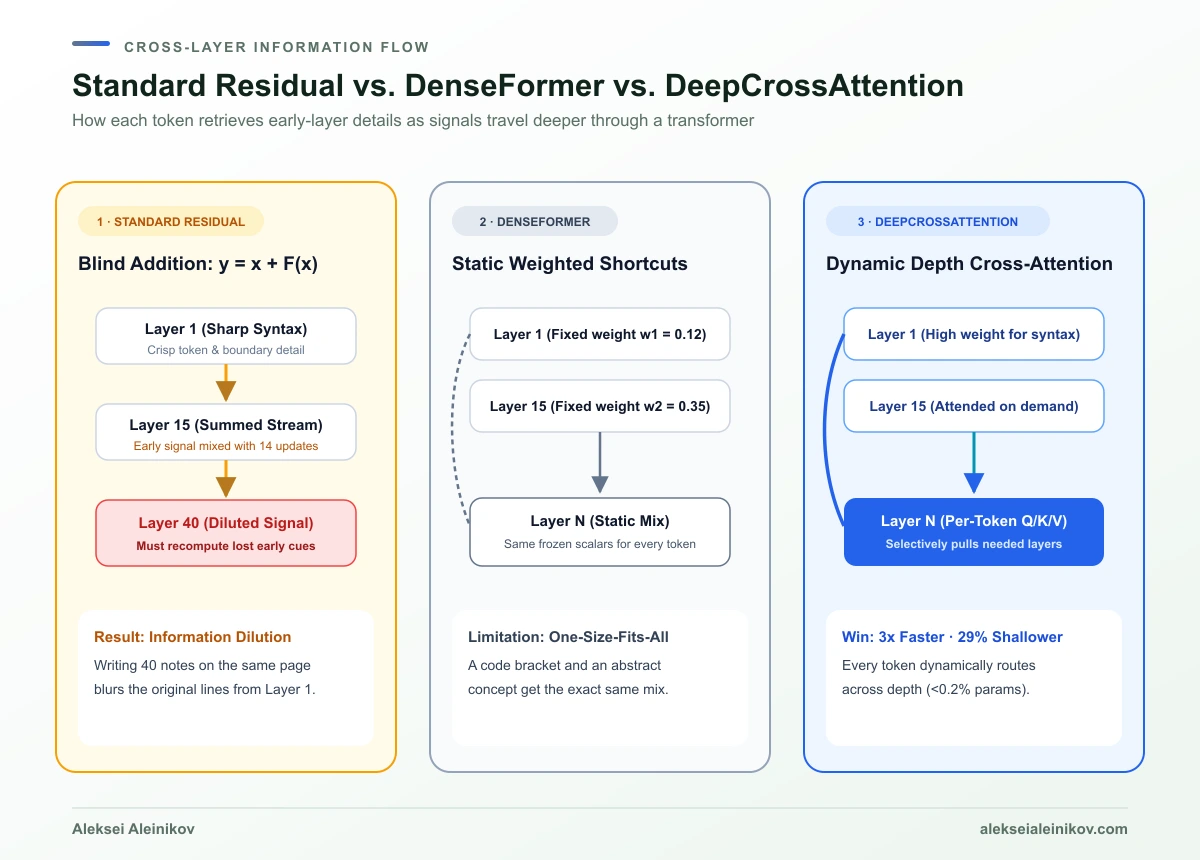
Notice the structural jump across the three designs:
- Standard Residual (
y = x + F(x)): Each layer only sees the blended running sum of everything before it. No selectivity. - DenseFormer (Static Depth Weighted Sum): Connects to earlier layers with learned scalar weights, but those weights are frozen across every input. A Python variable name and an English preposition are forced to use the exact same layer mix.
- DeepCrossAttention (Dynamic, Input-Dependent Routing): For every single token, DCA inspects the current state and dynamically decides which previous layers matter right now—combining learnable input-dependent weights with depth-wise cross-attention.
| Architecture | Cross-Layer Access | Per-Token Dynamic? | Mechanism | Key Trade-off |
|---|---|---|---|---|
| Standard Residual | Running sum only | No | Fixed x + F(x) addition |
Information dilution in deep stacks |
| DenseFormer | All prior layers | No (static scalars) | Weighted sum across depth | Same layer mix for every token |
| Hyper-Connections | Multi-stream residual | Partially | Expanded residual streams | Higher memory/activation footprint |
| DeepCrossAttention (DCA) | All prior layers (Q/K/V) | Yes (per-token) | Depth-wise cross-attention + dynamic weights | <0.2% param overhead, 3x faster convergence |
Inside DeepCrossAttention: Two Axes of Attention
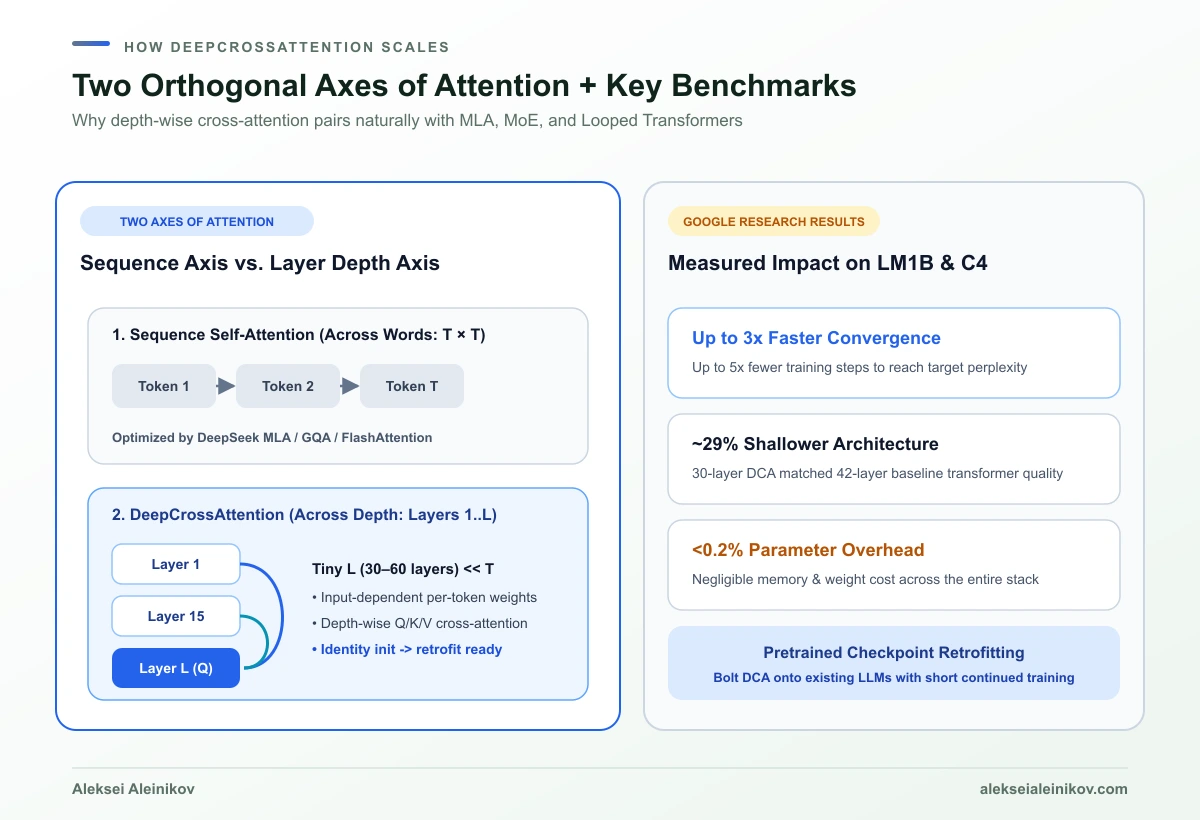
To understand why DCA works without blowing up GPU memory, it helps to separate the two orthogonal axes inside a transformer:
1. Input-Dependent Layer Weights
Instead of adding Layer L-1 and Layer L-12 with fixed numbers, a tiny projection computes weights conditioned on the current token. A token resolving a tricky coreference can pull strongly from middle semantic layers; a token predicting closing syntax (}, ;) can pull crisp details straight from Layer 2.
2. Depth-Wise Cross-Attention (Q/K/V Across Layers)
Classic self-attention computes Queries, Keys, and Values across tokens in a sequence (T × T). DeepCrossAttention applies cross-attention across previous layer outputs (L earlier representations for that token). Because L (e.g., 30–60 layers) is orders of magnitude smaller than sequence length T (8K–128K tokens), depth-wise attention is fast and adds less than 0.2% parameters.
3. Concrete Example: What Happens Inside One Token
Why does per-token routing matter so much in practice? Look at two tokens inside the exact same forward pass:
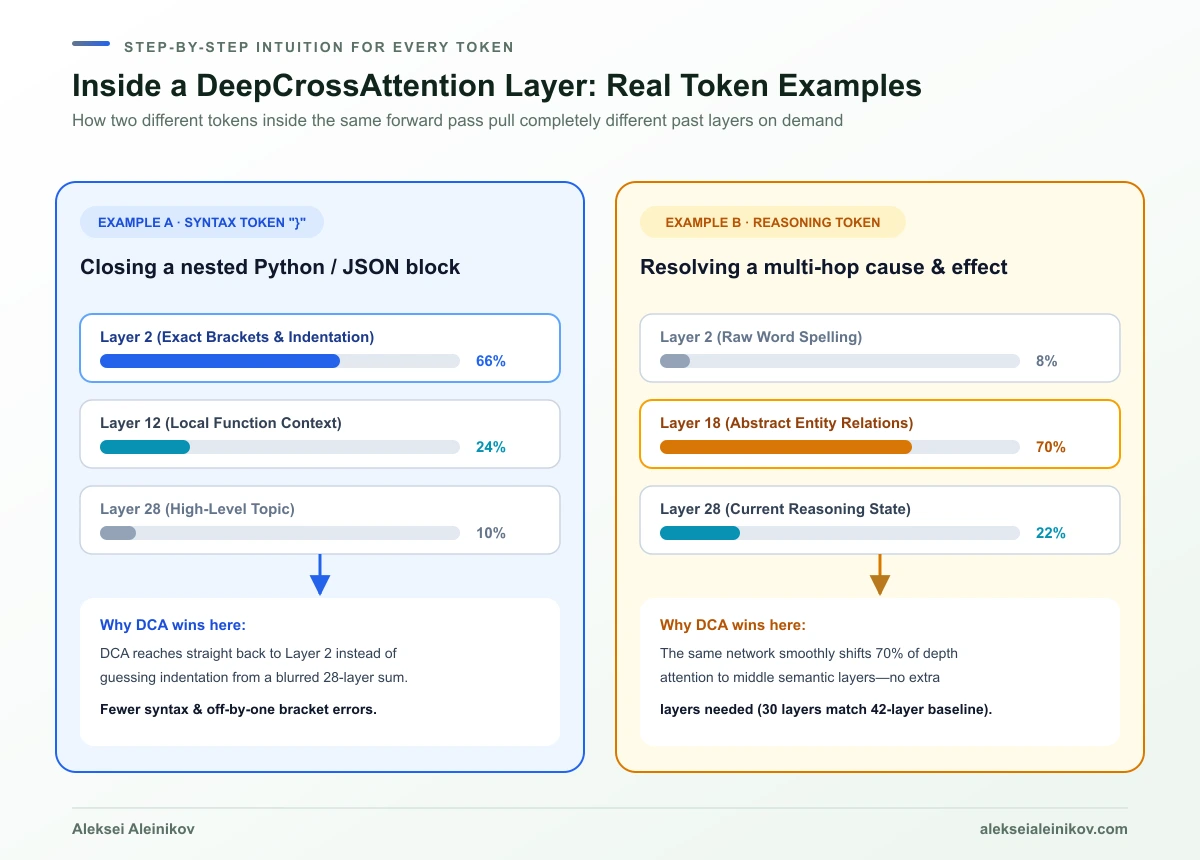
- A strict syntax token (like closing
}in JSON or Python): Needs crisp structural memory from early layers. DCA lets that token pull ~66% of its depth attention straight fromLayer 2instead of trying to decode indentation out of a 28-layer running sum. - A multi-hop reasoning token: Needs abstract entity relationships formed mid-network. The very next token shifts ~70% of its weight to
Layer 18—with zero manual rules.
4. Retrofitting Pretrained Checkpoints
One of the sharpest engineering properties of DCA is identity-preserving initialization. You can initialize DCA modules so that at step zero they behave identically to standard x + F(x) residuals—then attach them to an already-pretrained LLM checkpoint and run brief continued training to unlock faster convergence without starting from scratch.
Real-World Benefits: Why This Matters Beyond Benchmarks
Even if you never pretrain a foundation model from scratch, DeepCrossAttention directly impacts the tools you deploy and pay for:
- Lower Serving Latency (
-29%Sequential Depth): Transformer decoding is strictly sequential along layers—you cannot run Layer 30 until Layer 29 finishes. Matching a 42-layer model with 30 layers directly cuts time-to-first-token (TTFT) and per-token latency. - Cheaper Training & Fine-Tuning Runs: Reaching target perplexity in up to 5x fewer steps (3x faster wall-clock) shrinks GPU cluster hours for custom domain models and continual pretraining.
- Sharper Code & Long-Context Recall: Stopping information dilution preserves exact variable names, brackets, and early-prompt constraints even at deep layers.
- Upgrade Path for Existing Weights: Teams sitting on open-weight checkpoints can retrofit DCA blocks rather than throwing away millions of dollars of prior training compute.
Benchmarks & How DCA Compares to Other 2026 Trends
In Google Research’s language modeling evaluations (including LM1B and C4):
- Up to 3x faster wall-clock convergence (and up to 5x fewer training steps) to reach the same perplexity as a standard transformer baseline.
- ~29% shallower networks: A 30-layer DCA model matched the quality of a 42-layer standard transformer, directly cutting sequential depth and inference latency.
How does this fit alongside other major 2026 transformer innovations?
| Innovation | Primary Axis Optimized | Main Benefit | Compatible with DCA? |
|---|---|---|---|
| DeepCrossAttention (Google) | Depth (across layers) | Stops residual dilution, 29% shallower / 3x faster | — |
| DeepSeek MLA / GQA | Sequence (KV cache across tokens) | Shrinks long-context memory footprint | Yes (orthogonal axes) |
Looped Transformers (Inkling 2 / GLM-5.4) |
Weight reuse (recurrent depth) | High reasoning density per parameter | Yes (DCA can route across loop iterations) |
| Mixture of Experts (MoE) | Width (sparse FFN routing) | More capacity at constant FLOPs/token | Yes (MoE + DCA route experts & layers) |
If you want to see how the weight-reuse side of this trend works in practice, read our deep dives on Inkling 2 Mini and looped transformers and GLM-5.4’s loop-transformer coding architecture.
Summary
DeepCrossAttention proves that even the most boring line of transformer code—y = x + F(x)—was hiding a 3x efficiency gain. By letting every token dynamically attend across layer depth with <0.2% parameter overhead, Google Research gives future foundation models a cleaner, shallower highway that pairs naturally with MLA, MoE, and looped architectures.