
In December 2021 the industry learned a humbling lesson. A critical remote-code-execution bug in Log4j — Log4Shell, CVE-2021-44228 — set the internet on fire. But the vulnerability itself wasn’t the worst part. The worst part was the question nobody could answer: “Do we even use log4j, and where?”
Teams spent days grepping build systems, spelunking through transitive dependencies, and paging engineers at 2am to ask which services pulled in a logging library four levels deep. The fix was a one-line version bump. Finding every place that needed it took weeks.
The lesson everyone took away was “we need an SBOM.” That’s half right — and the half that’s wrong is quietly making teams feel safe while they’re not.
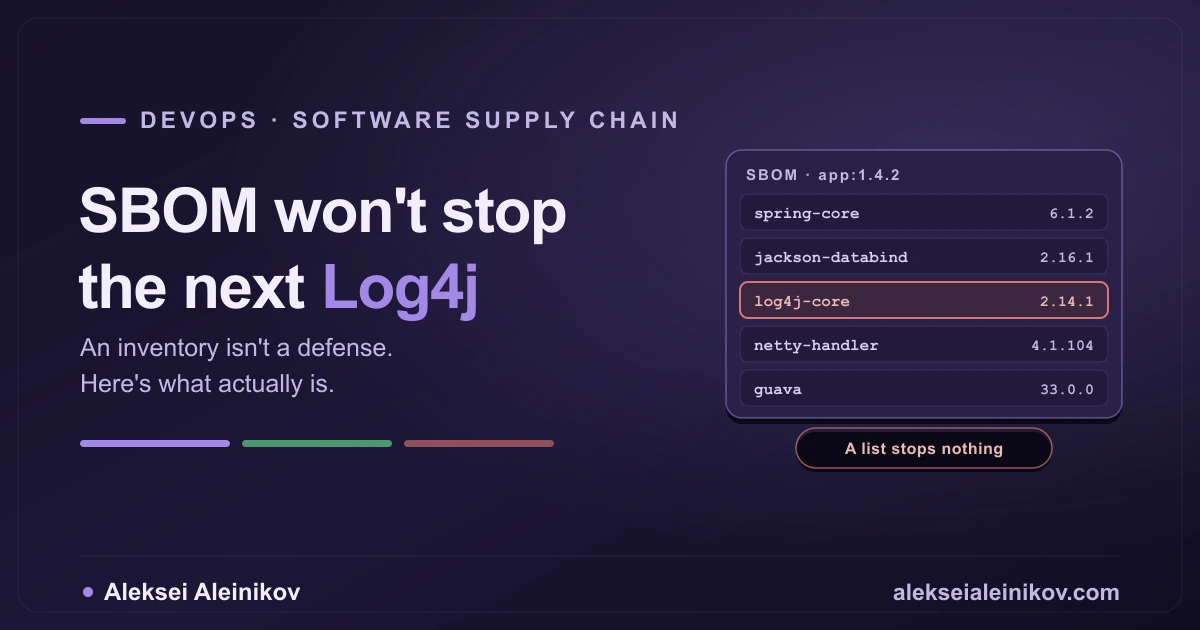
An SBOM is an inventory. Generating one does not stop the next Log4Shell any more than a packing list stops a fire. Here’s what an SBOM actually is, why it isn’t a defense, and the three things that turn it into one.
What an SBOM Actually Is (and Isn’t)
A Software Bill of Materials is a machine-readable list of the components inside a piece of software: names, versions, cryptographic hashes, licenses, and how they depend on one another. Two formats dominate — SPDX (Linux Foundation, ISO-standardized) and CycloneDX (OWASP). You generate one from a build with a tool like Syft, Trivy, or your package manager:
# Generate a CycloneDX SBOM for a container imagesyft my-registry/app:1.4.2 -o cyclonedx-json > app-1.4.2.sbom.jsonThat’s it. You now have a precise, versioned answer to “what is inside this artifact.” It is genuinely useful — and it is genuinely inert. The SBOM does not scan for vulnerabilities, does not block a bad build, and does not fix anything. It is a record, not a control.
This is the trap: teams add SBOM generation to CI, watch the files pile up in a bucket, check the compliance box, and believe they’ve addressed supply-chain risk. They’ve addressed the documentation of it. The risk is untouched.
Why the List Alone Would Not Have Saved You
Play the Log4Shell timeline forward with an SBOM in hand. On December 8, 2021, your SBOM lists log4j-core 2.14.1. Zero known vulnerabilities. Your scanner is green. Everything looks perfect.
On December 9, CVE-2021-44228 is published. Nothing in your SBOM changed — the world changed. The exact same inventory line is now a five-alarm fire. If your SBOM is a static file generated once and dropped in storage, it tells you nothing until a human thinks to go re-examine it.
The value of an SBOM is not created when you generate it. It’s realized in the future, every time you re-evaluate it against what the world has newly learned. A list you never look at again is a list that fails you on exactly the day you need it.
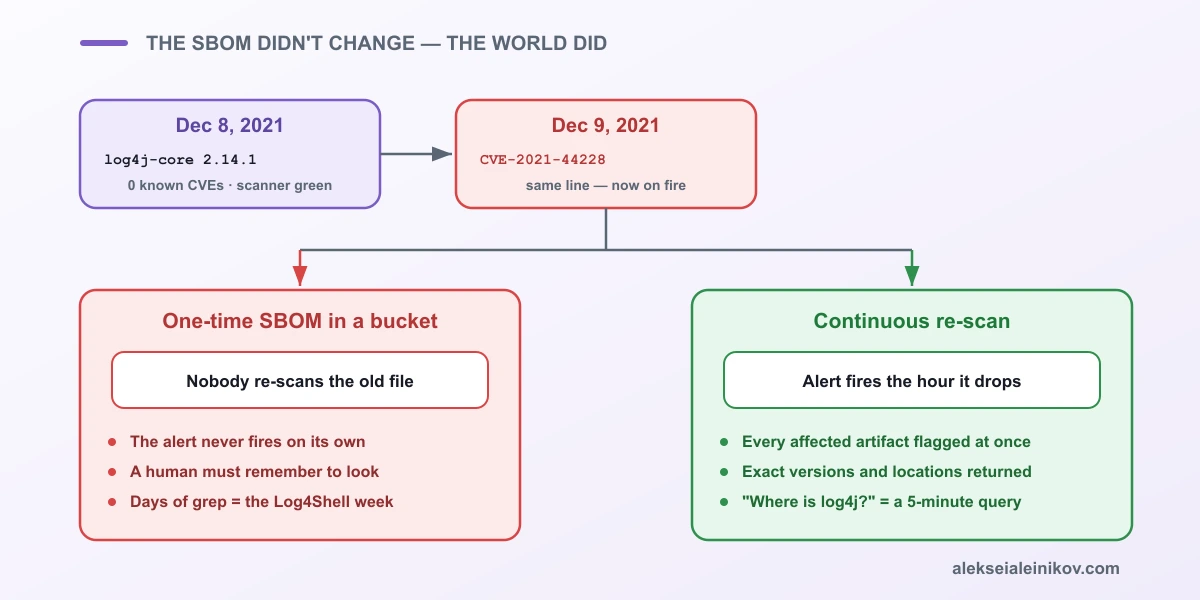
So the SBOM is necessary but nowhere near sufficient. Three things turn it from a filing-cabinet artifact into something that would actually have contained Log4Shell.
Thing 1: Continuous Correlation, Not a One-Time Scan
An SBOM lists components; it takes a vulnerability scanner to compare that list against known-CVE databases — NVD, OSV, the GitHub Advisory Database — and tell you what’s affected. The move most teams miss is that you must scan the same SBOM repeatedly over time, not once at build.
# Scan a stored SBOM against today's known vulnerabilitiesgrype sbom:./app-1.4.2.sbom.json
# Or query the OSV database directlyosv-scanner --sbom=app-1.4.2.sbom.json
Run that in a nightly job against every SBOM you’ve ever shipped, not just the one you built this morning. Now when a new CVE lands, the alert fires automatically against every affected artifact — and “where do we run log4j?” becomes a query that returns in minutes, with exact versions and locations. That is the capability everyone wished they had in December 2021. The SBOM makes it possible; the continuous scan makes it real.
This is the same discipline that separates a real cloud-security posture from a dashboard of green checkmarks. If you’re building that muscle, see Build Your Own CSPM on GCP: Security Command Center vs Open Source.
Thing 2: Provenance, or the SBOM Is Just a Story
Here’s the uncomfortable question: if an attacker compromises your build pipeline, what stops them from handing you a clean-looking SBOM that omits the malicious component? Nothing — unless the SBOM is signed and carries build provenance.
This is where Sigstore (via cosign) and SLSA (Supply-chain Levels for Software Artifacts) come in. You sign the SBOM and attach it as a verifiable attestation to the artifact, using keyless signing tied to your CI’s identity:
# Attach the SBOM to the image as a signed, verifiable attestationcosign attest --predicate app-1.4.2.sbom.json \  --type cyclonedx my-registry/app:1.4.2
# At deploy time, verify it really came from your pipelinecosign verify-attestation --type cyclonedx \  --certificate-identity-regexp '.*@your-org\.com' \  my-registry/app:1.4.2
Now the inventory is trustworthy: it provably came from your build system and wasn’t altered. Enforce it at the door with an admission policy that refuses any image without a valid, signed SBOM attestation. An SBOM you cannot verify is inventory theater — it feels like control and provides none.
Thing 3: VEX, or Your Team Drowns in False Positives
Point a scanner at a real SBOM and you’ll get hundreds of “vulnerable” findings. The overwhelming majority are not exploitable in your context: the vulnerable function is never called, the component isn’t loaded at runtime, or a mitigation already neutralizes it. Hand that raw list to a security team and they’ll do what any human does with a firehose of noise — start ignoring it. That’s exactly when the one finding that matters slips through.
VEX (Vulnerability Exploitability eXchange) is the fix. It’s a companion document that states, per CVE, whether you are actually affected — not_affected, affected, fixed, under_investigation — with a justification:
{ "vulnerability": { "name": "CVE-2021-44228" }, "products": ["pkg:maven/org.apache.logging.log4j/log4j-core@2.14.1"], "status": "affected", "action_statement": "Upgrade to 2.17.1; JNDI lookup disabled as interim mitigation."}VEX turns a wall of red into a short, honest list of what’s real. It’s the difference between a security queue people act on and one they’ve learned to swipe away.
What Actually Would Have Contained Log4Shell
Put the pieces together and the picture is clear. It was never the SBOM. It was the system around it:
- Every deployed artifact ships a signed SBOM with build provenance, stored centrally and queryable.
- Those SBOMs are continuously re-scanned against new CVEs, so Log4Shell fires an alert the hour it’s published — across every affected service at once.
- Provenance means you trust the inventory instead of hoping it’s honest.
- VEX filters the results to what’s genuinely exploitable, so responders move on the real fire instead of triaging noise.
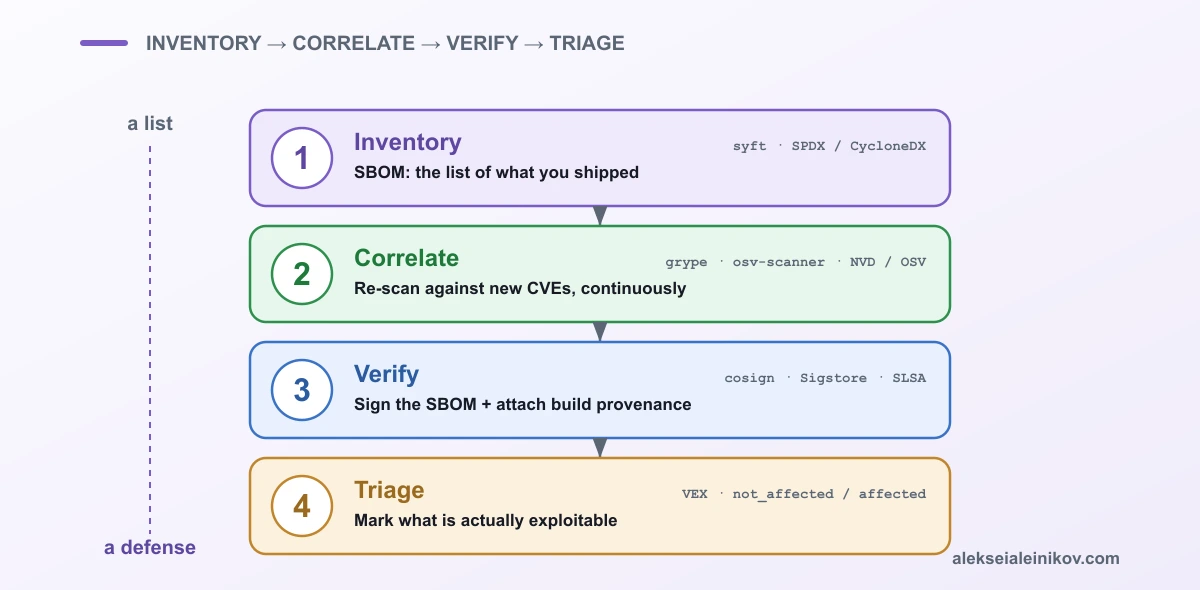
With that in place, “where do we run log4j?” is answered in minutes, the response is scoped precisely, and the fix ships before attackers finish scanning. The SBOM is the foundation — but the foundation isn’t the house.
Continuous scanning and signed provenance belong in the pipeline itself, not bolted on afterward. For hardening the pipeline that produces all this, see Secure GitLab CI/CD in 2026: A Practical Hardening Playbook.
This Is About to Be the Law, Not a Nice-to-Have
If ROI wasn’t enough, regulation is closing the gap. The US Executive Order 14028 already requires SBOMs for software sold to the federal government. The EU Cyber Resilience Act goes further: from 2027 it mandates SBOMs and vulnerability handling for effectively all products with digital elements sold in the EU. The teams treating SBOM as a checkbox today are the ones who’ll discover, too late, that the checkbox was supposed to be a working system.
The Field Rule
An SBOM is an inventory, not a defense — generating one and filing it away is security theater that would not have stopped Log4Shell. What stops the next one is the system around the list: continuously re-scan every SBOM against new CVEs so a fresh vulnerability fires an alert the hour it drops; sign the SBOM and attach build provenance so the inventory is trustworthy instead of forgeable; and layer VEX on top so the one real finding isn’t buried under hundreds of unreachable ones. Build that, and the next Log4Shell is a query and a scoped rollout — not a week of grep and prayer.

From the community
Discussion on the Fediverse
Replies from Mastodon and Bluesky — straight from the open web, no tracking.
Loading replies …
No replies yet. Start the conversation:
Replies could not be loaded right now.